A perfect spot for fresh air at 1.5 meters distance
This bench could be seen as a symbolic and poetic representation of the time, when we lived in a 1.5 meter long society as a result of the Covid-19 pandemic. It opened up opportunities for sustainable meetings with friends and family, as well as with strangers who could sit on the couch at the same time. It ensured that we were still able to meet at this exceptional time — even if it was from a distance.
The sofa was 2.5 metres wide, with a centre — exactly 1.5 metres — made of polished stainless steel. The intermediate part was invisible due to the mirror effect. Only the left and right sides of the sofa were clearly visible as seats. The reflection created a physical distance, but at the same time made the distance invisible.
Tuindorp Oostzaan was built 100 years ago, mainly as a garden village for the employees of the Nederlandsche Dock- en Scheepsbouw Maatschappij (NDSM). Raimond Wouda has spent the past 30 years capturing this part of Noord, which is visible in a publication and an exhibition at the city archives, and is now also shown on three billboards at the NDSM shipyard, near the source.
His mother and grandmother grew up there and he lived there for the first years of his life. Raimond Wouda about Tuindorp Oostzaan: “As I got older, my relationship with Tuindorp became more complex and ambivalent. It was a place that was both strange and familiar to me. I started taking pictures of the neighborhood and its residents to better understand what it meant to me. Tuindorp has become my most personal work.”
Inspired by the ideals of the English garden cities, the garden villages in Amsterdam were built, with Tuindorp Oostzaan being the first. Just behind the NDSM so that people could walk or cycle to work. Compared to the buildings on the other side of the IJ, the garden villages were given more space, gardens, squares and (cultural) facilities to serve as meeting places and create a sense of community. The close-knit community changed over time, the area expanded after the war, after which migrant workers and young families came to North. The most drastic change was, of course, the bankruptcy of the NDSM. As a result, the industry and other public functions such as the library slowly disappeared to a large extent.
The building boards now show a selection of photos that provide a glimpse into the larger story that Raimond has captured. A history of living and living in a changing city, a perspective on the community and surroundings of Tuindorp Oostzaan. The old obvious connection between Tuindorp Oostzaan and NDSM as a former shipyard, as a beacon in the district, no longer exists. However, it has been replaced by a new public and a so-called “cultural wharf”. The building signs reconnect the garden village and its residents and NDSM.
Raimond Wouda's photos are shown on the 'NDSM Billboards', with which Stichting NDSM-werf offers space for artists on large building boards: “In addition to the building signs on the western part of the NDSM, where construction is underway, we at NDSM-Oost give artists the opportunity to post their artistic statements on building boards. With its 10 hectares, the shipyard provides a wonderful background for large images in response to the context of the NDSM to make the work highly visible to Northerners and Amsterdammers,” says curator Petra Heck.
Credits and references
Raimond Wouda — Polder VIII, Tuindorp Oostzaan, Amsterdam 1921-2021, Thuis in de Stad. 100 jaar Tuindorp Oostzaan
The Tower of Babel project was a concept by artist Guido van der Werve. In his concept, Van der Werve took the Biblical story as a starting point. In this story, only one language was spoken on Earth and they collectively embraced the same idea: to build a city with a tower that would reach the sky. But God descended after this act of pride, made people all speak different languages, and spread everyone around the world. Because the people could no longer understand each other, construction was stopped.
What a contemporary Tower of Babel would look like, with just as many people as possible with different backgrounds, languages and voices, was what Guido van der Werve asked with this project. Stichting NDSM-werf and TAAK shaped this question in an architectural installation that expressed a certain polyphony of the city. The emphasis was precisely on the difference, the diversity and the (cultural) richness that lay therein. Watch a portrait of Guido van der Werve talking (in English) about the Tower of Babel and his art practice in the video:
WORKSHOPS
The polyphony also took shape in various specially developed workshops in which Amsterdammers and communities with different cultural, political, social or religious backgrounds of different ages participated. The starting point was how they thought about their ideal city and what values were important to them in it. The workshops were given by artists Fouad Lakbir, Tina Lenz, Mick La Rock, Olfa Ben Ali, Bengin Dawod, Rianne van Duin, Brendan Jan Walsh and Perrine Philomeen, who all worked from their own practice and discipline with themes such as ownership, visibility and storytelling and sharing.
The diverse “building blocks”, ideas and stories were translated into visual outcomes that were placed in the Tower between September 23, 2021 and storm Eunice in February 2022. There were banners, photos, a video, a sound system with stories, a Tower of Babel newspaper made by students at Klein Amsterdam primary school and a homemade brick wall that was incorporated into the tower. Brendan Jan Walsh rehearsed a libretto written by Guido van der Werve and performed on October 7 by the choir and the Promenade Orchestra, specially assembled for the tower. This is how the Tower of Babel became a metaphor for what the ideal polyphonic city could look like and what values and ideas were important to it.
For background stories about the Tower of Babel, check out the NDSM Online Magazine depot.
From May 5, 2022, Phase 2 of the Tower of Babel was visible: the tower was under construction, to indicate that it was still a work in progress. In addition to the videos and the libretto, there was a 3D sketch by Guido that illustrated how he wanted to see his ideal Tower of Babel finally realized: with a path where you could walk up and down endlessly. At that time, the path could be walked as a flat route.
The South African Artist Goldendean (Dean Hutton) made inflatable soft sculptures that depicted the contours of their own bodies. Especially for the NDSM shipyard, they created the 'Big Fat Trans Light MerQueer', a hybrid between man and sea monster that seemed to have crawled out of the IJ water — with tentacles. They were inspired by folk tales about sea-lake people, such as the “Mermaid of Edam” and “Mamlambo”, a serpent-like river goddess from South African and Xhosa mythology, who was often depicted as a mermaid. When they were captured, they allegedly brought prosperity.
Goldendean shared moments of gentle courage to affirm the right of all bodies to exist, be celebrated, and protected. They evoked tender feelings by deliberately pretending to be crazy and playful, sometimes a clown, sometimes a warrior, always vulnerable... Radically soft in an uncompromising world... A tenderqueer invested trust in an audience to respond kindly, to keep our bodies safe together, to give queer space, no matter how we sometimes failed each other.
Johannes Buttner: Free Energy II, Peak Panic
Location: waterfront near Pllek
In his sculptures, installations and videos, Johannes Büttner (Germany, 1985) addresses socio-economic themes such as energy, work in the digital age and power. In addition, he worked with people with diverse backgrounds: from mindset and business coaches and bakers to people from the “digital working class”.
Johannes Büttner showed sculptures that he made for Into Nature, an exhibition in Bargerveen, Drenthe, curated by Hans den Hartog Jager, where energy was key. Büttner's luminescent sculptures were battery-operated made of aluminum, magnesium and alum crystals. The story went that they recharged over and over again, so that these batteries would provide infinite energy. Büttner had the batteries designed by “free-energy engineers”, an online community that believed that environmentally friendly, sustainable and free energy sources had been around for a long time, but that they were hidden by large companies and governments out of self-interest. Somewhere between truth and fiction, (pseudo-) science and faith, and in response to the lack of opportunities to verify this, the work evoked alternative ways of imaging.
In addition, Johannes showed lightboxes with advertising-like photos of “survival hacks” for a post-apocalyptic scenario. How did you make light in times of crisis? Faced with a pandemic and climate change awareness, 2016's work was now seen differently. DIY creations and creativity to deal with new catastrophes seemed inevitable.
Alice Wong & Crys Leung: COHESION
Location: LOAD OUT
Alice Wong was a story designer. By showing how our perception of reality was constructed, she tried to turn complexity into understandable stories. For this project, she worked with Crys Leung, communication designer, who investigated the role of media and the relationship to identity in her work.
Alice and Crys revealed 'COHESION', a large-scale installation that connected fragmented elements on the NDSM. The reflective circle stood for unity and collectivity; one could all come together and become more than the individual parts. Because the total circle could not be understood from a single position in space, the work created an infinite number of perspectives, depending on the point of view. The process of interacting from different angles, heights and distances made it clear how people collectively shaped a shared reality, where no perspective should stand above the other. Visible and invisible, seen and unseen were all equally valuable.
There were wild animals at the NDSM shipyard in 2021!
Designer and Illustrator Luca Boscardin was one of the two winners of the Open Call launched in 2021 by Stichting NDSM-werf. His project Animal Factory consisted of minimalistic metal animals, such as a crocodile and a giraffe. The works invited you to sit on or climb up and thus played with the idea of the NDSM shipyard as an urban jungle.
Animal Factory was a collection of animals designed in a simple and abstract way, each maintaining the exact size and proportions of the real animals. The objects — a giraffe, gorilla, crocodile and wolf — were characterized by a minimal shape, made of metal tubes and a minimal use of color: each one was painted in a single shade to encourage passers-by to open their minds and let their imagination run wild. Where, from a certain angle, the steel structure did not seem to have a specific shape, the contours of a gorilla were clearly visible from another location. This is how the animals were surprises in the industrial landscape.
With the objects, Luca Boscardin hoped to encourage creativity and multifunctional use of the shipyard. For example, the gorilla could also serve as a play object, the giraffe may have been an alternative workout tool, and the crocodile was a suitable place for visitors to sit down with a cup of coffee. As a toy designer, Luca drew space rockets, fantasy creatures, imaginary characters and super-fast cars every day. Using the life-size metal animals, he gave shipyard visitors the space to use their own imagination and invited young and old to play, hang out or exercise.
Animal Factory was created with the help of steel carpenter Iwan Snel, who was also based at the NDSM shipyard. The entire project was designed and produced in the immediate vicinity of NDSM. Nowadays, they can be found on the west-side of NDSM next to the Noord-Dok building in a park.
When ADE was canceled due to the Corona pandemic, we came up with something else at NDSM
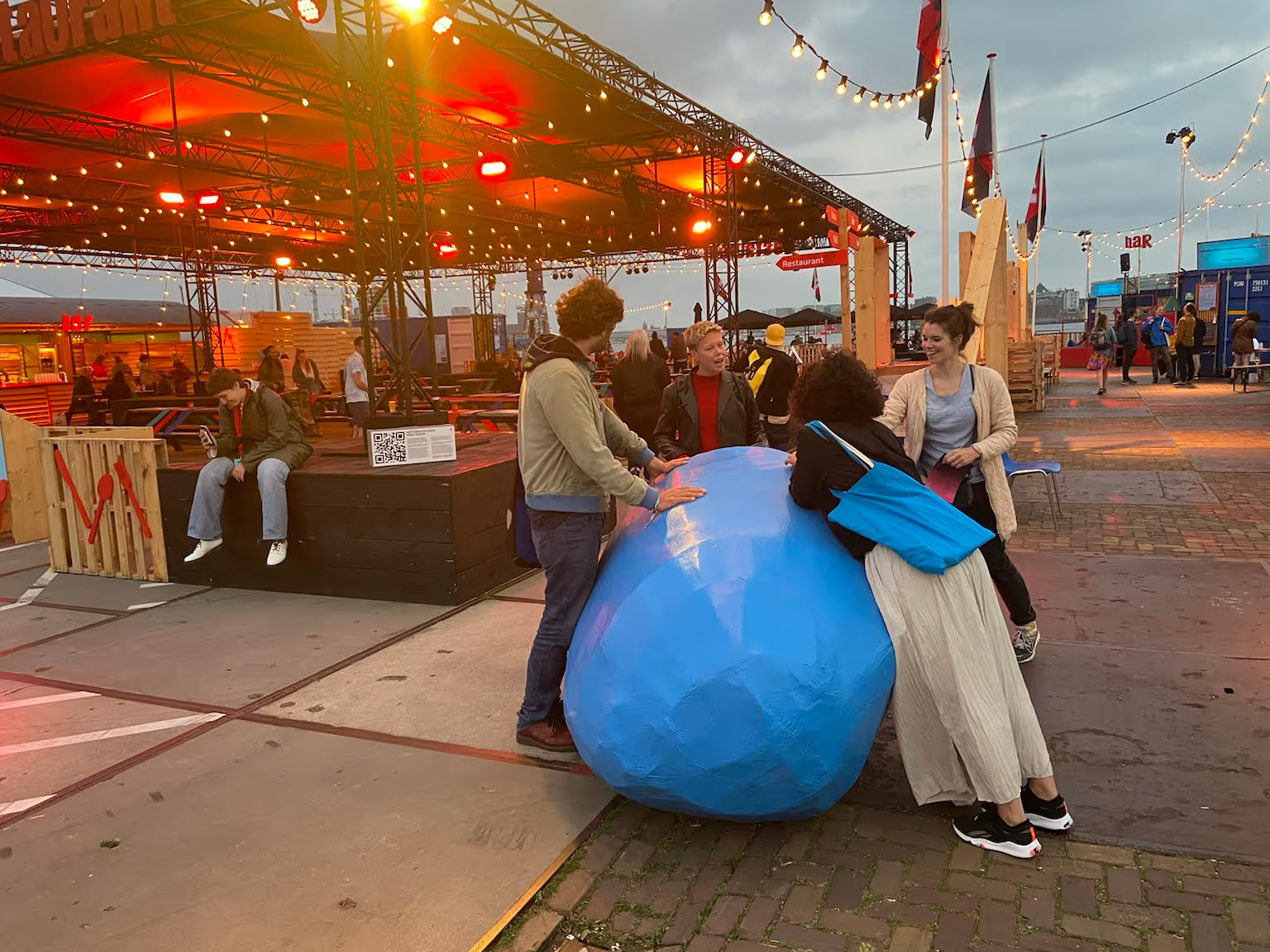
For this edition of ADE, Stichting NDSM-werf invited the art and activist group Tools for Action + Floor out to use their site as a public rehearsal space for RÆV REHEARSAL. They invited the audience to rehearse new forms of togetherness. With a Bluetooth speaker system, floating inflatable sculptures and a minimalist techno beat, they moved around the city like a radiant, dancing swarm. The streets became the club, the steps, roundabouts and benches acted as temporary stages.
RÆV REHEARSAL
RÆV REHEARSAL was initiated in Rotterdam in the summer of 2021 by visual artist Artúr van Balen, founder of Tools for Action, and choreographer Floor van Leeuwen. Every week, they rehearsed the dancing swarm in public space with a fixed group of twenty ravers, which in some editions grew to more than eighty people. After two massive editions of Unmute Us, the protest march for a more open event and night culture in Amsterdam, there was a strong need for people to come together, dance and have fun. By dancing, people were able to express their protest in a peaceful way.
Artúr van Balen, founder and artist at Tools for Action, explained: “Actually, this was intended as a new form of manifestation with the potential to become a protest. We used the rehearsal as a format because, from a legal perspective, it gave us the opportunity to meet with more than a hundred people in the open air, regardless of the changing corona rules.” Floor van Leeuwen added: “I saw the rehearsal as a way to practice collective movement together, coordinate, meet new people and even dance with people remotely, even when they were on their balconies.”
Swarms
RÆV REHEARSAL was based on the movement principles of swarms. Like a flock of birds, there was no central point or hierarchically organized movement; the direction was determined by the group as it moved. During each rehearsal, people had to move and dance about three meters apart. Based on these principles, the audience was invited to participate on October 15, 16 and 17 and to rehearse this collective movement together.
Music
RÆV REHEARSAL worked with a different DJ each time. As the swarm moved through public spaces, from iconic places to residential areas, the goal was to find sounds that resonated with the local environment or aroused curiosity. During previous editions, DJs performed such as Sukubratz, a Chilean DJ who combined techno with reggaeton, Cheb Runner, a Moroccan DJ who mixed electronic dance music with chaabi (a style of Moroccan folklore), and DJ Dance Divine, a queer artist from Brussels.
ADE
On October 15, 16 and 17, a group of up to a hundred people gathered at the NDSM shipyard to dance through Amsterdam-Noord. Various collectives, DJs and communities joined this initiative. The line-up was announced later. These were three unforgettable nights where a dancing swarm moved through the city, letting its heartbeat ring during the pandemic and activating spaces with bodies, music and light.
As an echo of the transformations in club culture, RÆV REHEARSAL highlighted the need to explore new forms of sociality and interrelationships by reclaiming and reprogramming public space.
In collaboration with Nieuw Dakota, Stichting NDSM-werf presented Public Air Filters by Anne-Jan Reijn at NDSM
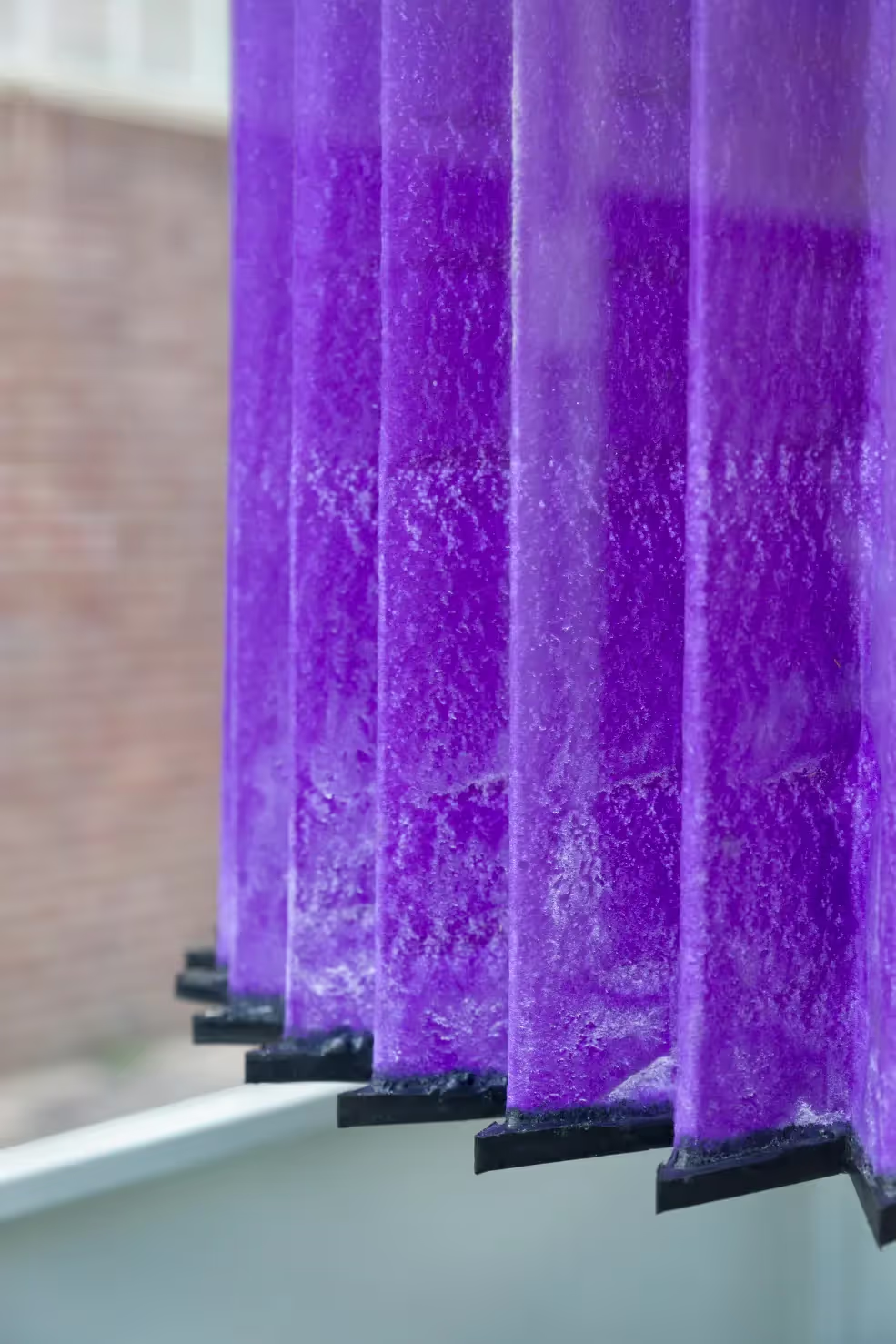
Public Air Filters was one of the two winning entries for the 2021 NDSM Open Call. For this work, artist proposed Anne-Jan Reijn the question is what actually happened in the outside air that we breathe. By filtering air in public spaces, a dichotomy automatically arose: filtered air and unfiltered air. This immediately raised a question: maybe the unfiltered air could not be trusted? The series of sculptures by Anne-Jan was on display between July and October and was changeable during this period. This slow process was, in fact, the essence of the work.
In theory, every cubic meter of filtered air left a residue on the outside of the filters. The artist wanted to play with this residue, creating an archaeology of air filter pollution, where a form of manipulation was allowed. What if that residue on the filters formed the most amazing colored crystals? Did that have a direct psychological effect, making the air we breathed, for example, undesirable or unpleasant? Reijn played with the idea of danger that we couldn't see. Invisible risks that were in the air, such as asbestos or a virus, were scary but could also evoke a form of awe. With this work, the artist offered a different perspective on this issue by materializing the invisible. “We were constantly connected to invisible matter — and therefore the risks — and we systematically tried to eliminate it. At the time, the relationship of trust we had with science and politics was under great pressure,” says Anne-Jan Reijn.
Under no circumstances did the artist claim that filtered air was safer than unfiltered air: “This was really a work of art that played with the idea of distinction.”
Also read the interview with Anne-Jan Reijn in the Digital Depot - Online Magazine.
Credits and references
Visuals: Robin van Dijk, Benjamin Kotek, Gert Jan van Rooij
In the spring of 2021, it was quieter than usual at the NDSM shipyard. This had everything to do with the Corona pandemic that gripped the entire country, and the whole world. Due to social safety restrictions, programming at the outdoor area of the NDSM shipyard was a challenge. Nevertheless, at the NDSM-werf Foundation, we looked for ways to make NDSM's public space as beautiful and accessible as possible, even though it was quieter than previous years during this period.
From this idea, the NDSM Yard Gardens came into being: 30 to 50 garden boxes where NDSM residents could use as a small piece of urban garden. All at least half a meter apart, so that users could garden while respecting social distancing”. It turned out to be a great success: all gardens were immediately used by residents, visitors, artists, neighbours, and some entrepreneurs at and around the NDSM shipyard. From early spring to autumn, flowers, vegetables and other plants were grown in the square between the Y slope and the Noorderlicht. Workshops were also given to small groups of gardeners and at the end of the season, a real NDSM garden community was created.
In 2021, the first expressions in the (Un)monumenting program series were published on NDSM, including on the NDSM Billboards
What should or could a monument be today, for whom, and who decides this? For their programme series (Un) Monumenting, Stichting NDSM-werf invited makers and artists to reflect on these questions by creating a (temporary) work at the shipyard. For (Un) Monumenting #1, the collective Frerara — Frederick Calmes, Raquel van Haver and Raul Balai — invited to make the Drawing Assignment 2020, which they realized for the Amsterdam City Archives, visible at the NDSM shipyard. (Un) monumenting #1 presented Frerara with images from “Breathing of the City”, which focused on understudied Amsterdammers and their stories.
From April 9, 2021, three construction boards at the shipyard showed drawings by Frerara, which they made as part of “Breathing of the City”. The collective saw the city as a “living organ that wakes up every morning and never sleeps in its entirety.” Especially at that precarious time, it became clear who had the luxury of being able to work from home, and who didn't. Cleaners, sex workers, bus drivers; diverse characters starred in the drawings that portrayed, fascinated or embodied the three artists separately. At the building signs, visitors were able to listen to audio clips about the images and/or the people portrayed with their smartphones. The three artists brought together themes such as the archive, transition, art and culture and the city's signature in their work. To do this, they investigated the residents of the city of Amsterdam and specifically into continuing the tradition of keeping the city alive as a ritual. For example, with the drawings, they showed a different face of Amsterdam and created a temporary 'monument' for a number of understudied townspeople. On April 9, not only did the presentation start at the NDSM shipyard, but Frederick, Raul and Raquel also physically handed over the drawings to the City Archives for inclusion. The collection of drawings was published by the City Archives in three separate zines, which could be viewed and purchased, and they worked towards a fine publication that year. What was special was that the topic “Breathing of the City” was submitted by Frerara to the City Archives even before the coronavirus pandemic, and it had only gained in urgency since then.
Continuation of (Un)monumenting
The global conversation about monuments meant that the Foundation used this moment to bring the shipyard's history more to the surface. What could a memorial be, mean, and who had a say in it? And asking who deserved to be present in public spaces and who felt represented (and who didn't)? Based on the wish of the NDSM-werf Foundation for a polyphonic public space, the foundation commissioned several artists to give their views on this on the shipyard. The (Un)monumenting project consisted of several episodes: for each chapter, the foundation invited one or more artists to reflect on the theme of 'monuments' of the future. At that time, work was underway on (Un)monumenting #2, a video work by Turkish-Dutch artist Belit Sağ, in which she highlighted the invisible history of the NDSM shipyard. In the video, a collaboration with the Institute for Sound and Vision, Belit Sağ investigated the role of female Turkish migrant workers at the shipyard using archival material.
An exhibition with an audiowalk that took place in the future
Plastic Hypersea is was an interactive, site-specific work by an artist Sissel Marie Tonn commissioned by Sonic Acts and was experienced at the NDSM shipyard in Amsterdam.
Set in 2099, Plastic Hypersea was a guided, spatial and interactive experience that speculated on a possible future in immunology, merged with the topic of environmental health. As listeners explored the terrain, they were invited to imagine the environment as an extension of their immune system and to consider the many ways their bodies intertwined with microplastics in the sediments of Amsterdam's waterways. Ultimately, Plastic Hypersea asked listeners to leave behind the war metaphors that haunted immunology and to think about a more expansive sense of self.
Produced in collaboration with musician Vincenzo Acquaria Castellana and sound and recording artist BJ Nilsen, the localized sound experience was complemented by custom boat sails and ceramic sculptures created by Sissel that acted as “membranes” encoded with material and immaterial data about the hydrophobic, industrial waste that flowed through the waters of the Netherlands.
About the artist
Sissel Marie Tonn was a Danish artist based in The Hague. Her practice focused on the shifts in perception that occurred when people became entangled in their surroundings, blurring the boundaries between body and environment. Her artistic research often resulted in interactive, sensory installations.
Plastic Hypersea was built on Echoes, an interactive GPS-enabled mobile app for audio walks. To access the work, you had to download the app from the App Store or Google Play. They then put on headphones and wandered around the area of the NDSM shipyard while following the sails and ceramic sculptures. The gradual unfolding of the work was activated while walking and exploring the environment.
SEXYLAND was an art project in the form of a temporary society. For 365 days, the club had a new owner every day. He was able to implement the program as he wished, ranging from art expressions to sporting events, from gangster rap to stroboscopic light dinners. SEXYLAND was a tabula rasa that could be described in any way. SEXYLAND strived to mark every unknown corner of Amsterdam and show the enormous diversity the city had to offer.
In 2021, Sexyland moved from the NDSM shipyard to the other side of Amsterdam-Noord under the name: Sexyland World. As part of Sexyland's departure, we spoke with stakeholders Aukje Dekker and Samira Ben Messaoud in a podcast episode of NDSM X. Listen to it below.
On the way to school or work, kissing behind a corner of a building, sprinting to the ferry, giggling from a car, chewing gum on the ground, fishing in the dock: daily activities at the NDSM shipyard. In NDSM Nursery Square, a project by Studio Makkink & Bey they looked at daily activities at the NDSM shipyard asking how they could reprogram them through cultural activities.
From October 2019, there was a temporary square to visit where there was space to intervene with a flexible infrastructure and influence the behavior in the shipyard's public space. The square therefore never looked the same, moved with its visitors and was sometimes coloured by artists in residence. For example, park furniture could be borrowed and there were singers and artists who sang to the sailors during rush hour in September.
Artist Antoine Guay built a bread oven in a container, after which the bread baked therein was distributed to visitors on a number of Saturdays in exchange for a nice gesture or action. City poet Gershwin Bonevacia spent a while at Nursery Square as a “poet-in-residence”. A documentary was also shown in the Nursery Square of Nina Swaeny Cherry. And because this was also a public square, by and for Amsterdammers, designer Jurgen Bey and curator Jules van den Langenberg also invited local residents and parties at the shipyard to make their own programming proposals.
Tower of Babel: meet the artists! Edition 3 — Rianne van Duin
tekst:
Anna Sidorchik (OAT Studio)
Video series Meet the artist! of Tower of Babel, 2021
As part of the Tower of Babel at NDSM, we will talk to eight artists who contribute to this art installation in their own way. Each with their own, unique workshop, allows Amsterdammers to reflect on the city of the future. Together, they create versatile works of art that will all be decorated in an impressive building at the NDSM shipyard from September 18 to October 17. In this third edition: designer Rianne van Duin.
No problems, parks with flowers, and taco places.” Together with a group of children, designer Rianne van Duin worked on a newspaper in which these very young journalists describe their ideal city.
Tower of Babel: meet the artists! Edition 4 — Fouad Lakbir
tekst:
Anna Sidorchik (OAT Studio)
Video series Meet the artist! of Tower of Babel, 2021
As part of the Tower of Babel at NDSM, we will talk to eight artists who contribute to this art installation in their own way. Each with their own, unique workshop, allows Amsterdammers to reflect on the city of the future. Together, they create versatile works of art that will all be decorated in an impressive building at the NDSM shipyard from September 18 to October 17. In this fourth edition: storytelling coach Fouad Lakbir.
As storytelling coach, Fouad Lakbir has the ambition to put stories that are not heard enough on a pedestal. For the Tower of Babel project, he brought together Amsterdammers who had never met before these workshops. By exchanging memories about their ideal city, they became acquainted with the art of storytelling.
Tower of Babel: meet the artists! Edition 5 — Olfa Ben Ali
tekst:
Anna Sidorchik (OAT Studio)
The Meet the artist! video series of the Tower of Babel, 2021
In the context of the Tower of Babel at NDSM, we will talk to eight artists who contribute to this art installation in their own way. Each with their own, unique workshop, allows Amsterdammers to reflect on the city of the future. Together, they create versatile works of art that will all be decorated in an impressive building at the NDSM shipyard from September 18 to October 17. In this fifth edition: Olfa Ben Ali.
“The first thing that refugees give you - even if they have nothing else - is tea. By doing this, even if you don't speak the same language, you capture communication, a gesture, a smile.”
Olfa Ben Ali is a French-Tunisian visual artist who works primarily with social issues. For the Tower of Babel at NDSM, she organized a workshop where refugees set up a social enterprise: Refutea (www.refutea.nl), an iced tea with unique flavors.
Come and see how Refutea was created in the video installation at the Tower of Babel at NDSM!
REFUTEA Credits:Concept/Poem: Olfa Ben Ali (France/Tunisia) Graphic Design: Super Collective Design (Germany/Romania) Video Artist: Ignas van Rijckevorsel (Netherlands/England) Text editing: Marie Medevielle (France) Translator Farsi: Keyvin Shaghaghi (Iran) Web design: Ot Leendertse (Netherlands/Indonesia) Composers: Tayebeh & Leila (Iran), Ssein & Narges (Afghanistan), Ibrahim (Sierra Leone), Emmad (Syria), Buba (Gambia) Coaching: Pieter Leendertse (Netherlands) Special thanks to AZC Amsterdam, Stichting Eigenwijks, Gina van der Linden (Netherlands), Elisabetta Pastorutti (Italy) REFUTEA is a project by Andy Wahloo.
To explain the Tower of Babel project, we asked various people to look at it from their expertise and background. As a Fleming, Tim Vermeulen, director of the NDSM-werf Foundation, knows better than anyone how quickly a Babylonian confusion can occur. Also in the debate about free space in the city. In this piece, he delves deeper into the nuance between “public space” and “public space”. Text: Tim Vermeulen
Anyone who has ever lived in a multilingual country will recognize it: the small differences between placeholders in the different national languages — almost the same, but just not entirely. In Brussels, for example, you can just go to the Uphill street living in one language, and, in the Rue de l'Ascension in the other; fun fact and interesting for the local culture. But there is certainly also an effect on how you move through this street. Because a better literal translation of this street from French is ascent street; an almost heroic fact — with the victory of the heights in sight. While uphill it still feels like gravity will keep pulling at you and the top will be out of the picture for a long time. Almost the same but not quite; technically, they are part of the same family. In terms of content, they have a completely different approach — and therefore a completely different perspective when you start your way up at the beginning of this street. An innocent Babylonian confusion from the reality of the city.
At NDSM, polyphony is the core of the so-called Cultural Wharf — the name for this period of temporality and transformation. But you could also just call it a Tower of Babel.
It is less noticeable in this country, but here too, we have a psychologizing effect of placeholders with a deeper effect of how we use them. And perhaps that is most noticeable in our designations for the places where we can move freely: sometimes it is called public space, the other time it is called public space. Offentliche Raum, public space, publicspace... maybe we have the only language that has two terms for the same thing. Or not entirely. Because technically, public space is wider than public space: the term is used for all places where — given the character of the space — the public should be able to move freely; from public roads and squares, to the entrances to public buildings — such as libraries, post offices and banks, and even virtual spaces. While public space is reserved for public roads, squares, streets, etc.
But with this specification of public space and demarcation to public space, a lot of meaning also seems to be lost. We mainly know public space as a space that is protected by rules, commandments and prohibitions. Uproar in public spaces is quickly seen as a nuisance, making your voice heard is mainly done when you are upset about something and is often accompanied by other noises, drowning out and having to ask for permission in advance. Public space, on the other hand, is about the right to move and express yourself freely. So space for public values and polyphony; and we should cherish them because it is increasingly oppressed between the public (regulated) and the private.
The NDSM shipyard is perhaps one of the last places in Amsterdam where public space really is public space. And that has everything to do with her temporality. As a public space, it is unfurnished in accordance with the rules and undeveloped — a piece of city that is unfinished. And that's why many rules don't apply. It went from an abandoned industrial relic to a sanctuary without much interference. And now, for almost 15 years, it has had a temporary status as a transformation area — but also as a cultural site. Waiting for its final status as part of an expanding city, a strange mix has emerged between the informal and the formal. With as many elements of public space — which can be filled in by individual voices — as of public space with evolving rules and commandments — to make as many simultaneous uses as possible. That chafes, but in a pleasant way. It results in conversations, sometimes discussions, but almost always great new meetings and collaborations between parties that would be less likely to meet in other places. And especially new polyphonic meanings that are being added to the many histories that this place already has. At NDSM, this is the core of the so-called Cultural Wharf — the name for this period of temporality and transformation. But you could also just call it a Tower of Babel — especially in the sense of Guido van der Werve's art project that is now on display and can be experienced at NDSM.
The NDSM wharf is perhaps one of the last places in Amsterdam where public space really is public space.
Now that the transformation is starting to get more hands and feet, however, there is also a run on the last free space. On the one hand, temporary initiatives are fighting to preserve space and new parties are emerging to use the seemingly indefinite space for all the things that the city of today and tomorrow needs. And that's how the first real Babylonian speech confusions arise. The consequences can be significant. Just like in the Biblical story, they could just lead to the decline of this beautiful fusion of public and public space that can give meaning to the city of today and tomorrow.
Let this Tower of Babel be the first of many to be built on this site now and in the future as polyphonic living expressions of our public values.
This year, Liza Folkertsma was the proud owner of a yard garden. She almost missed out, but at the last minute she was awarded not one, but two bins. In this memoir, she describes what the yard gardens brought her.
Text: Liza Folkertsma
I've loved coming to the NDSM for festivals and days out on the IJ, so when hotelship Botel was looking for people to temporarily occupy their rooms, I didn't hesitate for a moment. A week later, I was living at (or at) the NDSM!
When I was running around the Feralda crane at the beginning of the year, I saw the bucket and a strong cauliflower from last year even grew! One of the sculptors advised me to email the foundation so that I could get a yard garden. Once I had done that, they quickly turned out to be full... Fortunately, it all worked out and I even got 2 gardens appointed after a while.
I had no experience with vegetable gardening yet. A few hundred meters away, I started planting seeds in my hotel room and waiting for them to blossom. I dragged two gigantic bags of soil there with a friend — lovely afternoon, what a fun — and planted the little ones from the windowsill in the yard gardens.
There is no way to describe what this “small” project did to me. I watched insects, watched plants grow up, harvested, frustrated with the slowness of pumpkin growth and the speed of poppy leaves blowing. It was an active meditation and I came there a few times a week. I stood in the sun and begged for rain because the wind was drying things out.
“I realized that every moment with plants teaches me a lot of things and makes me wiser”
When the sunflowers opened, when the dill suddenly gained strength, when the chilli plant found its place after thinning and on the last day I saw how long the root of the apple tree (yes, really!) had become — that's when I realized that every moment with plants teaches me everything and makes me wiser.
I love that there is room for so many different things at the NDSM. From IJ Hallen to ADE, cafes and theater festivals, crossfit and massage therapy, sculptors and garden gardens. Botel is behind me, but luckily I still live nearby. I go there every week with a smile on my face, despite the wind or rain or bright sun. Beautiful place!
Tower of Babel: meet the artists! Edition 6 — Brendan Jan Walsh
tekst:
Anna Sidorchik (OAT Studio)
The Meet the artist! video series of the Tower of Babel, 2021
In the context of the Tower of Babel at NDSM, we will talk to eight artists who contribute to this art installation in their own way. Each with their own, unique workshop, allows Amsterdammers to reflect on the city of the future. Together, they create versatile works of art that will all be decorated in an impressive building at the NDSM shipyard from September 18 to October 17. In edition six: musical all-rounder Brendan Jan Walsh. Last week, in honor of the Tower of Babel, he performed a piece composed by initiator Guido van der Werve with a diverse choir ensemble (the Chaf of the Choirs of Babel) and Het Promenade Orkest at the NDSM theater.
Watch the video interview here that Anna Sidorchik (OAT Studio) made with him and the participants of his workshop.
Credits and references
Anna Sidorchik (OAT Studio)
Kijk
Tower of Babel: meet the artists! Edition 6 — Brendan Jan Walsh
Tower of Babel: meet the artists! Edition 7 - Bengin Dawod
tekst:
Editors
Anna Sidorchik (OAT Studio)
Video series Meet the artist! of the Tower of Babel
In the context of the Tower of Babel at NDSM, we will talk to eight artists who contribute to this art installation in their own way. Each with their own, unique workshop, allows Amsterdammers to reflect on the city of the future. Together, they create versatile works of art that will all be decorated in an impressive building at the NDSM shipyard from September 18 to October 17, 2021. In this edition: Architect and Urban Designer Bengin Dawod.
“A city must be developed by the people themselves.”
Bengin Dawod calls for a city where there is room for spontaneous, human initiatives. “What we call a 'bottom-up approach' is nothing new, that's how cities were developed in the past; by people.” For the Tower of Babel, he did exactly this: he let Amsterdammers feel what it's like to build with homemade bricks. These stones have now been placed in the Tower of Babel.
Watch the video interview here that Anna Sidorchik (OAT Studio) made with him and the participants of his workshop.
Credits and references
Anna Sidorchik (OAT Studio)
Kijk
Tower of Babel: meet the artists! Edition 7 - Bengin Dawod
Tower of Babel: meet the artists! Edition 8 — Tina Lenz
tekst:
Editors
Anna Sidorchik (OAT Studio)
Video series meet the artists of the Tower of Babel
In the context of the Tower of Babel at NDSM, we will talk to eight artists who contribute to this art installation in their own way. Each with their own, unique workshop, allows Amsterdammers to reflect on the city of the future. Together, they create versatile works of art that will all be decorated in an impressive building at the NDSM shipyard from September 18 to October 17. In this latest edition: design anthropologist Tina Lenz.
Watch the video interview here that Anna Sidorchik (OAT Studio) made with her and the participants of her workshop.
Credits and references
Anna Sidorchik (OAT Studio)
Kijk
Tower of Babel: meet the artists! Edition 8 — Tina Lenz
In recent years, the towers in and around the NDSM shipyard have been springing up like mushrooms. The Tower of Babel is a building of a completely different caliber than the crane, residential flats and other structures that fill out the horizon on the IJ. This Tower of Babel is not a place for people, but for ideas and stories created by Amsterdammers. Watch the video interviews that Anna Sidorchik made of all the workshops and the artists here. The frame of the tower is now still there until the end of June 2022. A mailbox has currently been hung up where you can leave your tips for the ideal city and we are brooding on a follow-up phase of the (physical) tower. To do this, keep an eye on the website and socials. Read briefly about the workshops given and the makers below. Huge thanks to all creatives, participants, the Mondriaan Fund and the AFK.
NDSM-werf Foundation and TAAK Foundation invited eight artists to provide workshops for city residents from their own disciplines. The result: an extraordinary collection of works of art that symbolize the city's countless voices. Unlike in the Biblical story, where polyphony actually led to the decline of construction, polyphony was precisely the strength of the work here. In this article, we look back one by one at the different artists of this project, which was based on an idea by Guido van der Werve, and how the works shaped the tower.
Watch here the video interviews that Anna Sidorchik made with all artists.
1. Perrine Philomeen (fashion stylist and creative director)
“Like many people, I see fashion and fashion as an extension of your identity. I always like to explore the boundaries of that in my workshops.”
In the ideal city of Perrine Philomene (1992) people no longer say dress to impress, but dressto empower! The collective's youngest artist allowed young people to experiment with textiles as a form of self-expression. Together, they worked on flags — a unique textile symbol for each participant — that still proudly flutter in the installation, including photographic images of participants showing their own flags as fashion items.
Victoria Ushkanova photography
2. Mick La Rock (graffiti artist)
“In a graffiti workshop, you give people a bit of freedom that they normally don't experience.”
Going wild with spray cans was part of most participants in these workshops, provided by a famous graffiti artist Mick La Rock (1970), maybe not in everyday life. This made it all the more special to let their writing run wild and their ideal image of the city to pieces to translate. In collaboration with Jeffrey Kroese from Vinger.nl, Mick processed the results into two collages on banners, which can be seen at the top of the tower.
Victoria Ushkanova photography
3. Rianne van Duin (graphic designer)
“Children get a bigger voice through these kinds of projects. Then they're suddenly in the newspaper and they have all kinds of things to say that we could take a little more to heart.”
The little people among us also have a big voice and this is for Rianne van Duin (1978) — graphic and 3D designer working at NDSM — an inexhaustible source of inspiration. Together with students from Klein Amsterdam primary school, she created a newspaper for Tower of Babel in which the children themselves make their wishes, dreams and ideas for the city visible in text and images. These newspapers are in a special cabinet in the tower and are free for everyone to take along.
Victoria Ushkanova photography
4. Fouad Lakbir (photographer and storyteller)
“The moment you tell a story, you not only create space for your story, but also space where another story can be told. By doing that, you make way for dissenters, for people who live their lives differently.”
An individual story doesn't have to be individualistic at all. That became clear during the storyteller and photographer workshops. Fouad Lakbir (1990). What is your best memory of a city? Based on this question, he started talking to several Amsterdammers, after which they interviewed each other about their ideal city. The special conversations he recorded during the workshops came together in a soundscape that can be heard in Tower of Babel.
Victoria Ushkanova photography
5. Olfa Ben Ali (visual artist and director)
“In my view, art has more impact on society when it is created in collaboration with others.”
As part of her larger project 'REFUTEA', French-Tunisian visual artist investigated Olfa Ben Ali (1974) during her workshops with refugees and undocumented people from the AZC, the ritual value of tea. The results of the tea workshop were translated into a poem, an advertising image on a banner and a video projection that bring together the participants' diverse stories about tea and “home” memories. The iced tea was actually served to visitors during the opening of the Tower of Babel.
Victoria Ushkanova photography
6. Brendan Jan Walsh (cellist, composer, conductor)
“We need to realize that we can achieve great things as humans, but in how we implement this, and why, there must be room for everyone.”
Working together on the city of the future means for Brendan Jan Walsh that the result contains a lot of individual expressions. He therefore prefers to see a modern Tower of Babel not as a big building made of glass, steel and concrete, but as a living work, where someone can say, for example: “Hey, do you see that flower there? That was my idea!” For Tower of Babel, he gave a literal expression to “polyphony”. At the opening of the project, a choir and a chamber orchestra performed a special piece under his direction, composed by Guido van der Werve.
Victoria Ushkanova photography
7. Bengin Dawod (architect and urban planner)
“A city must be developed by the people themselves. This must be able to take place in an organic and spontaneous way.”
Letting people help build their city themselves, both literally and figuratively, brings social commitment. Architect and urban planner helped Tower of Babel Bengin Dawod (1982) participants in creating bricks from natural materials, such as clay and hay, that now lay the foundation for the Tower of Babel as a wall. According to Bengin, these types of low-threshold yet collective activities give people a sense of ownership in their city.
Victoria Ushkanova photography
8. Tina Lenz (design anthropologist)
“What I really like about this project is that I've been to more places inside.”
By stepping into various worlds yourself, design anthropologist offers Tina Lenz (1972), together with the participants of her workshops, a gateway to the Tower of Babel. For this project, she worked with Surinamese women, men from the El Moutaquine mosque at the NDSM shipyard, visitors to the Taalcafé near Huis van de Wijk de Evenaar and her friends at the Chinese bookstore Ming Ya. They transform personal stories and symbols with paper into colorful banners that are positioned as four gates in the tower.
Victoria Ushkanova photography
What does your ideal city look like? Which voices are included in this? And how can we have a lasting conversation about this with art, culture, games and meetings? These are the questions that came up at Tower of Babel, and will hopefully continue to be answered in a fascinating way not only at the NDSM shipyard, but throughout Amsterdam.
Come and have a quick look at Tower of Babel in the fall of 2021 and be inspired! The tower (decorated with most of the works) will remain on display until the end of 2021.
NDSM X summer specials by Radio Noord Amsterdam: Driven in Noord
tekst:
For now, this is the last Radio Noord Amsterdam summer special. After all: it hasn't been summer for a long time. But we're glad we were able to enjoy our friends in the Canta for so long. This episode is called Driven in Noord.
This last time, a nice broadcast is waiting for you. Today, your hosts Selby Gildemacher aka DJ Fer Af Drijver and Gijs Velsink aka DJ Gijs Velsink will cover the following topics with Radio Noord Amsterdam, the spoken neighborhood newspaper:
Good news Mediocre news Bad News Alex and his guitar Fred puts his words where his words are. A commercial break Tactical discussions with Annemarie de Wild regarding our quest A battle song for the precariat And caviar from and for the precariat
PROFIT WITHOUT SOLIDARITY -Battle song for the precariat-
We come to the door with your package We lie in bed with you for quick sex We clean with a mop in your office And you act like you don't hear us (2x)
REF Step out of the shadows oh precarious March militantly across the street Sing our battle song loudly So that the whole world sees you
We do not live at a fixed address We have no prospect of a permanent job We are only allowed to exist on the margins And you act like you don't see us (2x)
REF Step out of the shadows oh precarious March militantly across the street Sing our battle song loudly So that the whole world sees you
After work, we immediately go back on the road. Because your happiness is our bad luck That is what our relationship is based on And you act like you don't feel us (2x)
REF (2x) Step out of the shadows oh precarious March militantly across the street Sing our battle song loudly So that the whole world sees you
The NDSM-werf Foundation is back with a podcast, but this time with a new look! In this three-part series, De Plotcast, architect Afaina de Jong explores Amsterdam-Noord. The goal: to gather ideas for a design for an empty plot on NDSM.
Once upon a time, there was an empty piece of land at the NDSM shipyard, where the old shipyard workers' club used to be, waiting to be filled in... What do Northerners want to see, do or experience here? In De Plotcast, a triptych by the NDSM-werf Foundation, architect Afaina de Jong investigates Noord's needs and ultimately translates them into a concrete design. Together with various podcast makers, she speaks to residents in kitchens, squares, coffee houses and the NDSM shipyard to hear what their ideas are about and for the shipyard. With these ideas in mind, Afaina de Jong is making an architectural intervention that will be installed at the NDSM shipyard in 2022.
In this edition entitled “Cranes and front gardens”, podcast maker Jesper Buursink dives in with Afaina Tuindorp-Oostzaan and speaks to several Northerners, from a new resident who moved there last week to someone who has lived there for 80 years. Jesper and Afaina ask residents about their ideas for the plot, from a people-watching tower to a paddling pool for adults and from AR arcade to green oasis.
Interview: NDSM (Come To) Light artist Johannes Büttner
tekst:
Editors
Visuals: Eric Seleky, Teus Hagen, Gert Jan van Rooij
In the winter of 2021 - 2022, the NDSM-werf Foundation will present (Come To) Light, an exhibition consisting of three light works by international artists. With their works, they shed light — literally and figuratively — on topics and people that are important to them. Who or what should be visible in the public space? In this edition, we speak with visual artist Johannes Büttner (DE, 1985)
How did this project start for you?
I came to the so-called Free Energyconspiracy theory on track by watching videos suggested to me by the YouTube algorithm. The protagonists in the Free Energy The Internet's niche claim that there are better, cheaper, and more efficient and ecological ways to produce energy. This caught my attention because I think it's one of the biggest challenges we face today. There are voices in that scene who are sure that this knowledge is being suppressed by the authorities and the oil or nuclear lobby. However, this seems to me to be a conspiracy theory. I found videos and guides from Free Energy prototypes, such as machines and batteries, that promise to produce energy without wasting resources but by using undiscovered energy sources. What fascinates me is this idea of making inventions that should revolutionize our society and our way of life. It's like looking for the “stone of wisdom”: trying to make gold with alchemy, inventing machines that bring peace, and so on. Some of these projects work as a perpetual mobile machine (which is impossible under the laws of physics), others use energy fields from the Earth or space. Their creators (critical voices would say “pseudo-scientists”) make the fair point that there are many things we don't know yet — just like humanity believed the Earth was flat for a long time. That brings us to another niche of the conspiracy theory on YouTube.
What do you find most compelling about these theories?
I find it interesting to see how these “utopian” machines are claimed as disruptive technologies and how they are presented in these underground scene. The tech industry loves disruptive technology, referring to a catharsis or cleansing storms that wipe out old systems and habits. Presentations of tech products are usually less questionable than when presenting a perpetual mobile machine. And I agree that there are good reasons for this on one level. On the other hand, the tech industry largely determines what is seen as utopian today and also what should be swept away by their disruptive technology. We are constantly confronted with new technologies that promise to make our lives better. This technology is also so present that it is very difficult to beat around it. When you are then confronted with a presentation of a machine that produces electricity and thus drives a light bulb — and its inventor tells you that this offers an opportunity to change the world and liberate humanity — that is somehow poetic.
I'm not sure if this Free Energy movement should be brought to light.
I got in touch with some of these hobby scientists and asked them if they would provide me with some of their inventions. Eventually, I started working with “crystal batteries”, consisting of sticks of aluminum, copper and magnesium, that make tiny LEDs blink. The myth of these batteries is that they last forever as an endless supply of energy.
The second work, “Peak Panic,” includes two photos — one of a Coca-Cola bottle mask, and the other shows a DIY candle made from a light bulb. It was interesting for me to revisit this 2016 work through the lens of our current times and the global pandemic. I knew DIY masks and protections from protests and also found manuals for building them in Prepper community forums, which are preparing for all kinds of apocalyptic scenarios. When I saw images of people wearing these items in supermarkets and public transport at the start of the pandemic, it felt like the battlefield was expanding. We've become accustomed to masks and other safety measures as part of our awareness to take care of ourselves. It's interesting how easily these things can change, and how a homemade mask can take on a new meaning over time.
What role do the elements of light and visibility play in your work?
I'm not sure if this one Free Energy movement “must come to light” or that everyone should know about it. I don't really think so. I'm not trying to give this specific group of people a stage and visibility. Rather, I project my own story about how these ideas are told and developed and confront that with an aesthetic of science fiction and utopian architecture. I don't know how these batteries work. I don't even know if they work. People might say, “These batteries will work forever!” Do we believe in that or not? Or maybe, we just hope it works, fascinated by this promise.
I enjoy leaving the protection of an art space behind
For me, the beauty of light is that it reminds me of things that come to life. Electricity brings a machine to life: when it blinks, it works, and that's when we begin to identify with it.
What is it like for you to show your work in the public space? What do you find valuable or important about that?
I like to show my work in a public space and enjoy leaving the protection of an art space behind me. Frames, protective walls, the white cube, or simply the fact that we call something an “art space” — all of this makes us handle objects carefully. It is a challenge for me to produce work outside. How does it enter into a dialogue or communicate with the place where it is being exhibited? What is it doing there?
How do you expect the audience to respond to the work? What kind of interaction do you think they're going to have with it?
The audience may consist of a few people who deliberately come to see work, but most people just walk by. I try to work with a research background, but that can also be understood by people who do not share this knowledge.
Your work was previously shown at Into Nature in Drenthe. How do you like to transfer your work to other locations?
The images were first exhibited in nature, and now they have moved to NDSM. That means they already have their scars — they've seen a lot. They come from their forest retreat, where they recharged in the shade of the trees, and now they're out in civilization. Already a little bit injured, a little bit dirty, and they're likely to get hurt even more in the near future, I hope. I wonder what they will look like in a month. Maybe it has some graffiti on it — I would really like that. The first location was a nature reserve, which was really beautiful and had forces like wind and rain at play. But at NDSM, there was not only bad weather, but also a carnival in the background, and people coming out of the bars were probably drunk. I'm really glad that my work is facing that.
The exhibition '(Come To) Light' can be visited free of charge at NDSM in the winter period 2021 - 2022, with different durations and dates per work.
Credits and references
Visuals: Eric Seleky, Teus Hagen, Gert Jan van Rooij
Lees
Interview: NDSM (Come To) Light artist Johannes Büttner
By clicking “Accept all cookies”, you agree to the storage of cookies on your device to improve site navigation, analyze site usage, and assist with our marketing efforts. Check out our Privacy Policy for more information.




.avif)
.avif)
.avif)


.avif)






.webp)


