A perfect spot for fresh air at 1.5 meters distance
This bench could be seen as a symbolic and poetic representation of the time, when we lived in a 1.5 meter long society as a result of the Covid-19 pandemic. It opened up opportunities for sustainable meetings with friends and family, as well as with strangers who could sit on the couch at the same time. It ensured that we were still able to meet at this exceptional time — even if it was from a distance.
The sofa was 2.5 metres wide, with a centre — exactly 1.5 metres — made of polished stainless steel. The intermediate part was invisible due to the mirror effect. Only the left and right sides of the sofa were clearly visible as seats. The reflection created a physical distance, but at the same time made the distance invisible.
Tuindorp Oostzaan was built 100 years ago, mainly as a garden village for the employees of the Nederlandsche Dock- en Scheepsbouw Maatschappij (NDSM). Raimond Wouda has spent the past 30 years capturing this part of Noord, which is visible in a publication and an exhibition at the city archives, and is now also shown on three billboards at the NDSM shipyard, near the source.
His mother and grandmother grew up there and he lived there for the first years of his life. Raimond Wouda about Tuindorp Oostzaan: “As I got older, my relationship with Tuindorp became more complex and ambivalent. It was a place that was both strange and familiar to me. I started taking pictures of the neighborhood and its residents to better understand what it meant to me. Tuindorp has become my most personal work.”
Inspired by the ideals of the English garden cities, the garden villages in Amsterdam were built, with Tuindorp Oostzaan being the first. Just behind the NDSM so that people could walk or cycle to work. Compared to the buildings on the other side of the IJ, the garden villages were given more space, gardens, squares and (cultural) facilities to serve as meeting places and create a sense of community. The close-knit community changed over time, the area expanded after the war, after which migrant workers and young families came to North. The most drastic change was, of course, the bankruptcy of the NDSM. As a result, the industry and other public functions such as the library slowly disappeared to a large extent.
The building boards now show a selection of photos that provide a glimpse into the larger story that Raimond has captured. A history of living and living in a changing city, a perspective on the community and surroundings of Tuindorp Oostzaan. The old obvious connection between Tuindorp Oostzaan and NDSM as a former shipyard, as a beacon in the district, no longer exists. However, it has been replaced by a new public and a so-called “cultural wharf”. The building signs reconnect the garden village and its residents and NDSM.
Raimond Wouda's photos are shown on the 'NDSM Billboards', with which Stichting NDSM-werf offers space for artists on large building boards: “In addition to the building signs on the western part of the NDSM, where construction is underway, we at NDSM-Oost give artists the opportunity to post their artistic statements on building boards. With its 10 hectares, the shipyard provides a wonderful background for large images in response to the context of the NDSM to make the work highly visible to Northerners and Amsterdammers,” says curator Petra Heck.
Credits and references
Raimond Wouda — Polder VIII, Tuindorp Oostzaan, Amsterdam 1921-2021, Thuis in de Stad. 100 jaar Tuindorp Oostzaan
The Tower of Babel project was a concept by artist Guido van der Werve. In his concept, Van der Werve took the Biblical story as a starting point. In this story, only one language was spoken on Earth and they collectively embraced the same idea: to build a city with a tower that would reach the sky. But God descended after this act of pride, made people all speak different languages, and spread everyone around the world. Because the people could no longer understand each other, construction was stopped.
What a contemporary Tower of Babel would look like, with just as many people as possible with different backgrounds, languages and voices, was what Guido van der Werve asked with this project. Stichting NDSM-werf and TAAK shaped this question in an architectural installation that expressed a certain polyphony of the city. The emphasis was precisely on the difference, the diversity and the (cultural) richness that lay therein. Watch a portrait of Guido van der Werve talking (in English) about the Tower of Babel and his art practice in the video:
WORKSHOPS
The polyphony also took shape in various specially developed workshops in which Amsterdammers and communities with different cultural, political, social or religious backgrounds of different ages participated. The starting point was how they thought about their ideal city and what values were important to them in it. The workshops were given by artists Fouad Lakbir, Tina Lenz, Mick La Rock, Olfa Ben Ali, Bengin Dawod, Rianne van Duin, Brendan Jan Walsh and Perrine Philomeen, who all worked from their own practice and discipline with themes such as ownership, visibility and storytelling and sharing.
The diverse “building blocks”, ideas and stories were translated into visual outcomes that were placed in the Tower between September 23, 2021 and storm Eunice in February 2022. There were banners, photos, a video, a sound system with stories, a Tower of Babel newspaper made by students at Klein Amsterdam primary school and a homemade brick wall that was incorporated into the tower. Brendan Jan Walsh rehearsed a libretto written by Guido van der Werve and performed on October 7 by the choir and the Promenade Orchestra, specially assembled for the tower. This is how the Tower of Babel became a metaphor for what the ideal polyphonic city could look like and what values and ideas were important to it.
For background stories about the Tower of Babel, check out the NDSM Online Magazine depot.
From May 5, 2022, Phase 2 of the Tower of Babel was visible: the tower was under construction, to indicate that it was still a work in progress. In addition to the videos and the libretto, there was a 3D sketch by Guido that illustrated how he wanted to see his ideal Tower of Babel finally realized: with a path where you could walk up and down endlessly. At that time, the path could be walked as a flat route.
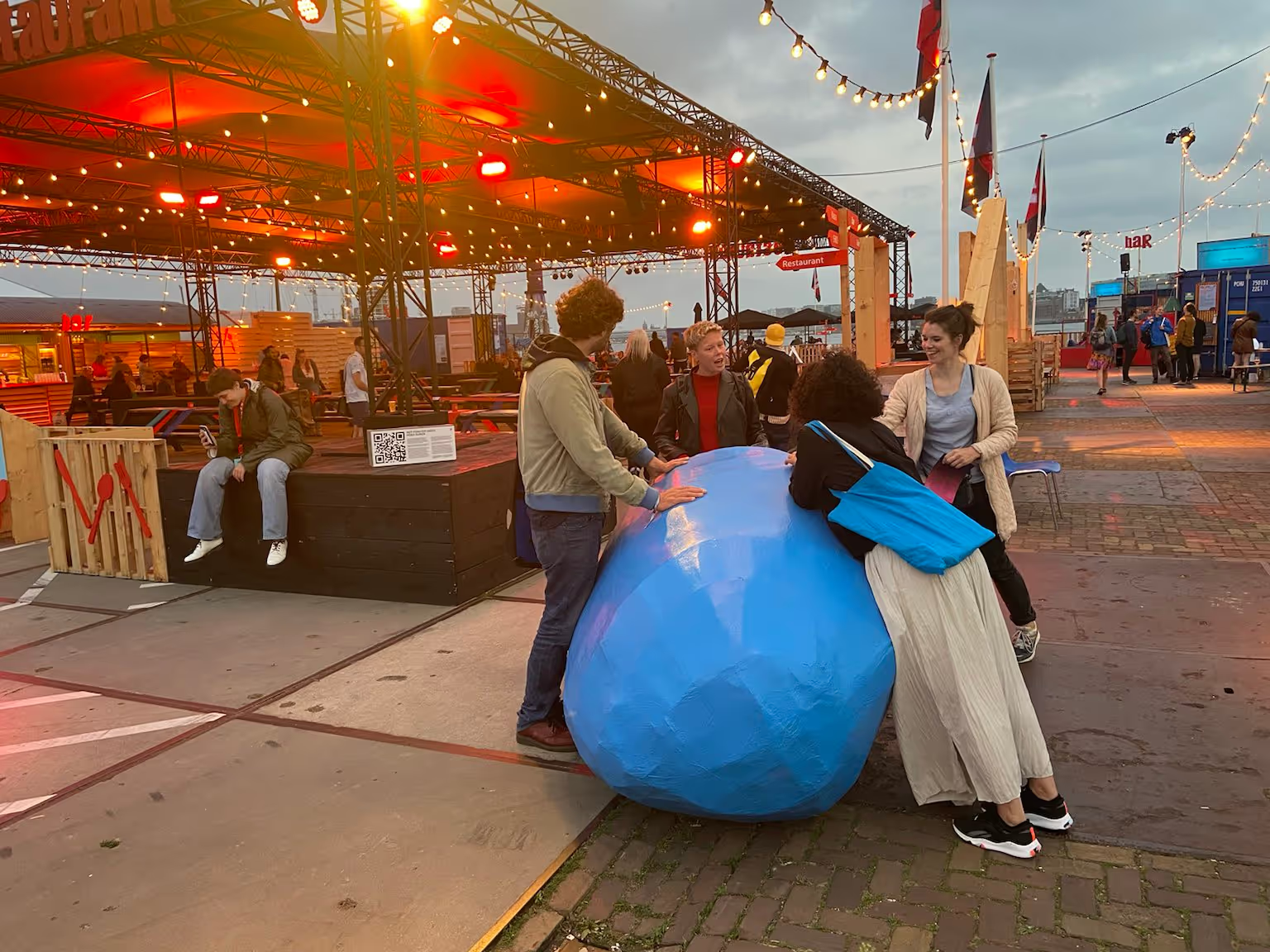
The South African Artist Goldendean (Dean Hutton) made inflatable soft sculptures that depicted the contours of their own bodies. Especially for the NDSM shipyard, they created the 'Big Fat Trans Light MerQueer', a hybrid between man and sea monster that seemed to have crawled out of the IJ water — with tentacles. They were inspired by folk tales about sea-lake people, such as the “Mermaid of Edam” and “Mamlambo”, a serpent-like river goddess from South African and Xhosa mythology, who was often depicted as a mermaid. When they were captured, they allegedly brought prosperity.
Goldendean shared moments of gentle courage to affirm the right of all bodies to exist, be celebrated, and protected. They evoked tender feelings by deliberately pretending to be crazy and playful, sometimes a clown, sometimes a warrior, always vulnerable... Radically soft in an uncompromising world... A tenderqueer invested trust in an audience to respond kindly, to keep our bodies safe together, to give queer space, no matter how we sometimes failed each other.
Johannes Buttner: Free Energy II, Peak Panic
Location: waterfront near Pllek
In his sculptures, installations and videos, Johannes Büttner (Germany, 1985) addresses socio-economic themes such as energy, work in the digital age and power. In addition, he worked with people with diverse backgrounds: from mindset and business coaches and bakers to people from the “digital working class”.
Johannes Büttner showed sculptures that he made for Into Nature, an exhibition in Bargerveen, Drenthe, curated by Hans den Hartog Jager, where energy was key. Büttner's luminescent sculptures were battery-operated made of aluminum, magnesium and alum crystals. The story went that they recharged over and over again, so that these batteries would provide infinite energy. Büttner had the batteries designed by “free-energy engineers”, an online community that believed that environmentally friendly, sustainable and free energy sources had been around for a long time, but that they were hidden by large companies and governments out of self-interest. Somewhere between truth and fiction, (pseudo-) science and faith, and in response to the lack of opportunities to verify this, the work evoked alternative ways of imaging.
In addition, Johannes showed lightboxes with advertising-like photos of “survival hacks” for a post-apocalyptic scenario. How did you make light in times of crisis? Faced with a pandemic and climate change awareness, 2016's work was now seen differently. DIY creations and creativity to deal with new catastrophes seemed inevitable.
Alice Wong & Crys Leung: COHESION
Location: LOAD OUT
Alice Wong was a story designer. By showing how our perception of reality was constructed, she tried to turn complexity into understandable stories. For this project, she worked with Crys Leung, communication designer, who investigated the role of media and the relationship to identity in her work.
Alice and Crys revealed 'COHESION', a large-scale installation that connected fragmented elements on the NDSM. The reflective circle stood for unity and collectivity; one could all come together and become more than the individual parts. Because the total circle could not be understood from a single position in space, the work created an infinite number of perspectives, depending on the point of view. The process of interacting from different angles, heights and distances made it clear how people collectively shaped a shared reality, where no perspective should stand above the other. Visible and invisible, seen and unseen were all equally valuable.
There were wild animals at the NDSM shipyard in 2021!
Designer and Illustrator Luca Boscardin was one of the two winners of the Open Call launched in 2021 by Stichting NDSM-werf. His project Animal Factory consisted of minimalistic metal animals, such as a crocodile and a giraffe. The works invited you to sit on or climb up and thus played with the idea of the NDSM shipyard as an urban jungle.
Animal Factory was a collection of animals designed in a simple and abstract way, each maintaining the exact size and proportions of the real animals. The objects — a giraffe, gorilla, crocodile and wolf — were characterized by a minimal shape, made of metal tubes and a minimal use of color: each one was painted in a single shade to encourage passers-by to open their minds and let their imagination run wild. Where, from a certain angle, the steel structure did not seem to have a specific shape, the contours of a gorilla were clearly visible from another location. This is how the animals were surprises in the industrial landscape.
With the objects, Luca Boscardin hoped to encourage creativity and multifunctional use of the shipyard. For example, the gorilla could also serve as a play object, the giraffe may have been an alternative workout tool, and the crocodile was a suitable place for visitors to sit down with a cup of coffee. As a toy designer, Luca drew space rockets, fantasy creatures, imaginary characters and super-fast cars every day. Using the life-size metal animals, he gave shipyard visitors the space to use their own imagination and invited young and old to play, hang out or exercise.
Animal Factory was created with the help of steel carpenter Iwan Snel, who was also based at the NDSM shipyard. The entire project was designed and produced in the immediate vicinity of NDSM. Nowadays, they can be found on the west-side of NDSM next to the Noord-Dok building in a park.
When ADE was canceled due to the Corona pandemic, we came up with something else at NDSM
For this edition of ADE, Stichting NDSM-werf invited the art and activist group Tools for Action + Floor out to use their site as a public rehearsal space for RÆV REHEARSAL. They invited the audience to rehearse new forms of togetherness. With a Bluetooth speaker system, floating inflatable sculptures and a minimalist techno beat, they moved around the city like a radiant, dancing swarm. The streets became the club, the steps, roundabouts and benches acted as temporary stages.
RÆV REHEARSAL
RÆV REHEARSAL was initiated in Rotterdam in the summer of 2021 by visual artist Artúr van Balen, founder of Tools for Action, and choreographer Floor van Leeuwen. Every week, they rehearsed the dancing swarm in public space with a fixed group of twenty ravers, which in some editions grew to more than eighty people. After two massive editions of Unmute Us, the protest march for a more open event and night culture in Amsterdam, there was a strong need for people to come together, dance and have fun. By dancing, people were able to express their protest in a peaceful way.
Artúr van Balen, founder and artist at Tools for Action, explained: “Actually, this was intended as a new form of manifestation with the potential to become a protest. We used the rehearsal as a format because, from a legal perspective, it gave us the opportunity to meet with more than a hundred people in the open air, regardless of the changing corona rules.” Floor van Leeuwen added: “I saw the rehearsal as a way to practice collective movement together, coordinate, meet new people and even dance with people remotely, even when they were on their balconies.”
Swarms
RÆV REHEARSAL was based on the movement principles of swarms. Like a flock of birds, there was no central point or hierarchically organized movement; the direction was determined by the group as it moved. During each rehearsal, people had to move and dance about three meters apart. Based on these principles, the audience was invited to participate on October 15, 16 and 17 and to rehearse this collective movement together.
Music
RÆV REHEARSAL worked with a different DJ each time. As the swarm moved through public spaces, from iconic places to residential areas, the goal was to find sounds that resonated with the local environment or aroused curiosity. During previous editions, DJs performed such as Sukubratz, a Chilean DJ who combined techno with reggaeton, Cheb Runner, a Moroccan DJ who mixed electronic dance music with chaabi (a style of Moroccan folklore), and DJ Dance Divine, a queer artist from Brussels.
ADE
On October 15, 16 and 17, a group of up to a hundred people gathered at the NDSM shipyard to dance through Amsterdam-Noord. Various collectives, DJs and communities joined this initiative. The line-up was announced later. These were three unforgettable nights where a dancing swarm moved through the city, letting its heartbeat ring during the pandemic and activating spaces with bodies, music and light.
As an echo of the transformations in club culture, RÆV REHEARSAL highlighted the need to explore new forms of sociality and interrelationships by reclaiming and reprogramming public space.
In collaboration with Nieuw Dakota, Stichting NDSM-werf presented Public Air Filters by Anne-Jan Reijn at NDSM
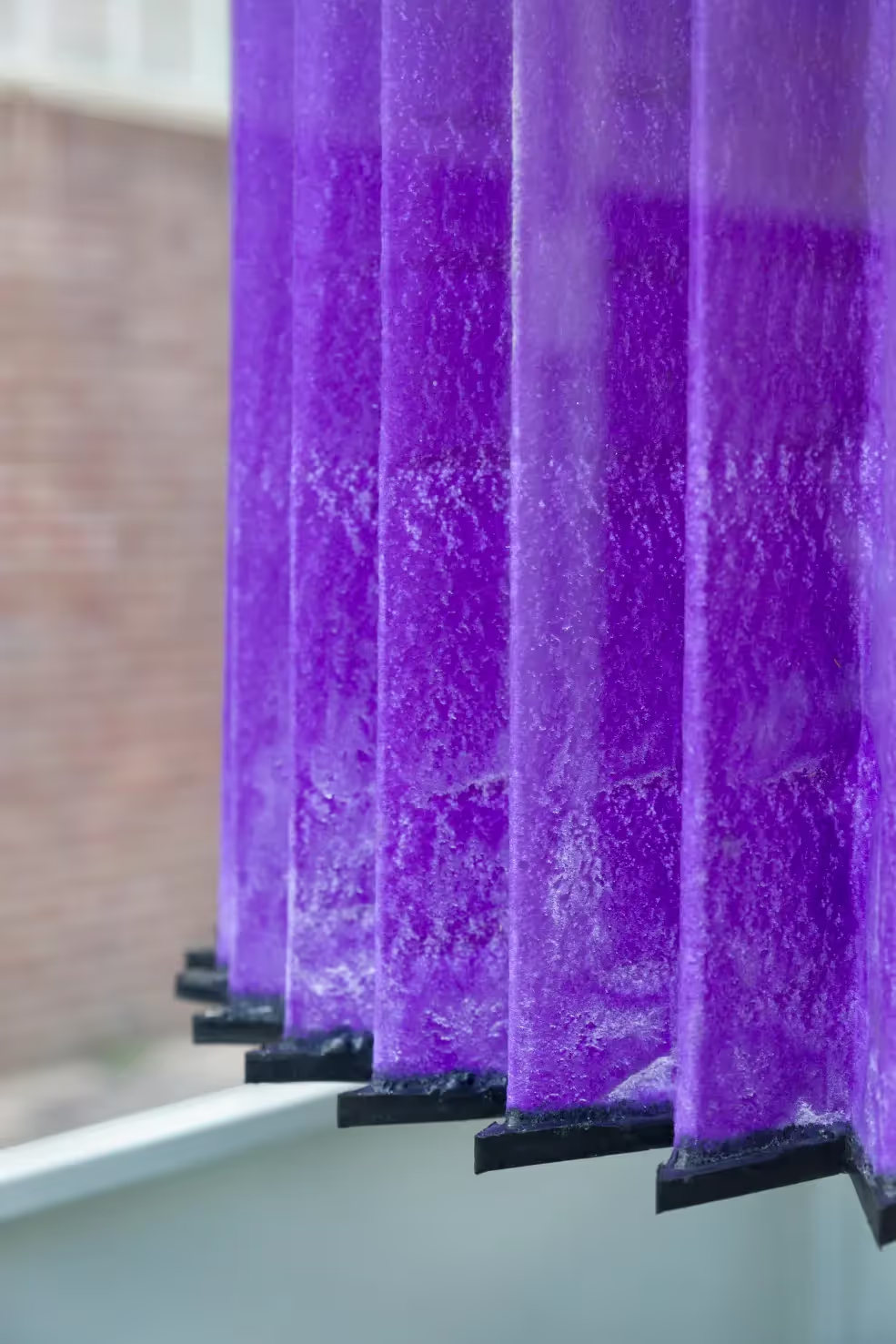
Public Air Filters was one of the two winning entries for the 2021 NDSM Open Call. For this work, artist proposed Anne-Jan Reijn the question is what actually happened in the outside air that we breathe. By filtering air in public spaces, a dichotomy automatically arose: filtered air and unfiltered air. This immediately raised a question: maybe the unfiltered air could not be trusted? The series of sculptures by Anne-Jan was on display between July and October and was changeable during this period. This slow process was, in fact, the essence of the work.
In theory, every cubic meter of filtered air left a residue on the outside of the filters. The artist wanted to play with this residue, creating an archaeology of air filter pollution, where a form of manipulation was allowed. What if that residue on the filters formed the most amazing colored crystals? Did that have a direct psychological effect, making the air we breathed, for example, undesirable or unpleasant? Reijn played with the idea of danger that we couldn't see. Invisible risks that were in the air, such as asbestos or a virus, were scary but could also evoke a form of awe. With this work, the artist offered a different perspective on this issue by materializing the invisible. “We were constantly connected to invisible matter — and therefore the risks — and we systematically tried to eliminate it. At the time, the relationship of trust we had with science and politics was under great pressure,” says Anne-Jan Reijn.
Under no circumstances did the artist claim that filtered air was safer than unfiltered air: “This was really a work of art that played with the idea of distinction.”
Also read the interview with Anne-Jan Reijn in the Digital Depot - Online Magazine.
Credits and references
Visuals: Robin van Dijk, Benjamin Kotek, Gert Jan van Rooij
In the spring of 2021, it was quieter than usual at the NDSM shipyard. This had everything to do with the Corona pandemic that gripped the entire country, and the whole world. Due to social safety restrictions, programming at the outdoor area of the NDSM shipyard was a challenge. Nevertheless, at the NDSM-werf Foundation, we looked for ways to make NDSM's public space as beautiful and accessible as possible, even though it was quieter than previous years during this period.
From this idea, the NDSM Yard Gardens came into being: 30 to 50 garden boxes where NDSM residents could use as a small piece of urban garden. All at least half a meter apart, so that users could garden while respecting social distancing”. It turned out to be a great success: all gardens were immediately used by residents, visitors, artists, neighbours, and some entrepreneurs at and around the NDSM shipyard. From early spring to autumn, flowers, vegetables and other plants were grown in the square between the Y slope and the Noorderlicht. Workshops were also given to small groups of gardeners and at the end of the season, a real NDSM garden community was created.
In 2021, the first expressions in the (Un)monumenting program series were published on NDSM, including on the NDSM Billboards
What should or could a monument be today, for whom, and who decides this? For their programme series (Un) Monumenting, Stichting NDSM-werf invited makers and artists to reflect on these questions by creating a (temporary) work at the shipyard. For (Un) Monumenting #1, the collective Frerara — Frederick Calmes, Raquel van Haver and Raul Balai — invited to make the Drawing Assignment 2020, which they realized for the Amsterdam City Archives, visible at the NDSM shipyard. (Un) monumenting #1 presented Frerara with images from “Breathing of the City”, which focused on understudied Amsterdammers and their stories.
From April 9, 2021, three construction boards at the shipyard showed drawings by Frerara, which they made as part of “Breathing of the City”. The collective saw the city as a “living organ that wakes up every morning and never sleeps in its entirety.” Especially at that precarious time, it became clear who had the luxury of being able to work from home, and who didn't. Cleaners, sex workers, bus drivers; diverse characters starred in the drawings that portrayed, fascinated or embodied the three artists separately. At the building signs, visitors were able to listen to audio clips about the images and/or the people portrayed with their smartphones. The three artists brought together themes such as the archive, transition, art and culture and the city's signature in their work. To do this, they investigated the residents of the city of Amsterdam and specifically into continuing the tradition of keeping the city alive as a ritual. For example, with the drawings, they showed a different face of Amsterdam and created a temporary 'monument' for a number of understudied townspeople. On April 9, not only did the presentation start at the NDSM shipyard, but Frederick, Raul and Raquel also physically handed over the drawings to the City Archives for inclusion. The collection of drawings was published by the City Archives in three separate zines, which could be viewed and purchased, and they worked towards a fine publication that year. What was special was that the topic “Breathing of the City” was submitted by Frerara to the City Archives even before the coronavirus pandemic, and it had only gained in urgency since then.
Continuation of (Un)monumenting
The global conversation about monuments meant that the Foundation used this moment to bring the shipyard's history more to the surface. What could a memorial be, mean, and who had a say in it? And asking who deserved to be present in public spaces and who felt represented (and who didn't)? Based on the wish of the NDSM-werf Foundation for a polyphonic public space, the foundation commissioned several artists to give their views on this on the shipyard. The (Un)monumenting project consisted of several episodes: for each chapter, the foundation invited one or more artists to reflect on the theme of 'monuments' of the future. At that time, work was underway on (Un)monumenting #2, a video work by Turkish-Dutch artist Belit Sağ, in which she highlighted the invisible history of the NDSM shipyard. In the video, a collaboration with the Institute for Sound and Vision, Belit Sağ investigated the role of female Turkish migrant workers at the shipyard using archival material.
An exhibition with an audiowalk that took place in the future
Plastic Hypersea is was an interactive, site-specific work by an artist Sissel Marie Tonn commissioned by Sonic Acts and was experienced at the NDSM shipyard in Amsterdam.
Set in 2099, Plastic Hypersea was a guided, spatial and interactive experience that speculated on a possible future in immunology, merged with the topic of environmental health. As listeners explored the terrain, they were invited to imagine the environment as an extension of their immune system and to consider the many ways their bodies intertwined with microplastics in the sediments of Amsterdam's waterways. Ultimately, Plastic Hypersea asked listeners to leave behind the war metaphors that haunted immunology and to think about a more expansive sense of self.
Produced in collaboration with musician Vincenzo Acquaria Castellana and sound and recording artist BJ Nilsen, the localized sound experience was complemented by custom boat sails and ceramic sculptures created by Sissel that acted as “membranes” encoded with material and immaterial data about the hydrophobic, industrial waste that flowed through the waters of the Netherlands.
About the artist
Sissel Marie Tonn was a Danish artist based in The Hague. Her practice focused on the shifts in perception that occurred when people became entangled in their surroundings, blurring the boundaries between body and environment. Her artistic research often resulted in interactive, sensory installations.
Plastic Hypersea was built on Echoes, an interactive GPS-enabled mobile app for audio walks. To access the work, you had to download the app from the App Store or Google Play. They then put on headphones and wandered around the area of the NDSM shipyard while following the sails and ceramic sculptures. The gradual unfolding of the work was activated while walking and exploring the environment.
SEXYLAND was an art project in the form of a temporary society. For 365 days, the club had a new owner every day. He was able to implement the program as he wished, ranging from art expressions to sporting events, from gangster rap to stroboscopic light dinners. SEXYLAND was a tabula rasa that could be described in any way. SEXYLAND strived to mark every unknown corner of Amsterdam and show the enormous diversity the city had to offer.
In 2021, Sexyland moved from the NDSM shipyard to the other side of Amsterdam-Noord under the name: Sexyland World. As part of Sexyland's departure, we spoke with stakeholders Aukje Dekker and Samira Ben Messaoud in a podcast episode of NDSM X. Listen to it below.
On the way to school or work, kissing behind a corner of a building, sprinting to the ferry, giggling from a car, chewing gum on the ground, fishing in the dock: daily activities at the NDSM shipyard. In NDSM Nursery Square, a project by Studio Makkink & Bey they looked at daily activities at the NDSM shipyard asking how they could reprogram them through cultural activities.
From October 2019, there was a temporary square to visit where there was space to intervene with a flexible infrastructure and influence the behavior in the shipyard's public space. The square therefore never looked the same, moved with its visitors and was sometimes coloured by artists in residence. For example, park furniture could be borrowed and there were singers and artists who sang to the sailors during rush hour in September.
Artist Antoine Guay built a bread oven in a container, after which the bread baked therein was distributed to visitors on a number of Saturdays in exchange for a nice gesture or action. City poet Gershwin Bonevacia spent a while at Nursery Square as a “poet-in-residence”. A documentary was also shown in the Nursery Square of Nina Swaeny Cherry. And because this was also a public square, by and for Amsterdammers, designer Jurgen Bey and curator Jules van den Langenberg also invited local residents and parties at the shipyard to make their own programming proposals.
In this English-language podcast episode, we speak with Camille de Wit. Director at Treehouse NDSM, a creative incubator at the shipyard.
A playground for serious artists
In this conversation, we will delve deeper into the question: what exactly is Treehouse NDSM? And we are talking about their new pavilion 'Momentum', which can be visited since today. In addition, Camille also gives a glimpse of their programming at the first edition of NDSM Get Lost on May 26.
Follow Treehouse NDSM on Instagram and Facebook so as not to miss out on any of their artists.
Interview: Manaf Halbouni about his work 'Monument'
tekst:
Julia Lefeber
The Syrian-German artist Manaf Halbouni (1984) parked three buses upright at the NDSM shipyard in 2022.
Manaf Halbouni was born in Damascus, Syria, where he spent most of his life and currently — as he says — “works and lives everywhere”. In 2008, he completed his studies in sculpture at the University of Fine Arts in his hometown, before moving to Dresden where he graduated from the Academy of Fine Arts. Halbouni's work covers a wide range of media, including everyday objects and materials, and is characterised by a socially critical approach to themes related to war, global conflicts, flights, borders and migration. The artist is not afraid to use public space as a stage for his art, which has certainly caused quite a stir in the past. This article illustrates the creation of one of Halbouni's most iconic works' Monument ', which is now on display at the NDSM.
With five different trucks, Halbouni's immense work is Monument transported from the warehouse in Berlin to the NDSM site in Amsterdam. This twelve-metre-high installation consists of three German passenger buses that are placed side by side and have their “noses” turned to the sky in an upright position. Due to its size and composition, it disappears Monument certainly not in the background of the expansive quay, but it immediately attracts attention when you get off the ferry. The installation was exhibited for the first time in 2017 at the Neumarkt in Dresden, Germany, and can still be admired at the NDSM until the end of August.
While he's at work “Nowhere is home” exhibited at the 2015 Venice Biennale, Halbouni read the news one morning and stumbled across the widespread image that Syrian photographer Karam Al-Masri made in the Bustan al-Qasr neighborhood of Aleppo. The March 14 photo shows how three destroyed public buses were raised to form a barricade to protect civilians from snipers when the country's civil war reached a climax. “I saw the image and thought how amazing it is what people do to protect themselves,” says Halbouni. “They blocked the streets for snipers so they could open their stores on the other side of the barricade,” Halbouni continues. “I started playing on paper by cutting out the buses with Photoshop. I placed them [hypothetically] in public squares in Europe and imagined that this is a peace sculpture against the war”.
Two years elapsed between experimenting with the idea and implementing it for the first time. During that period, Kunsthaus Dresden asked Halbouni to make a work for their cultural festival. Am Fluss, zu Cultures des Ankommens [By the river, about cultures of arrival]. Halbouni showed them the images he had taken with Photoshop and said, “How about doing that?” His proposal was met with some reluctance because — given its size — it was a very ambitious plan. However, the artist had already come up with an idea for the construction of the work so that the buses could stand firmly. After further negotiations with the city, they received permission to continue the project, and with donations from the local community, they were able to do so.
And there is always war, but there is also reconstruction.
In 2017, Monument installed on the Neumarkt in Dresden near the Frauenkirche; a very symbolic location considering that the church was demolished in World War II and rebuilt after German reunification. “I've done historical research into the situation in Dresden in '45 when it was bombed and Aleppo in 2015, which was almost completely destroyed by the bombings. I wanted to show how war and peace can change very quickly,” says Halbouni. “And there is always war, but there is also reconstruction. Dresden was rebuilt after the war ended. So there is also hope for the people of Aleppo and the Middle East in general. But first, the war must stop”. The memorial — as an “undamaged” symbol of hope — was placed in the square a few days before the annual memorial day on February 13, where the victims of the city's bombing are commemorated.
Although Halbouni's Monument intended to bridge the war experiences of the Middle East and Europe, the work was — to say the least — not very well received by some of the spectators. Dresden is home to the right-wing anti-immigration movement Pegida, whose supporters were ready to vehemently disrupt the 2017 opening and criticize the work. Around 400 people shouted at Halbouni as he tried to elaborate on its significance. “They didn't see it as a peace memorial, but as a provocation by me to insult the German victims of the Second World War. That wasn't the intention at all!” , explains Halbouni. “It's a reference to all war victims, inspired by an image from Syria. But the far-right dynamic is always very interesting, as they try to tweak stories to make them fit their own alley. They had changed the meaning of the work to portray it in a hateful light. This had quite an impact”. Halbouni must be strong, because he has also faced countless hate emails and death threats. How he dealt with that? Well, Halbouni gave it an artistic twist. “I actually made a work of art out of it. I printed out 15 of those e-mails — 'the best of' — and showed them in an exhibition”.
A lot of people didn't see it as art. They called it Schrott or crap.
Moreover, art in public spaces was a hot topic of the discussion in Dresden at that time. The three-part 'readymade' installation touches strongly on the perpetual question of what art is or isn't. “A lot of people didn't see it as art. They called it Schrott or crap,” notes the artist. Here in Amsterdam, too, some people have expressed skepticism on social media about why this is considered art, possibly without knowing its background. However, Halbouni deliberately uses a lot of ready-made art in his work that people can recognize from everyday life. “You can reach people much better with that and let them interact with or think about your work than if it were something complicated,” Halbouni explains. The artist likes to observe how people engage with his work in public spaces, and he noticed that something interesting happened at the Neumarkt in Dresden in 2017. “The funny thing was that everyone met in front of the buses to have those discussions; both those who were in favor of public art and those who were against it were standing there talking the whole time. That was great. They weren't yelling at each other. It was like in a parliament,” explains the artist. The installation was on display in Dresden for two months, and it was always busy during that period. “Normally it's a place where only tourists come, but during those two months, the whole of Dresden was there”.
For Halbouni, exhibiting his work in public spaces allows him to discuss with people and understand what they think about it. “Public space is that innocent place where you can reach everyone. Technically, you're forcing people to watch something because they can't escape it. In contrast to indoor galleries where people decide to go,” says the artist. “I show things in a different way than you know them. Most of the time, people are annoyed at my work at first. But then I notice how they're going to think about it and later have that “Oh, I get it now” moment. This often happens with Monument”. Halbouni even took the courage to visit a far-right demonstration in Dresden in 2015, where he was Sachse auf der Vlught [Saks on the run] created a refugee scenario at Theatherplatz and engaged in talks with protesters to understand their opposition position. This was his first public art installation and even though a demonstration was underway, the encounters that took place were not aggressive. “A very important fact is that when you talk to people who don't share your views, you need a neutral meeting point. Monument was exactly that in 2017,” Halbouni explains.
With the events in Ukraine and all the aggressions everywhere, we need it more than ever. We need peace.
After Dresden became Monument set up in 2017 at the Brandenburg Gate in Berlin during the Berliner Herbstsalon festival. Here, too, the context of this location added an extra layer of symbolism to the work, as the gate once embodied the division of the city into East and West, but also represents the reunification since the fall of the Berlin Wall. Now, five years later, Amsterdam has the honor of hosting this memorable work and drawing attention to and connecting the voices of the Middle East with those from Ukraine and other conflict zones. The unveiling of the work took place on July 7 under the musical accompaniment of the Marmoucha Orchestra. Halbouni's project will be presented at the shipyard as part of the '(Un) Monumenting' programme series by the NDSM-Werf Foundation. At the heart of this program is the question: “What should or could a monument be or could be today and for whom?” on which the artist is asked to reflect. According to Halbouni, a monument should convey a message to the public. ”Monument sends the message to think about war and peace. I hope we all take a moment and reflect on our actions and their consequences,” says the artist. “With the events in Ukraine and all the aggressions everywhere, we need it more than ever. We need peace.”
Credits and references
Lees
Interview: Manaf Halbouni about his work 'Monument'
In this episode, we speak with Ellis Kat, director of New Dakota. Although she has been at the helm of this contemporary art exhibition space for almost a year, the first self-made programs will not be shown until September. So it's high time to get to know each other more closely.
My most important lesson? Always say yes
Ellis Kat came into the shipyard with a bang because of an interview where, in particular, her statements “I want to jump in puddles” and “let's set things on fire” lingered. But despite being one of the youngest directors in the art world (if not the youngest), she already has an impressive resume. She can't wait to start her own programming, which focuses on experimentation and deviating from the beaten path. In this episode, you'll hear all about it, as well as where she learned her most important lessons. Listen to this new episode here.
The three major billboards that are distributed on the NDSM have been renewed with work by none other than South African photographer Zanele Muholi (they/them). Muholi is an engaged photographer who — through an activist lens — explores and documents South Africa's LGBTQI black identity.
For more than twenty years, he has been laying Muholi black queer, transgender and intersex people caught through his lens, resulting in powerful contrasting black and white portraits that reclaim the meaning of “blackness” and undermine the clichéd, stereotypical images of black people. His work is a genuine representation of the black and queer identity whose versatility is shown in a celebrated way. For the photographer, the people in their photos are not “just” models, but rather participants who contribute as much to the photo as themselves.
The works on display at the NDSM are all self-portraits by the artist, where Muholi in two cases looks directly into the camera, or rather, into the eye of the viewer. Muholi has increased the contrast of the images to highlight the color of his skin. In addition, Muholi takes on a different shape in each photo — through the use of everyday matter — changing it into different characters. In the work 'Kodwa I, Amsterdam' (2017), the artist is draped in hair, once again challenging stereotypes about Africans.
Over the years, his work has been exhibited in leading museums worldwide, such as Tate Modern in London and the Guggenheim Museum in New York. In 2017, Muholi debuted his photo series “Somnyama Ngonyama” (Hail, the Dark Lioness) in the Netherlands at the Stedelijk Museum in Amsterdam, along with a selection of photos from his series “Faces and Phases” and “Brave Beauties”. With several awards, Muholi has become one of the most acclaimed photographers of our time.
The compelling works shown on the NDSM Billboards were shown during Pride week Amsterdam.
NDSM X S3 E7: The New NDSM Young Curator: Jarwo Gibson
tekst:
In this episode of NDSM X, we speak with Jarwo Gibson. In addition to his own ABCND store in Amsterdam-Noord, he does many other things.
Jarow Gibson likes to surround themselves with other talented creators, bring them together and want to offer them a stage. For that reason, he was also selected for the Young Curator program at the NDSM-werf Foundation. During the Museum Night, he will put together a program. Curious about Jarwo? Then take a quick listen to the latest episode of NDSM X.
Credits and references
Luister
NDSM X S3 E7: The New NDSM Young Curator: Jarwo Gibson
Interview with SpY about their work 'Barrier Tape'
tekst:
Julia Lefeber
Visuals: Benjamin Kotek, Gert Jan van Rooij, Ruben B Pescos, Jann Senn
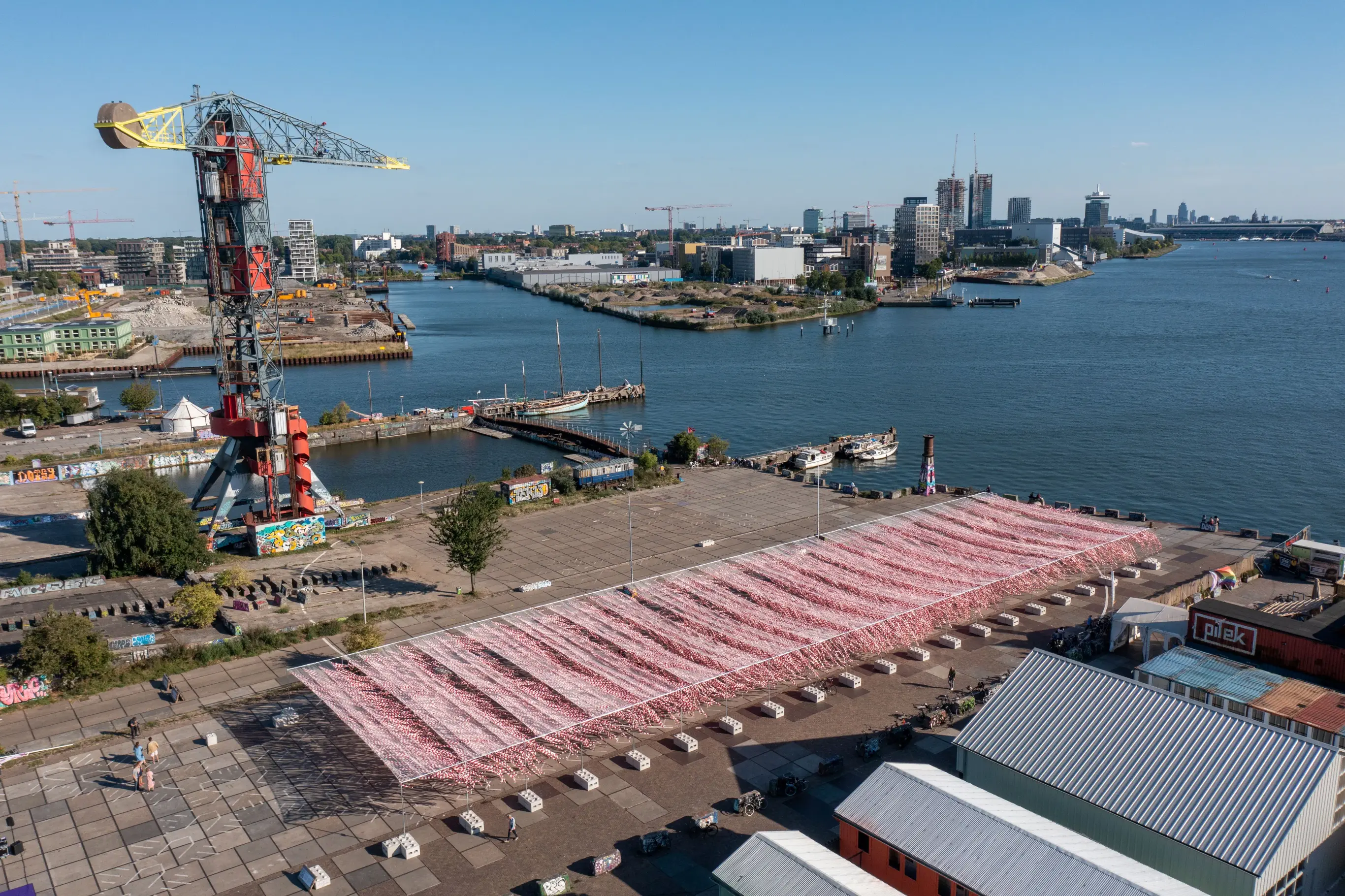
Whoever makes their way across the shipyard will be able to hear the new work 'Barrier Tape' from a distance. The countless barriers hanging on parallel strings dance together to the beat of the wind and visitors can move through and around these hypnotic “waves”. The brain behind this multi-sensory experience is Spanish artist SpY whose work has appeared internationally in many urban public spaces. SpY is known for its spectacular and large-scale public interventions and installations that are in dialogue with the environment. The artist plays with a contrast in the aesthetics of his work and the recognisable everyday urban utensils that comprise it, and also involves spectators as active participants in the artistic process. SpY designs and realises its projects from its SpY Studio platform. 'Barrier Tape' will be on display at the shipyard until September 26 and we asked the artist all our pressing questions about this work in an interview.
Who SpY is is is quite a mystery. Although what you do — your work — has (been) seen in many cities around the world. How would you describe the essence of your work?
My goal is to address the audience directly to induce reflection and dialogue, to interrogate them and to allow them to act as active rather than passive subjects. In this sense, the urban environment facilitates and promotes this process.
I look beyond the formalism or aesthetics of the works, so that my own artistic attitude and that of the audience becomes a way of building the work in its entirety.
Observing and being receptive to dialogue with the city has been the process and framework in which I have expressed and communicated my ideas for years.
Your work is very public, but you, as an artist, are not. What is the motivation behind staying under the radar?
We're living in a time of social media overexposure that creates confusing realities. We're navigating a blur of misinformation and hectic social conditioning. Distraction is preferred over concentration, the automatic over the reflexive, and confrontation over empathy. The earthly order is being replaced by the digital order that denaturalizes the world's things and emotions by automating them.
All this overwhelms me and by staying in the background, I can move quietly without exposing myself too much to the media that should create a “SpY” character where everyone expects a witty and brilliant summary of the intentions of the works.
How did you get started with what you do and how did your public interventions evolve over the years?
At the end of the 80s — attracted by the paintings I saw on the street — I started painting graffiti.
As an autodidact, I started developing my own paintings and identifying myself with my own style, I had no experience nor was educated at an art school, but I was strongly attracted to the idea of seeing my name everywhere.
After many years of working on the streets, it was as a natural evolution that I developed a keen sense of seeing the city as an artistic medium with great opportunities to create my current urban artworks.
From graffiti to the present, I have been characterised by a determination and curiosity to explore other means and formats in my work. I spend a lot of time thinking, theory, practice and managing projects. My aim is to raise important questions that generate reflection around the work, and I try to formalize and communicate these approaches through different formats.
It has been a journey where I have transformed my working method and proposed new ways of working within this framework.
There are a lot of people involved in developing your ideas, can you explain what SpY Studio's platform is and how you work?
It is a highly dynamic studio that adapts quickly to the new challenges of each project. The studio is both a laboratory space and an eclectic team of specialists, technicians and craftspeople who work together with a strong desire to learn and explore. Intertwining disciplines and collaborating with other professionals from different areas presupposes a solid work methodology that adapts well to different challenges while being flexible enough to be open to experimenting with the unexpected.
The Studio is currently researching and experimenting with kinetic art in motion and the use of new tools and media that combine the digital, mechanical, and electronic with elements of the urban imagination that we usually find on the streets of every city.
For example, we are working on a large permanent kinetic installation for the atrium of a hospital in Switzerland. It requires sophisticated engineering that integrates seamlessly into architecture and a customized programming system that will bring all the movements of the work to life. It is a project on which we will be collaborating with an engineering firm and two architecture studios, and it will take two years for the hospital to be completed and operational.
In a more ephemeral way, we recently created a 60-metre-long kinetic sculpture called ECLYPSES in the warehouses of the old weapons factory, consisting of 20 backlit mobile drives and a sound system. This work involves visitors in a unique experience through the modulation of scale, light, color and music. The different elements are combined through choreographies that form a sequence of hypnotic and compelling patterns.
And how have you developed as an artist now that your works are increasingly being picked up in many cities and by diverse cultures on different continents?
Each project is ultimately a learning process, because there is never a work like the last. It's always about new challenges where we try to understand and connect new tools, propose different research processes, and surround ourselves with the best possible team to carry them out.
As I said, through my works, I try to raise important questions that we, as a society, need to keep an eye on. This quest is formalized by conceptual contrasts between the aesthetics of my works and the difficult connotations of the objects they are built with, often elements used to condition people's behavior.
The work 'Barrier Tape' on the NDSM relates to the natural elements around it, creating a hypnotic (multi-sensory) experience for the audience. Can you tell us more about how your idea for this work came about and where this fascination with using everyday objects in your public works of art comes from?
It's about creating new works from the everyday. You start the process based on elements that are already familiar to most, but if you regroup them into a new combination, you are already creating something new and memorable.
This is a sound sculpture made with recycled deposit tape that continues the line of kinetic works with hypnotic patterns that I've explored in my latest projects.
Something fundamental in the work is the dialogue with the context and effect of the wind that plays and dances with the tapes, creating beautiful choreographies and wavy movements throughout the installation, almost as if it were a sea wave.
As you can see, it's a living work that interacts with the audience, making it part of the experience and creating a memorable moment for everyone.
Your works are in dialogue with their urban environment. 'Barrier Tape' explores the urban context of the NDSM and recalls the ever-changing nature of this place and the city of Amsterdam. How do you view or approach these changes as someone who is not from here and how do you translate this into a work?
I believe that, as an artist, you should not strive for the complacency and acceptance of the widest possible audience with your propositions. You have to be faithful and consistent in what you want to express, and work within an artistic rigor, even if not everyone likes it. But you also need to understand the context in which you are exhibiting your works and enter into dialogue with it, because we have an important responsibility when we share our creations with neighbours and residents who give up their space, otherwise we are not much different from the mass advertising noise.
Finally, you'll explore the urban environment as a “playing field full of untapped opportunities”. What kind of “playing field” do you think the NDSM is?
Without a doubt, the urban environment is a framework that offers great opportunities to work and propose artistic projects. From micro, as a small intervention on an urban element, to macro with a large installation in the urban core of a city.
Cities can generally be quite rigid, but the street acts like a living entity with blood flowing through it. It is not an aseptic space like the gallery, museum, or stock exchange. It is constantly evolving and that is part of the creation process of the works.
In the case of 'Barrier Tape' at NDSM, the artistic proposal in this public space is aimed at making passers-by complicit in their own city, and thus leaving behind the monotony that usually takes up their lives in big cities.
Rarely do we find artistic performances that break into the everyday life of cities to generate reflection and dialogue between creators, cities and citizens.
Credits and references
Visuals: Benjamin Kotek, Gert Jan van Rooij, Ruben B Pescos, Jann Senn
Lees
Interview with SpY about their work 'Barrier Tape'
Interview with Amauta García & David Camargo: Are We Future Sediment?
tekst:
Julia Lefeber
“Are We Future Sediment?” (Are we future sediment?) is the question asked on the five-metre-high billboard that was placed on the NDSM at the beginning of this month. This temporary installation is part of a new project by Mexican artist duo Amauta García and David Camargo, who are currently artists-in-residence at the Jan van Eyck Academy in Maastricht. The artists submitted the winning entry for the Open Call that the NDSM-werf Foundation launched among the Academy's participants. With this work, García and Camargo visualize the situation in which Amsterdam could be in fifty years; namely five meters under the sea.
García and Camargo met fifteen years ago and have been collaborating on various projects since 2011. García's work includes sculptures, videos and interventions in public spaces and addresses socio-political themes, including unequal housing opportunities in cities. Camargo is a visual artist whose work focuses on exploring stories about the notion of simulacrum (an image or representation of someone or something) in the context of an image-driven society. Together, they founded an artist collective in Mexico City called 'Colective Trafico Libre de Conocimientos', TLC (Free Knowledge Traffic Collective). The collective has five other members and experiments with public space, education and art and focuses on critical thinking, collective learning and knowledge sharing.
The rather compact city of Maastricht is a completely different world for the artist duo as they are used to traveling long distances in Mexico City. Their stay in the Netherlands has given them more time to focus on their projects and the residency at the Jan van Eyck Academy provided them with the opportunity to share their work and research with different people and gather their input. Thanks to the Open Call, the artists were also able to discover the capital. They had never heard of the NDSM in Amsterdam before, but during their research, they learned a lot about the rich history of the former shipyard and the city's possible wet fate. The latter inspired them to come up with the idea for the installation 'Are We Future Sediment? ' on the NDSM.
Water is a recurring theme in García and Camargo's work, which they approach in a very poetic way. They found that there is such a contrast in the relationship that the Netherlands has with water compared to Mexico. “In Mexico, we have a lot of problems with water, but unlike in the Netherlands. In Mexico, there is a shortage of them. There is a lot of rain, but nothing is being done with it. The water that falls mixes with the city's soil, making it dirty right away,” explains García. “The drought in Mexico is very complex. In that regard, we need to think about how we can capture the rain,” she continues. For the Open Call, she proposed an idea for a fog catcher that they had wanted to realize in Mexico but were not yet able to achieve. “It's a really good opportunity to learn how to do it, and maybe we can do it there too when we return to Mexico,” says García. “It's like a sketch for other projects,” Camargo adds.
The installation created by the artist duo consists of a five-metre-high banner whose structure is usually used for public advertising along roads in the Netherlands. Within this structure, there is a mesh fog catcher that captures water droplets in the air. It is essentially a water collector that condenses the rain and, via a piping system, the water is led to the mobile garden in front of it. The total height of the structure is five meters; the estimated level that the water will reach in five decades if no action is taken. The most striking is the message that is embroidered on it: “Are we future sediment?”
Instead of fighting against the water, maybe we can accept that it was here before we did. How can we live with it and not against it?
The artists reflect on the idea that the current soil of Amsterdam can become the sediment of tomorrow. “In that sense, we are the future sediment. And we have to think about what kind of sediment we want to be,” says García. Their approach to the threatening waters is quite unique. “Instead of fighting against the water, maybe we can accept that it was here before us. How can we live with it and not against it?” , adds García. “The problem is that we now only see water as an object, in a very utilitarian way. Maybe it would be good if we could develop a kind of empathy for it,” she continues. That is why the work not only captures the water, but also welcomes it.
Before working on this project, García and Camargo started researching two underwater volcanoes located at the bottom of the sea in the north of the Netherlands. These volcanoes formed the bottom of the Jurassic era and are now part of the marine sediment. “You have to remember that volcanoes and water are entities of nature,” says Camargo. “Something we're thinking about is whether water and volcanoes have their own agency and how we can understand that. How can we develop a different relationship with them? Instead of seeing them as things or resources, we can see them as subjects with their own rights and way of life,” adds García. With their installation at the NDSM, they want to “continue this exploration of water as a living being with a geological memory.”
Public space isn't just the physical thing, the path, the park, the street or the square. It is the relationships that develop that space. It's about people sharing experiences.
The artists regard the NDSM as a very valuable public space where many different things and projects exist at the same time. They emphasise the importance of the human element in public space. “I think working in public spaces can cause that effect of weirdness. It's like a shock to people because they're not used to seeing something like that and it allows people to share something with each other. I think that public art can increase the 'public' in public spaces,” says García. “Public space isn't just the physical thing, the path, the park, the street or the square. It is the relationships that develop that space. It's about people sharing experiences,” she adds. After the public intervention, the duo wants to donate the plants that make up the mobile garden to people who live and work in the neighborhood.
García and Camargo deliberately chose to incorporate a familiar object — the banner — into their work to take it out of its usual context. “I love works that use ordinary street objects, such as billboards like this. I see them a lot in the Netherlands for marketing and advertising purposes. They can sell anything on it: products, houses or dreams. But we can also use them for other ideas, and people will recognize them anyway,” says Camargo. “It shows the possibility of objects,” adds the artist. In this context, the banner is used to convey a message that the artists hope people will think about. “I think it's kind of a joke in a way. The billboard is like a tombstone,” notes Camargo. “It's a question about time. The time is huge, it is massive. Human life takes 100 years, but Earth's time is another concept,” he continues. “So it's an invitation to think about the future, but also about the present. What kind of future are we building right now?” , adds García.
click here to follow Amauta García and here to follow David Camargo on Instagram.
Credits and references
Lees
Interview with Amauta García & David Camargo: Are We Future Sediment?
In this episode of our podcast NDSM X, we talk to Henk Schut, NDSM artist from the first hour, about his new work IN TUNE: a sound installation that will be on view on the Y-slope of the NDSM shipyard from October 1, 2022.
In 1979, the last ship was launched from the Y-ramp at the NDSM shipyard, after which the bells announcing the launch of a ship stopped ringing. That silence is now being broken by a new location-specific artwork by Henk Schut, an artist who has been operating from the NDSM shipyard for more than 20 years. The installation, which will be on view on the Y-slope of the shipyard from 1 October, consists of a 3 meter high tuning fork and four horns that bring the sound to all four directions. In this way, the artwork aligns with the environment at ever-changing times.
From the Y-slope, Henk and Robin walk together to Erik's house where he then talks to Petra Heck (curator at the NDSM-werf Foundation) and Ewa Scheifes (program maker at the NDSM-werf Foundation) about his new work at NDSM. In fact, the IN TUNE tuning fork is tuned to a key note of 54 hertz, the same tone with which greats such as Jimmy Hendrix but also Mozart have worked a lot. The same tone will also be heard at the NDSM shipyard from 1 October and will come to our ears via the concrete walls and water at the Y slope. What does the interplay between art, sound, and the ever-evolving city sound like?
NDSM X illuminating the underexposed with belit sağ
tekst:
In this episode of NDSM X, visual artist and teacher belit sağ (1980, Turkey, she/them) joins us and tells us all about her new work at the shipyard 'An-sisters [NDSM] '
With 'An-sisters [NDSM] ', sağ highlights hidden stories and struggles of female Turkish textile workers at the former NDSM shipyard and beyond. To do this, they interviewed several women and delved into various archives to shed light on these mostly invisible individuals through the generations. All these stories come together in a videographic installation at NDSM that will be on display at the shipyard for a month from November 5 (Museum Night). What do these women's stories tell us about the history of NDSM and the Netherlands? And how do they flow together in a work of art that literally and figuratively shines light on previously invisible subjects? Listen to the new episode of NDSM X now!
This is the last episode of NDSM X season 3, but don't worry, in the cold months, we'll be back with an NDSM X winter special! Keep an eye on our channels for more info.
Credits and references
Luister
NDSM X illuminating the underexposed with belit sağ
Interview with Romain Tardy on 'The Great Indecision Council'
tekst:
Julia Lefeber
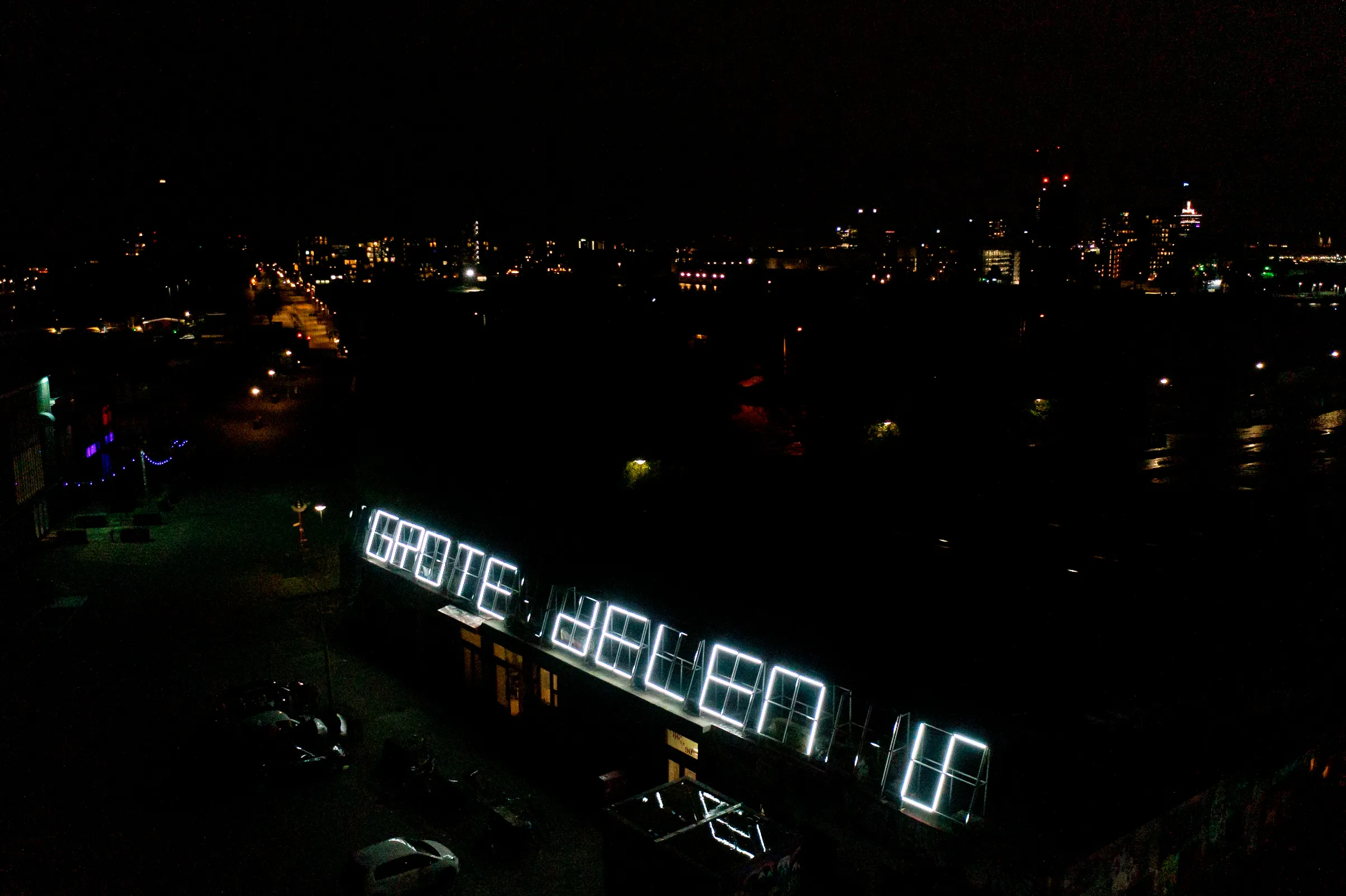
The new work 'The Great Indecision Council' will be located at the highest point of the Y slope for the coming months. Paris-born artist Romain Tardy is the brain behind the light and sound installation and visualises the most common online searches made by people in the region. The work immediately draws your attention because the abstract patterns and words alternately appear and disappear before your eyes, providing insight into the thoughts of Amsterdammers. We spoke to Tardy himself to find out more about it.
Can you tell us about the role that light and sound play in your work and what effect this has on the audience?
“Although I've been working with light and sound for years, I wouldn't consider myself a light or sound artist. I think one of my artistic goals is to create sensory environments that respond to a pre-existing context that can be physical, historical, or sociological. In this sense, light and sound, especially when combined, allow me to bring my own perishable landscape into public space, which mixes with light and sound that are already part of the environment.
I'm also inclined to regard light and sound as the most universal form of vibration imaginable, and even though this work uses language, the light and sound signals could also be seen as universal stimuli.”
The work The Great Indecision Council, shown at the NDSM, shows both abstract patterns and words. The previous times the installation was seen elsewhere, these words showed the most frequent Google searches in the country where the installation was located. How did you come up with this idea?
“Yes, that's how the installation usually works. To make it more location-specific to the NDSM, I've modified the algorithm for this version to combine the most popular words on Twitter in the Amsterdam region with the most accessed news nationally.
In fact, it's one step closer to my original idea: I wanted to reveal and reinforce what people really care about with this installation. My assumption is that what you look up on Google and Twitter when no one is watching you reflects your real thoughts in all their dimensions, and that's where the most trivial thoughts can meet conceptual or political content.”
The technical infrastructures behind the remote and wireless connections are huge and complex
What's the most surprising online search you've come across?
Part of the concept of this art installation is that I cannot know in advance what will be shown. For an artist, this loss of control is both stimulating and challenging. In addition, I can usually only ask local people to explain to me what the installation depicts, because I don't speak the language. This sometimes makes for very interesting interactions.
One story I can share about how I was surprised by a Google search was the time I showed this installation in France in the middle of the 2019 Yellow Vest protest period, when there were massive strikes across the country and many people were asking for the government to resign. It was very interesting to see that the installation amplified these voices. I think it really made sense as an art project in public spaces.
What do you find interesting about transferring the digital world into the physical realm and confronting the public with it?
I've never felt comfortable with the discourse where everything digital is presented as “non-material” (remember the words) cloud, air-something, wireless, light, smart and so on). The technical infrastructures behind the remote and wireless connections are huge and complex, and we are now also collectively beginning to realise how much energy they require. As an artist, my response is to make these structures visible: although I have a visual approach that is quite minimalistic, all technical structures and cables are visible in my work. Of course, the fact that I often work on a large scale is also part of that idea.
What do you think of the NDSM as a stage for your work?
I like that this temporary work takes place in such a vibrant artistic spot among other artworks — some official, some unofficial — because the area is also an important place for street art. I also see an interesting parallel in the different ways of using text: from graffiti to several previous neon works commissioned by Stichting NDSM-werf, where freedom of expression is a central part.
Interview with Cosimo Scotucci about his work 'STARS'
tekst:
Julia Lefeber
Sometimes you find a little bit of magic in a little corner and sometimes it meets you like a bright light in a dark sky. This is also the case at the shipyard where dozens of “stars” are now hovering under half the crane. Architect and artist Cosimo Scotucci brought his installation 'STARS' to the NDSM at the beginning of this month, creating a dreamscape full of wonder. This starry night consists of spheres that emit UV light to the surrounding trees. This gives them an extra boost that they urgently need in the stressful urban landscape. So 'STARS' is not only a magical installation, but also helps stimulate the ecosystem in an innovative way. With all his innovations and designs, Scotucci tries to imagine a better future and encourages people to reflect on it. We spoke to the designer to explain “STARS” even more.
The work 'STARS' that you are presenting at the NDSM not only looks like a beautiful shimmering starry sky, but also has a purpose. Can you tell us a bit more about how the idea for this installation came about?
We live in a very turbulent time; the climate crisis is the most threatening challenge for humans. As an artist and designer, I see it as a design assignment. Every morning I ask myself, “Is it possible to design a better world? Is it possible to invent a better future?”
My daily routine consists of experiments, tests, research, failures, and sometimes successes. 'STARS' was created during one of these days when I was experimenting with the beneficial effects of specific light waves on stressed plants. A stressed plant does not work as it should; too much stress can lead to permanent damage or even death to the tree. To achieve the global plan for atmospheric carbon sequestration, we need to heal and support the existing flora. Plants use the power of our nearest star for their metabolic process. 'STARS' replicates it, giving extra vitality to the surrounding landscape and at the same time transforming it into a dreamscape.
The light installation uses the solar radiation it is exposed to during the day and returns it at night. The bulbs show different shades that mimic the solar spectrum. Can you delve deeper into the stylistic choices such as the different sizes of the light bulbs?
It all started with understanding what part of the solar spectrum plants use for their metabolic processes and how they can capture and release it when it isn't supplied naturally. After deciphering the physics behind the process, I simply let the plants choose their favorite colors.
With 'STARS', I wanted to bring the sky a little closer to people, to make them feel part of the cosmos. When you look at the sky at night, some stars look brighter than others; some closer, some more brilliant. I wanted to bring all of this to Earth, recreate the beauty of a starry night and bring people among the stars.
In addition, with 'STARS', you ask the question: “is it possible to stimulate nature?” This work shows that there are ways to support the existing flora. What do you think we can do ourselves as individuals to stimulate nature, especially in an urban environment?
Everyone can actively contribute to a better future. We have a great opportunity to shape tomorrow's world today. Through our choices, we are the true designer of our own and collective future.
Dealing respectfully and thoughtfully with our choices — our daily choices — will already make the whole system better. Every thing counts right now.
Plants are highly sensitive to noise, light and pollution. If we think carefully about our carbon footprint, we can make the plants work at their best and create the basis for sustaining life on Earth as we know it, which for me is extremely beautiful.
Do you see this light installation as a message to give people a sense of hope about the future?
Absolutely. For centuries and millennia, humans have been following the stars to navigate safely across the dark oceans. Now, I'm hoping the stars can help us navigate through this threatening time of change. I really hope that the people who are watching or reading about the installation will come up with other solutions to make this a better place. We've just started a plan to combat climate change and we need everyone to fix it. I am a strong believer in people, in their ability to adapt and respond to threats, in their resilience, and in their imagination. What I like most is watching the people who stand just below the installation with their noses turned to the sky and find a private moment in the infinity of the sky.
What do you think of the NDSM as a rather industrial stage for your work that is more grey than green?
Honestly, I couldn't think of a better place for the project. It is indeed grey, but the greenery is still growing and it is our duty to make it healthy and lush. A place like the NDSM is a place where many factors can strain the plants, but it's also where we make the strongest statement. We're not letting greyness win, we're fighting. We are doing everything we can to succeed.
I think we've sent a message to the whole world. Even when the conditions are unfavorable and even when it seems impossible, there are always lights in our sky that we should chase. After all, we're all made of stardust.
click here to see more work by Cosimo Scotucci and click here to follow him on Instagram.
Credits and references
Lees
Interview with Cosimo Scotucci about his work 'STARS'
In 2022, the NDSM-werf Foundation organized the NDSM Light exhibition in which we asked artists to shine light literally and figuratively on (dis) exposed topics. One of those works was 'An-sisters [NDSM] ', a video installation by belit sağ (1980, Turkey, she/them), visual artist and teacher in Amsterdam.
'An-sisters [NDSM] 'connects and traces the stories and struggles of female migrant workers from Turkey through the generations. sağ interviewed several women for this work: a former textile worker talks about working at various locations in Amsterdam, including the NDSM in the late 80s, early 90s; her daughter reminisces about her mother's working life; an organizer/translator talks about co-ownership of a textile atelier here at NDSM in the late 1980s. In addition to the interviews, the film includes excerpts from archives such as Institute for Sound and Vision and a spoken word audio piece that is built from the interviews. 'An-sisters [NDSM] 'traces the materiality, precarity and invisibility of female migrant workers through the generations.
The entire installation as it was shown during the NDSM Light exhibition is no longer on display at the shipyard, but you can watch the film here.
By clicking “Accept all cookies”, you agree to the storage of cookies on your device to improve site navigation, analyze site usage, and assist with our marketing efforts. Check out our Privacy Policy for more information.




.avif)
.avif)
.avif)


.avif)




%20Manaf%20Halbouni-8.webp)


%20Manaf%20Halbouni-2.webp)
%20Manaf%20Halbouni-11.webp)
%20Manaf%20Halbouni-6.webp)
%20Manaf%20Halbouni-33.avif)
%20Manaf%20Halbouni-39.webp)
%20Manaf%20Halbouni-65.webp)


%204%20(1).avif)



.webp)
.webp)
.webp)




.webp)
.webp)
.webp)
.webp)


