A perfect spot for fresh air at 1.5 meters distance
This bench could be seen as a symbolic and poetic representation of the time, when we lived in a 1.5 meter long society as a result of the Covid-19 pandemic. It opened up opportunities for sustainable meetings with friends and family, as well as with strangers who could sit on the couch at the same time. It ensured that we were still able to meet at this exceptional time — even if it was from a distance.
The sofa was 2.5 metres wide, with a centre — exactly 1.5 metres — made of polished stainless steel. The intermediate part was invisible due to the mirror effect. Only the left and right sides of the sofa were clearly visible as seats. The reflection created a physical distance, but at the same time made the distance invisible.
Tuindorp Oostzaan was built 100 years ago, mainly as a garden village for the employees of the Nederlandsche Dock- en Scheepsbouw Maatschappij (NDSM). Raimond Wouda has spent the past 30 years capturing this part of Noord, which is visible in a publication and an exhibition at the city archives, and is now also shown on three billboards at the NDSM shipyard, near the source.
His mother and grandmother grew up there and he lived there for the first years of his life. Raimond Wouda about Tuindorp Oostzaan: “As I got older, my relationship with Tuindorp became more complex and ambivalent. It was a place that was both strange and familiar to me. I started taking pictures of the neighborhood and its residents to better understand what it meant to me. Tuindorp has become my most personal work.”
Inspired by the ideals of the English garden cities, the garden villages in Amsterdam were built, with Tuindorp Oostzaan being the first. Just behind the NDSM so that people could walk or cycle to work. Compared to the buildings on the other side of the IJ, the garden villages were given more space, gardens, squares and (cultural) facilities to serve as meeting places and create a sense of community. The close-knit community changed over time, the area expanded after the war, after which migrant workers and young families came to North. The most drastic change was, of course, the bankruptcy of the NDSM. As a result, the industry and other public functions such as the library slowly disappeared to a large extent.
The building boards now show a selection of photos that provide a glimpse into the larger story that Raimond has captured. A history of living and living in a changing city, a perspective on the community and surroundings of Tuindorp Oostzaan. The old obvious connection between Tuindorp Oostzaan and NDSM as a former shipyard, as a beacon in the district, no longer exists. However, it has been replaced by a new public and a so-called “cultural wharf”. The building signs reconnect the garden village and its residents and NDSM.
Raimond Wouda's photos are shown on the 'NDSM Billboards', with which Stichting NDSM-werf offers space for artists on large building boards: “In addition to the building signs on the western part of the NDSM, where construction is underway, we at NDSM-Oost give artists the opportunity to post their artistic statements on building boards. With its 10 hectares, the shipyard provides a wonderful background for large images in response to the context of the NDSM to make the work highly visible to Northerners and Amsterdammers,” says curator Petra Heck.
Credits and references
Raimond Wouda — Polder VIII, Tuindorp Oostzaan, Amsterdam 1921-2021, Thuis in de Stad. 100 jaar Tuindorp Oostzaan
The Tower of Babel project was a concept by artist Guido van der Werve. In his concept, Van der Werve took the Biblical story as a starting point. In this story, only one language was spoken on Earth and they collectively embraced the same idea: to build a city with a tower that would reach the sky. But God descended after this act of pride, made people all speak different languages, and spread everyone around the world. Because the people could no longer understand each other, construction was stopped.
What a contemporary Tower of Babel would look like, with just as many people as possible with different backgrounds, languages and voices, was what Guido van der Werve asked with this project. Stichting NDSM-werf and TAAK shaped this question in an architectural installation that expressed a certain polyphony of the city. The emphasis was precisely on the difference, the diversity and the (cultural) richness that lay therein. Watch a portrait of Guido van der Werve talking (in English) about the Tower of Babel and his art practice in the video:
WORKSHOPS
The polyphony also took shape in various specially developed workshops in which Amsterdammers and communities with different cultural, political, social or religious backgrounds of different ages participated. The starting point was how they thought about their ideal city and what values were important to them in it. The workshops were given by artists Fouad Lakbir, Tina Lenz, Mick La Rock, Olfa Ben Ali, Bengin Dawod, Rianne van Duin, Brendan Jan Walsh and Perrine Philomeen, who all worked from their own practice and discipline with themes such as ownership, visibility and storytelling and sharing.
The diverse “building blocks”, ideas and stories were translated into visual outcomes that were placed in the Tower between September 23, 2021 and storm Eunice in February 2022. There were banners, photos, a video, a sound system with stories, a Tower of Babel newspaper made by students at Klein Amsterdam primary school and a homemade brick wall that was incorporated into the tower. Brendan Jan Walsh rehearsed a libretto written by Guido van der Werve and performed on October 7 by the choir and the Promenade Orchestra, specially assembled for the tower. This is how the Tower of Babel became a metaphor for what the ideal polyphonic city could look like and what values and ideas were important to it.
For background stories about the Tower of Babel, check out the NDSM Online Magazine depot.
From May 5, 2022, Phase 2 of the Tower of Babel was visible: the tower was under construction, to indicate that it was still a work in progress. In addition to the videos and the libretto, there was a 3D sketch by Guido that illustrated how he wanted to see his ideal Tower of Babel finally realized: with a path where you could walk up and down endlessly. At that time, the path could be walked as a flat route.
The South African Artist Goldendean (Dean Hutton) made inflatable soft sculptures that depicted the contours of their own bodies. Especially for the NDSM shipyard, they created the 'Big Fat Trans Light MerQueer', a hybrid between man and sea monster that seemed to have crawled out of the IJ water — with tentacles. They were inspired by folk tales about sea-lake people, such as the “Mermaid of Edam” and “Mamlambo”, a serpent-like river goddess from South African and Xhosa mythology, who was often depicted as a mermaid. When they were captured, they allegedly brought prosperity.
Goldendean shared moments of gentle courage to affirm the right of all bodies to exist, be celebrated, and protected. They evoked tender feelings by deliberately pretending to be crazy and playful, sometimes a clown, sometimes a warrior, always vulnerable... Radically soft in an uncompromising world... A tenderqueer invested trust in an audience to respond kindly, to keep our bodies safe together, to give queer space, no matter how we sometimes failed each other.
Johannes Buttner: Free Energy II, Peak Panic
Location: waterfront near Pllek
In his sculptures, installations and videos, Johannes Büttner (Germany, 1985) addresses socio-economic themes such as energy, work in the digital age and power. In addition, he worked with people with diverse backgrounds: from mindset and business coaches and bakers to people from the “digital working class”.
Johannes Büttner showed sculptures that he made for Into Nature, an exhibition in Bargerveen, Drenthe, curated by Hans den Hartog Jager, where energy was key. Büttner's luminescent sculptures were battery-operated made of aluminum, magnesium and alum crystals. The story went that they recharged over and over again, so that these batteries would provide infinite energy. Büttner had the batteries designed by “free-energy engineers”, an online community that believed that environmentally friendly, sustainable and free energy sources had been around for a long time, but that they were hidden by large companies and governments out of self-interest. Somewhere between truth and fiction, (pseudo-) science and faith, and in response to the lack of opportunities to verify this, the work evoked alternative ways of imaging.
In addition, Johannes showed lightboxes with advertising-like photos of “survival hacks” for a post-apocalyptic scenario. How did you make light in times of crisis? Faced with a pandemic and climate change awareness, 2016's work was now seen differently. DIY creations and creativity to deal with new catastrophes seemed inevitable.
Alice Wong & Crys Leung: COHESION
Location: LOAD OUT
Alice Wong was a story designer. By showing how our perception of reality was constructed, she tried to turn complexity into understandable stories. For this project, she worked with Crys Leung, communication designer, who investigated the role of media and the relationship to identity in her work.
Alice and Crys revealed 'COHESION', a large-scale installation that connected fragmented elements on the NDSM. The reflective circle stood for unity and collectivity; one could all come together and become more than the individual parts. Because the total circle could not be understood from a single position in space, the work created an infinite number of perspectives, depending on the point of view. The process of interacting from different angles, heights and distances made it clear how people collectively shaped a shared reality, where no perspective should stand above the other. Visible and invisible, seen and unseen were all equally valuable.
There were wild animals at the NDSM shipyard in 2021!
Designer and Illustrator Luca Boscardin was one of the two winners of the Open Call launched in 2021 by Stichting NDSM-werf. His project Animal Factory consisted of minimalistic metal animals, such as a crocodile and a giraffe. The works invited you to sit on or climb up and thus played with the idea of the NDSM shipyard as an urban jungle.
Animal Factory was a collection of animals designed in a simple and abstract way, each maintaining the exact size and proportions of the real animals. The objects — a giraffe, gorilla, crocodile and wolf — were characterized by a minimal shape, made of metal tubes and a minimal use of color: each one was painted in a single shade to encourage passers-by to open their minds and let their imagination run wild. Where, from a certain angle, the steel structure did not seem to have a specific shape, the contours of a gorilla were clearly visible from another location. This is how the animals were surprises in the industrial landscape.
With the objects, Luca Boscardin hoped to encourage creativity and multifunctional use of the shipyard. For example, the gorilla could also serve as a play object, the giraffe may have been an alternative workout tool, and the crocodile was a suitable place for visitors to sit down with a cup of coffee. As a toy designer, Luca drew space rockets, fantasy creatures, imaginary characters and super-fast cars every day. Using the life-size metal animals, he gave shipyard visitors the space to use their own imagination and invited young and old to play, hang out or exercise.
Animal Factory was created with the help of steel carpenter Iwan Snel, who was also based at the NDSM shipyard. The entire project was designed and produced in the immediate vicinity of NDSM. Nowadays, they can be found on the west-side of NDSM next to the Noord-Dok building in a park.
When ADE was canceled due to the Corona pandemic, we came up with something else at NDSM
For this edition of ADE, Stichting NDSM-werf invited the art and activist group Tools for Action + Floor out to use their site as a public rehearsal space for RÆV REHEARSAL. They invited the audience to rehearse new forms of togetherness. With a Bluetooth speaker system, floating inflatable sculptures and a minimalist techno beat, they moved around the city like a radiant, dancing swarm. The streets became the club, the steps, roundabouts and benches acted as temporary stages.
RÆV REHEARSAL
RÆV REHEARSAL was initiated in Rotterdam in the summer of 2021 by visual artist Artúr van Balen, founder of Tools for Action, and choreographer Floor van Leeuwen. Every week, they rehearsed the dancing swarm in public space with a fixed group of twenty ravers, which in some editions grew to more than eighty people. After two massive editions of Unmute Us, the protest march for a more open event and night culture in Amsterdam, there was a strong need for people to come together, dance and have fun. By dancing, people were able to express their protest in a peaceful way.
Artúr van Balen, founder and artist at Tools for Action, explained: “Actually, this was intended as a new form of manifestation with the potential to become a protest. We used the rehearsal as a format because, from a legal perspective, it gave us the opportunity to meet with more than a hundred people in the open air, regardless of the changing corona rules.” Floor van Leeuwen added: “I saw the rehearsal as a way to practice collective movement together, coordinate, meet new people and even dance with people remotely, even when they were on their balconies.”
Swarms
RÆV REHEARSAL was based on the movement principles of swarms. Like a flock of birds, there was no central point or hierarchically organized movement; the direction was determined by the group as it moved. During each rehearsal, people had to move and dance about three meters apart. Based on these principles, the audience was invited to participate on October 15, 16 and 17 and to rehearse this collective movement together.
Music
RÆV REHEARSAL worked with a different DJ each time. As the swarm moved through public spaces, from iconic places to residential areas, the goal was to find sounds that resonated with the local environment or aroused curiosity. During previous editions, DJs performed such as Sukubratz, a Chilean DJ who combined techno with reggaeton, Cheb Runner, a Moroccan DJ who mixed electronic dance music with chaabi (a style of Moroccan folklore), and DJ Dance Divine, a queer artist from Brussels.
ADE
On October 15, 16 and 17, a group of up to a hundred people gathered at the NDSM shipyard to dance through Amsterdam-Noord. Various collectives, DJs and communities joined this initiative. The line-up was announced later. These were three unforgettable nights where a dancing swarm moved through the city, letting its heartbeat ring during the pandemic and activating spaces with bodies, music and light.
As an echo of the transformations in club culture, RÆV REHEARSAL highlighted the need to explore new forms of sociality and interrelationships by reclaiming and reprogramming public space.
In collaboration with Nieuw Dakota, Stichting NDSM-werf presented Public Air Filters by Anne-Jan Reijn at NDSM
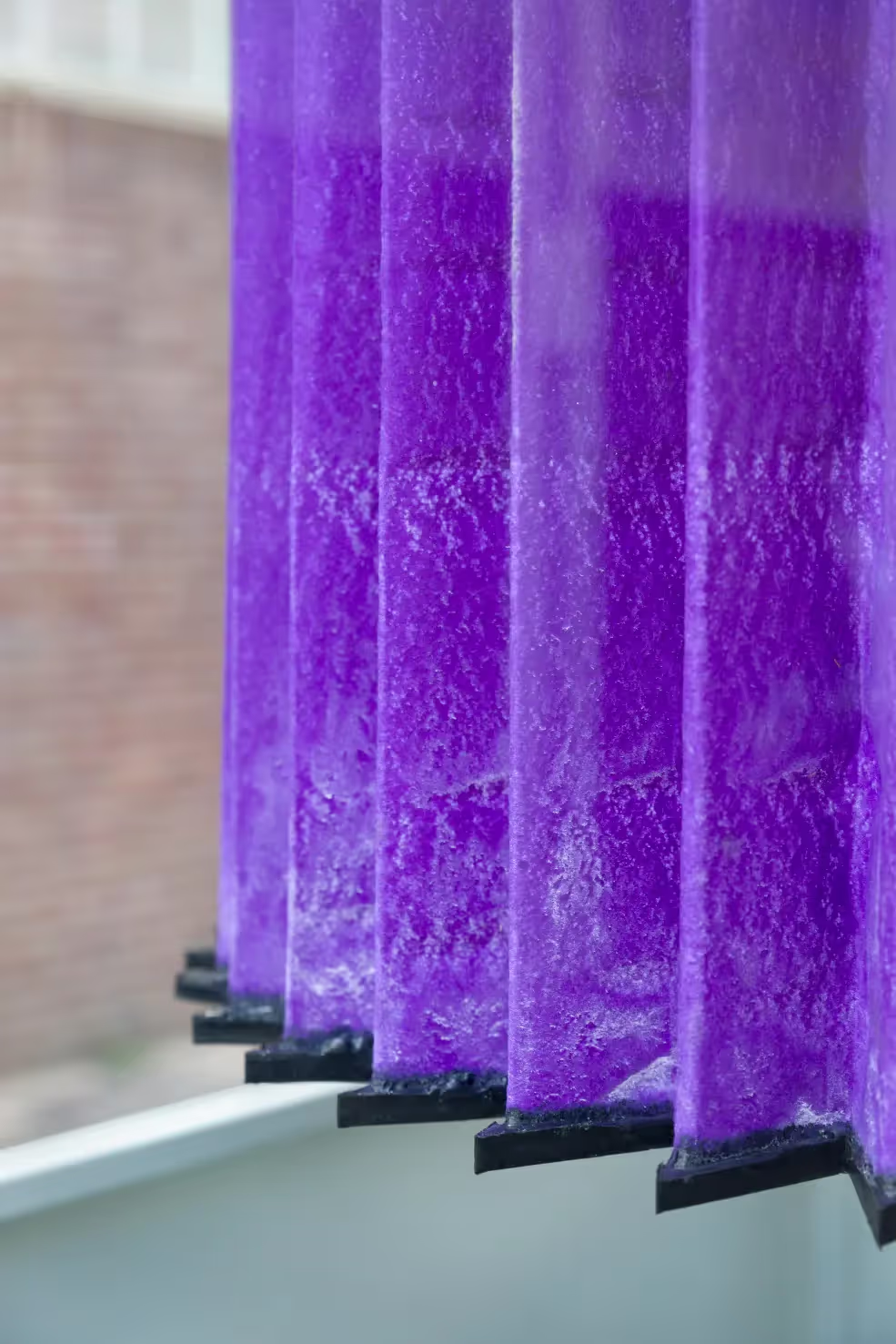
Public Air Filters was one of the two winning entries for the 2021 NDSM Open Call. For this work, artist proposed Anne-Jan Reijn the question is what actually happened in the outside air that we breathe. By filtering air in public spaces, a dichotomy automatically arose: filtered air and unfiltered air. This immediately raised a question: maybe the unfiltered air could not be trusted? The series of sculptures by Anne-Jan was on display between July and October and was changeable during this period. This slow process was, in fact, the essence of the work.
In theory, every cubic meter of filtered air left a residue on the outside of the filters. The artist wanted to play with this residue, creating an archaeology of air filter pollution, where a form of manipulation was allowed. What if that residue on the filters formed the most amazing colored crystals? Did that have a direct psychological effect, making the air we breathed, for example, undesirable or unpleasant? Reijn played with the idea of danger that we couldn't see. Invisible risks that were in the air, such as asbestos or a virus, were scary but could also evoke a form of awe. With this work, the artist offered a different perspective on this issue by materializing the invisible. “We were constantly connected to invisible matter — and therefore the risks — and we systematically tried to eliminate it. At the time, the relationship of trust we had with science and politics was under great pressure,” says Anne-Jan Reijn.
Under no circumstances did the artist claim that filtered air was safer than unfiltered air: “This was really a work of art that played with the idea of distinction.”
Also read the interview with Anne-Jan Reijn in the Digital Depot - Online Magazine.
Credits and references
Visuals: Robin van Dijk, Benjamin Kotek, Gert Jan van Rooij
In the spring of 2021, it was quieter than usual at the NDSM shipyard. This had everything to do with the Corona pandemic that gripped the entire country, and the whole world. Due to social safety restrictions, programming at the outdoor area of the NDSM shipyard was a challenge. Nevertheless, at the NDSM-werf Foundation, we looked for ways to make NDSM's public space as beautiful and accessible as possible, even though it was quieter than previous years during this period.
From this idea, the NDSM Yard Gardens came into being: 30 to 50 garden boxes where NDSM residents could use as a small piece of urban garden. All at least half a meter apart, so that users could garden while respecting social distancing”. It turned out to be a great success: all gardens were immediately used by residents, visitors, artists, neighbours, and some entrepreneurs at and around the NDSM shipyard. From early spring to autumn, flowers, vegetables and other plants were grown in the square between the Y slope and the Noorderlicht. Workshops were also given to small groups of gardeners and at the end of the season, a real NDSM garden community was created.
In 2021, the first expressions in the (Un)monumenting program series were published on NDSM, including on the NDSM Billboards
What should or could a monument be today, for whom, and who decides this? For their programme series (Un) Monumenting, Stichting NDSM-werf invited makers and artists to reflect on these questions by creating a (temporary) work at the shipyard. For (Un) Monumenting #1, the collective Frerara — Frederick Calmes, Raquel van Haver and Raul Balai — invited to make the Drawing Assignment 2020, which they realized for the Amsterdam City Archives, visible at the NDSM shipyard. (Un) monumenting #1 presented Frerara with images from “Breathing of the City”, which focused on understudied Amsterdammers and their stories.
From April 9, 2021, three construction boards at the shipyard showed drawings by Frerara, which they made as part of “Breathing of the City”. The collective saw the city as a “living organ that wakes up every morning and never sleeps in its entirety.” Especially at that precarious time, it became clear who had the luxury of being able to work from home, and who didn't. Cleaners, sex workers, bus drivers; diverse characters starred in the drawings that portrayed, fascinated or embodied the three artists separately. At the building signs, visitors were able to listen to audio clips about the images and/or the people portrayed with their smartphones. The three artists brought together themes such as the archive, transition, art and culture and the city's signature in their work. To do this, they investigated the residents of the city of Amsterdam and specifically into continuing the tradition of keeping the city alive as a ritual. For example, with the drawings, they showed a different face of Amsterdam and created a temporary 'monument' for a number of understudied townspeople. On April 9, not only did the presentation start at the NDSM shipyard, but Frederick, Raul and Raquel also physically handed over the drawings to the City Archives for inclusion. The collection of drawings was published by the City Archives in three separate zines, which could be viewed and purchased, and they worked towards a fine publication that year. What was special was that the topic “Breathing of the City” was submitted by Frerara to the City Archives even before the coronavirus pandemic, and it had only gained in urgency since then.
Continuation of (Un)monumenting
The global conversation about monuments meant that the Foundation used this moment to bring the shipyard's history more to the surface. What could a memorial be, mean, and who had a say in it? And asking who deserved to be present in public spaces and who felt represented (and who didn't)? Based on the wish of the NDSM-werf Foundation for a polyphonic public space, the foundation commissioned several artists to give their views on this on the shipyard. The (Un)monumenting project consisted of several episodes: for each chapter, the foundation invited one or more artists to reflect on the theme of 'monuments' of the future. At that time, work was underway on (Un)monumenting #2, a video work by Turkish-Dutch artist Belit Sağ, in which she highlighted the invisible history of the NDSM shipyard. In the video, a collaboration with the Institute for Sound and Vision, Belit Sağ investigated the role of female Turkish migrant workers at the shipyard using archival material.
An exhibition with an audiowalk that took place in the future
Plastic Hypersea is was an interactive, site-specific work by an artist Sissel Marie Tonn commissioned by Sonic Acts and was experienced at the NDSM shipyard in Amsterdam.
Set in 2099, Plastic Hypersea was a guided, spatial and interactive experience that speculated on a possible future in immunology, merged with the topic of environmental health. As listeners explored the terrain, they were invited to imagine the environment as an extension of their immune system and to consider the many ways their bodies intertwined with microplastics in the sediments of Amsterdam's waterways. Ultimately, Plastic Hypersea asked listeners to leave behind the war metaphors that haunted immunology and to think about a more expansive sense of self.
Produced in collaboration with musician Vincenzo Acquaria Castellana and sound and recording artist BJ Nilsen, the localized sound experience was complemented by custom boat sails and ceramic sculptures created by Sissel that acted as “membranes” encoded with material and immaterial data about the hydrophobic, industrial waste that flowed through the waters of the Netherlands.
About the artist
Sissel Marie Tonn was a Danish artist based in The Hague. Her practice focused on the shifts in perception that occurred when people became entangled in their surroundings, blurring the boundaries between body and environment. Her artistic research often resulted in interactive, sensory installations.
Plastic Hypersea was built on Echoes, an interactive GPS-enabled mobile app for audio walks. To access the work, you had to download the app from the App Store or Google Play. They then put on headphones and wandered around the area of the NDSM shipyard while following the sails and ceramic sculptures. The gradual unfolding of the work was activated while walking and exploring the environment.
SEXYLAND was an art project in the form of a temporary society. For 365 days, the club had a new owner every day. He was able to implement the program as he wished, ranging from art expressions to sporting events, from gangster rap to stroboscopic light dinners. SEXYLAND was a tabula rasa that could be described in any way. SEXYLAND strived to mark every unknown corner of Amsterdam and show the enormous diversity the city had to offer.
In 2021, Sexyland moved from the NDSM shipyard to the other side of Amsterdam-Noord under the name: Sexyland World. As part of Sexyland's departure, we spoke with stakeholders Aukje Dekker and Samira Ben Messaoud in a podcast episode of NDSM X. Listen to it below.
On the way to school or work, kissing behind a corner of a building, sprinting to the ferry, giggling from a car, chewing gum on the ground, fishing in the dock: daily activities at the NDSM shipyard. In NDSM Nursery Square, a project by Studio Makkink & Bey they looked at daily activities at the NDSM shipyard asking how they could reprogram them through cultural activities.
From October 2019, there was a temporary square to visit where there was space to intervene with a flexible infrastructure and influence the behavior in the shipyard's public space. The square therefore never looked the same, moved with its visitors and was sometimes coloured by artists in residence. For example, park furniture could be borrowed and there were singers and artists who sang to the sailors during rush hour in September.
Artist Antoine Guay built a bread oven in a container, after which the bread baked therein was distributed to visitors on a number of Saturdays in exchange for a nice gesture or action. City poet Gershwin Bonevacia spent a while at Nursery Square as a “poet-in-residence”. A documentary was also shown in the Nursery Square of Nina Swaeny Cherry. And because this was also a public square, by and for Amsterdammers, designer Jurgen Bey and curator Jules van den Langenberg also invited local residents and parties at the shipyard to make their own programming proposals.
This week is National Second Hand Textile Week (April 20 to 27, 2021). I couldn't let this pass me by without highlighting my (and probably many others) favorite spot for second-hand items, but especially clothing: the IJ-Hallen.
Not only is it the largest organized flea market in Europe, it's also a place to get inspired and enjoy the unique atmosphere. The IJ-Halls are part of the identity of the NDSM shipyard, a good reason to look back and forward during this special week in these corona times.
I remember it like it was yesterday, the first time I set foot in Amsterdam-Noord. With a friend, I traveled north from the Betuwe for two hours to visit the IJ-Hallen. For two girls from a farming village, it was an incredibly impressive experience. It was also the moment when I fell in love with Amsterdam, a few from which I never really escaped. In addition to the impressive structure of the market on the NDSM site outside and inside the warehouse, there was also a typical “IJ-hallen atmosphere”: welcoming, warm and curious. Something you don't experience like that anywhere else and is almost impossible to describe in words. After that first time, the monthly trip to Amsterdam-Noord had become a regular occurrence. Weekend after weekend, I strolled through the stalls, finding out over and over again that I could really use a new sweater, pants or pair of shoes.
I'm not the only one who looks back on long afternoons by the stalls with a certain sense of nostalgia. If you venture into the IJ-Hallen review page, you'll be overwhelmed by unique stories from visitors, from Amsterdam and beyond. About how they found their new showpiece for the living room or their new solid wood dining table they've been looking for so long. In addition to being a place to buy or sell new acquisitions, the IJ-Hallen are also a meeting place. There's nothing like taking a seat on the Y-slope with fries, next to you is a bag filled with new additions while you chat with a fellow visitor who has also settled down.
It's really fun to find people's extraordinary stories at the IJ-Hallen
Undoubtedly, many connections, friendships and most likely also loves have arisen on the sacred ground of the IJ-Hallen. As a visitor, you also get a fascinating glimpse into the lives of sellers at the IJ-Hallen, who, by displaying their contents or wardrobe, give a glimpse into their style and what they once loved but have now decided to say goodbye to. Hiring for a fine-knit sweater, you'll find out how much you have in common with the salesman at the other end of the stall.
Besides the fact that the IJ-Hallen have an enormous emotional value, buying second-hand textiles and other items is also good for the world. Indeed, the textile industry is a huge one. polluter and responsible for 10% of total global CO2 emissions. Just to be clear, this is more than all international flights and all commercial sea transport combined. The production and processing of clothing, footwear and home textiles also cause water pollution and landfills: landfills of waste in the ground that then sinks into the soil. And we haven't even talked about the human rights violation from some clothing companies in developing countries. In short: buying a little more second-hand can have a huge impact on the world and with a place like the IJ-Hallen, it can also make a fantastic impression on yourself.
As a visitor, you also get a fascinating glimpse into the lives of sellers at the IJ-Hallen
Unfortunately, we weren't able to enjoy the stalls very often last year and it all had to be in a much smaller form.. This had everything to do with the situation surrounding corona and the measures taken to prevent the rising infections. “I hope we can open safely again soon,” says Nichon Glerum, the photographer of the IJ-Hallen for 6 years, when I ask her how she feels about the market in a phone conversation. “It's really a great event. Every time, the stories are there for grabs; together with the photogenic warehouse and NDSM site, this really creates a unique atmosphere. It's really fun to find out people's extraordinary stories and the reasons why they buy or sell things. It's really fun playing a shop.” Nichon's enthusiasm can be felt over the phone. When I ask her about the future, she lets out a sigh. “I really miss the IJ-Hallen,” she says, “as soon as the government gets the green light, we want to go full throttle again. We have a lot of great plans to make the market even more special.”
Don't miss out on the IJ-Hallen and the potential next market when we are allowed again? Watch here the website or click here to stay up to date via social media.
Text and performance: Omar Dahmani, director: Eric Seleky, camera and edit: Ran Govaars
The NDSM-werf Foundation, in cooperation with the shipyard's cultural partners, asked Omar Dahmani to write a poem in honor of 5 May about freedom and solidarity, two concepts that have taken on an even broader meaning in these times. The poem was designed and printed by Grafische Werkplaats Amsterdam and donated meal soups to the Cordaan Foundation (@cordaan_ams) along with May 5. Omar Dahmani recited the poem at the NDSM shipyard, portrayed by Ran Govaars, artist with a studio in NDSM Treehouse. The poem can be read below.
Free from God
when neon lights dim and the song closes so that only hopeful slogans resound through a grim demonstration
a railway car is being painted sleeping in the draw stammers the penniless street musician
then you will see with your ears what your mind doesn't believe
until we bite we are prey only fold your hands in case of a storm suddenly thankful just after loss
then you will see with your ears what your mind doesn't believe because he doesn't believe in people
Well yes Wel believes there is something
but what exactly no one knows
Made possible in part by @4en5meiamsterdam and the shipyard's cultural partners: @Nieuw Dakota, @Straat, @Beautiful .Distress, @GWA Grafische Werkplaats Amsterdam, @Ndsm -fuse, @MACA, @OverhetIJproducties and @Treehouse .NDSM.
Credits and references
Text and performance: Omar Dahmani, director: Eric Seleky, camera and edit: Ran Govaars
A final round of honor for the Museum of Undeboiled Art
tekst:
Robin van Dijk
With the Museum of Unintentional Art (MOK) coming to an end at NDSM, we asked Willem Dieleman, one of the founders of the MOK, to contribute to our online magazine as guest editor. A tribute, an honorary parade and a standing ovation as a farewell and review of the past few months of the MOK at NDSM.
Text: Willem Dieleman Are you ready? I'm counting to three. One. Two. Three... four? Five. Six?! Seven! Seven months and seven opening announcements, it took us with the Museum of Unintentional Art (MOK) were allowed to open. Seven is a symbolic number that the MOK would normally go very well with. Three days later or forty hours of delay had also had symbolism that we could rely on. In any case, we can count ourselves lucky that it has not been canceled six times. How should I have told this story then.
Storytelling is what we love to do at the Museum of Unintentional Art, preferably with objects that everyone just walks by. Because of these stories, people stand still and look at their surroundings differently. The NDSM-werf Foundation also thought it was a good idea to curate unintended art in addition to all “regular” art. We won the NDSM Open Call 2020, which required the entry to be corona-proof. November 7 (there's that number again) was our official opening. We had chilled the champagne, flew in speakers, decorated the room with fringes and balloons. We were ready to start. However, the Tuesday before, the “press conference of death” came. Wouldn't corona have blown over on December 20? No, not anyway. When things seemed to be getting better, everyone went out, but we weren't allowed to encourage anyone to actually do that. When the sports clubs were allowed to engage in self-flagellation en masse and people were allowed to queue for hours before Primark, we decided to start the race ourselves.
I sent a festive announcement that we nought would organize and that, if you were in the area, you were definitely not supposed to be present at the NDSM Square at 3 p.m. I just emphasized: “stay inside, we won't organize anything!” It was a watertight plan if I hadn't had to self-quarantine the day before.
April 28, 2021: terraces open We open. Really now. However, there are other factors to take into account, such as the weather. You would almost forget that that was once a topic of conversation even when you had nothing to say. The weather. Someone should make it a good drama series with the title May 2021. Our work was corona-proof, which means, among other things: outside. And in probably the wettest May since 1983, “outside” was a suboptimal place to take an accidental art tour.
It must have been good for something. That's what people tell victims to comfort them, that all that suffering was not for nothing. For us, it was indeed a year that taught us a lot, especially cancellation. I've also become incredibly good at writing off-the-shelf emails, dealing with disappointment, patience, and acceptance. And, of course, not to walk in seven locks at the same time. Some people stay in Tibet for seven years before that. We were just trying to open a modest, coronaproof, unintended art exhibition.
Despite all the previous suffering, we have done a number of wonderful tours (I even think 7, but now that point has been made, someone will add another conspiracy theory to it). There were beautiful works among them, they are still there by the way: the tour can still be run independently and you can also take a live tour with our director Gilad Bino Jr. Walvic books. He takes you through the collection and after the tour, you will never look at the surroundings the same way again. A participant said after the tour: I thought it was very beautiful and incredibly funny, but I didn't know if I could laugh. She had a good point there. Art is not meant to be laughed about and certainly not accidental art. The more seriously you take it, the funnier it gets. If you want to laugh, go to the Stedelijk. At least they have signs that say: you can laugh at this work.
The MOK can be visited at the NDSM wharf until the last weekend of June. Click the button below for more information about how to do your museum tour by yourself, or how to book a guided tour
Credits and references
Lees
A final round of honor for the Museum of Undeboiled Art
Interview: Sijben Rosa about Not Forever before (Un) monumenting
tekst:
Robin van Dijk
On June 25, 2021, Sijben Rosa launched her work Not Forever at the NDSM shipyard as part of (Un) monumenting #2. We talked to her about her work and her vision of what monuments (in her opinion should or could) be in the context of art in public space.
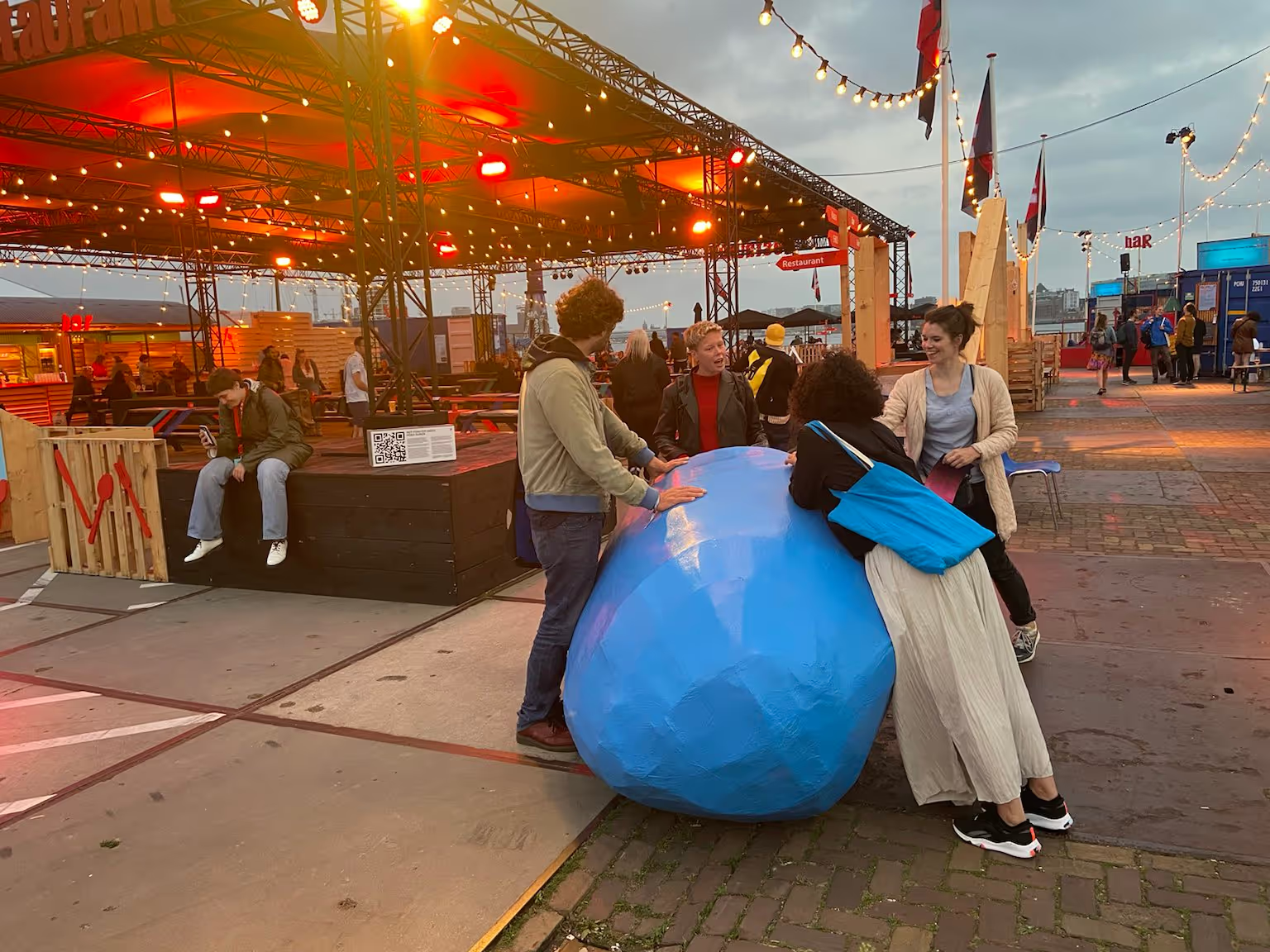
The exhibition series (Un) monumenting is about the concept of monuments today and what they should be, and who decides that. In this context, tries Rosa with Not Forever to make the versatile soul of the NDSM shipyard tangible with a large ambiguous object. The object will roam the NDSM shipyard for the next two months, each time under the care of a different shipyard user, while laden with that person's conviction about what the soul of the NDSM shipyard is.
On a sunny day, I meet Rosa in her workshop in East Amsterdam. This is an incubator in a former school building where several artists house their studio or studio. We take a seat on the building's sunny roof terrace and start talking about her work.
Rosa, when Stichting NDSM-werf asked you to make a work for (Un) monumenting, what went through your head and how did the idea of this work come about? How did NDSM end up in your work?
“I think the question from Stichting NDSM-werf came partly because I was involved in organizing a demonstration in Hoorn, where I grew up, against a monument by Jan Pieterszoon Coen that is in public space. I find it scandalous that that statue is still there and that it takes so long to remove it, if it is ever removed at all. So I've been working on the concept of monuments and who should be represented in public spaces for a while now. In addition, I have made work in public spaces in the past, for example my work Demo and Things you know, which makes me think I've ended up on the radar of the NDSM-werf Foundation. Then the Foundation asked if I could do something with the idea of a monument at the NDSM shipyard. Not so much to make a monument but to respond to the idea of monuments. At first, I found that very difficult for various reasons. First, De NDSM wharf is so big and expansive that everything you put in it has a great chance of disappearing. Secondly, the NDSM shipyard has been inhabited by artists for quite some time and so much has been done there. Each spot has been used to show something so many times that I also found it difficult to relate to it at first.”
“That's when I started thinking about what form this work should have,” Rosa continues, “I like to leave my work in the middle of the world. I sometimes find it easier to show something at a construction site than in a museum, while in a museum, something gets a lot of attention. But on a construction site, there is much more of a context that you can use and respond to, making your work even more meaningful. It is this interaction that I often find interesting; I even like it to have a bit of a clash or to reveal the weirdness of art: the contradiction between a very practical, functional, direct reality and what art is.
Want to give firm shape to something that is elusive, that could represent the soul of the NDSM shipyard.
But art itself is also something very basic at the same time. Even in a museum, it's still a lot of weight that needs to be brought to that place. It's those aspects that I often really like about art because they're actually all just things. We sometimes have that tendency to forget the “thingness of art” with ourselves. We often only see ourselves as a subject, as something that has symbolic value and not as something that only takes up space, as an object or a thing. That idea fascinates me; if you were to completely disassemble a painting in a museum, you wouldn't find one piece that had the value of the work. Just like if you were to completely dissect a person, you won't find one piece that contains the soul or identity, it's in your whole being.”
So how did you end up with this object?
“What I love about monuments is that they make something you cherish together into something material and tangible. So the idea for this work is also about wanting to give permanent shape to something that is elusive, which could represent the soul of the NDSM shipyard. Which you can also easily make a topic of conversation with it. When there is a discussion about a statue in Hoorn, it is not only about that statue, of course, but also about what that statue represents, it makes the subject concrete. If you were to ask me what topic makes this work concrete? Then that's what the NDSM shipyard is at the moment, and if we continue in the same way, there won't be any more very soon.
It's about caring, and that you have to do that together, caring for a place
I am talking about climate change, among other things, but also about the fact that gentrification is knocking at the door and that the NDSM shipyard may be further commercialized and there will be less and less space for art. That's why I have the job Not Forever mentioned, also in response to a nice quote by Sasha Pevak (curator and artist ed.): 'The monument becomes visible only when it is removed'.
“What I also wanted in it,” Rosa continues, “is that it's about caring, and that you have to do that together, caring for a place. So because the object is so big and you can't move it alone, care providers always need several people to move it in and out or to a new place. Exactly those stupid practical consequences, I think that's what the artwork will be in. I think that's where the moment I'm looking for comes in. Provoking interaction, dialogue and stumbling. The intention is that each caretaker of the object gives their own interpretation, giving the object value. The work will be launched on June 25, but I think in a way it's not there yet. The object is there, but just over the next two months, all the experiences it experiences will gather in the object, which is what together becomes what I want it to be.”
You also included the aspect of transience in your choice of materials, can you tell us more about that?
“Certainly, in addition to the fact that it fits the concept of this work, I also think that, as artists, we should take responsibility for what materials we choose for our works of art. Especially for a temporary work like this, I think it's important to focus on what kind of materials I might be able to reuse from other works and what materials have the least impact on the environment. Definitely a job like Not Forever, which, of course, is also partly about climate change, I would find it hypocritical to throw a whole mountain of plastic on the table myself. That is why I chose to use materials from the recently demolished building of Sexyland. I do like the fact that there is also literally a part of the NDSM shipyard in it. Of course, that's not just because of Sexyland, but also because of what that building used to be.”
“What I'm not sure yet is what to do with the boulder after the two months that the work has been active. What reassures me is that all the material I used for it, including the screws, are all things that were already waste before it became this object. That soothes my conscience somewhat. I'm also curious what it is then, what it has become in meaning. I think the final destination also depends on what the collective idea makes of the object.”
Rosa, how do you see art in public spaces, what makes it different from art in a museum or “inside”?
“The main difference is that you didn't ask to see art in public spaces, that's something you're confronted with whether you like it or not. That's what I really like about art in the public space, it also integrates more into daily life than much other art. There is a certain piece of art that I see on my way home every day, and every day I look at it differently depending on my own state of life and state of mind at that moment. It changes shape because my mind changes and time goes by. This can also happen with monuments, just look at Jan Pieterszoon Coen, public opinion is changing (although there have always been protests against the statue), while the thing itself still looks exactly the same. When something is in a museum, it is also viewed differently. That's what I find interesting, how space and time influence the way we look at something.”
“By the way, it's not just that art is subject to the influence of public space,” Rosa continues, “but it can also be the catalyst that starts or starts a conversation. In the ideal situation, work is not only subject to external circumstances, but can also influence those conditions.”
Do you want to know more about Sijben Rosa and her work? Then check here her website. (Un) monumenting continues! In addition to the already visible work Breathing the City by artist collective Frerara on the NDSM Billboards, is also the third edition of this exhibition series in the making. Don't miss anything? Follow the NDSM-werf Foundation on our socials!
Credits and references
Lees
Interview: Sijben Rosa about Not Forever before (Un) monumenting
From 1 to 12 July 2021, a theater performance called Fire Play will ignite in Treehouse. Created by young makers Tinka Bruneau (18) and Zenzi Gil Hogenboom (19), this is the perfect warm-up for the upcoming Over Het IJ theater festival at the NDSM wharf. We talked to Tinka and Zenzi about their production and how they ended up at the shipyard.
Tinka and Zenzi are both fresh out of high school and initially ended up at the NDSM shipyard with their face mask company. Meanwhile, they moved to the east wing in the NDSM Loods where they came into contact with NDSM Fuse and the artists from the City of Art, among others. “That's when we actually thought, why don't we do something creative?” says Tinka, “there is Fireplay hatched. It's the first major project for both of us, and I also call myself a starting cultural entrepreneur.”
“We've both always been into theater,” Zenzi adds, “for me, there has gradually been an increasing interest in the production side. I really directed a play for the first time two years ago, I really liked that. Unfortunately, that production had to be cut off due to corona.”
“We work really well together, we're really a collaborative idea machine,” Zenzi continues, “we call that a “hivemind”. Then we came to the idea that we wanted to make a dialogue, i.e. a play with two people. Precisely because that way, we were also able to keep it small if necessary due to the pandemic. Actually, it's only been a few weeks that we've been handing things over. Suddenly, we have actors and a production assistant, etc. It's like watching your baby grow up.” Tinka nods in agreement. “Indeed, it has suddenly become bigger than us alone,” she says, “it's also a great way to get to know people at the NDSM shipyard and see how everyone thinks along with you and wants to help you where possible. For example, we initially wanted to play the piece in public spaces, but then ended up with Treehouse as they have more facilities and experience in this area. They were immediately enthusiastic as they also played a bit of a role on site by helping young, beginning makers. That's how the ball started rolling”
Next, the two young theater makers tell us a bit more about where Fireplay is about content. “The idea originates from the concept of cyclicity,” Zenzi begins, “the idea that everything in nature is not just progress but a cycle of phenomena that recur all the time. If you are in that cycle, you may not fully realize that the moment you are sitting in is a repetition of what once happened in a certain way. For example, the end of a relationship is often seen as a tragic end to a good time, while it can also be the beginning of something new.”
“From this concept, we started with the idea of dialogue,” Tinka continues, “we wanted to fully build two people in the play and explore how their personalities, experiences and habits interrelated. In it, we try to make a story that does not have a beginning and an end, but is a cycle.”
“The characters in the play are named Daan and Doris,” Zenzi continues, “these are two girls who have been in a relationship for a few years and are both very present people in different ways. In their dealings with each other, a lot has gone under the rug over the years and it all comes up in one evening.” “That then inflames a heated conversation,” Tinka adds, “the play shows how the history of both characters influences their behavior and how that can sometimes be a bit awkward between two people. In the play, these interactions are juxtaposed with natural cyclicality (think behavioral patterns that you adopted from your parents), shedding light on the relationship between two people that the audience has hopefully not seen before.”
In our conversation, I notice Zenzi and Tinka's passion and energy as they're about Fireplay talk. They have used and expanded their entire network to make this production and there is a great sense of professionalism. “The proverb”no you have and yes you can get ' is very true,” says Tinka when I ask what the biggest lesson they take away from this adventure is. “With so many aspects of this production, it has been a matter of daring to ask.” “We were on top of it all,” says Zenzi, “which really makes it a personal production, we were there for the fun and not so fun jobs, but that's also the great thing about such a project, I think.”
It promises to be a spectacular show series full of intrigue and plot twists you didn't see coming. In combination with Treehouse's artistic atmosphere, Fireplay one to put on your agenda. Bring plenty of water, because we can't guarantee that it won't get a little hot underfoot! It's also a great opportunity to get to know the creativity of young makers at NDSM and support them after a bummer when it comes to stage art.
Next, the two young theater makers tell us a bit more about where Fireplay is about content. “The idea originates from the concept of cyclicity,” Zenzi begins, “the idea that everything in nature is not just progress but a cycle of phenomena that recur all the time. If you are in that cycle, you may not fully realize that the moment you are sitting in is a repetition of what once happened in a certain way. For example, the end of a relationship is often seen as a tragic end to a good time, while it can also be the beginning of something new.”
“From this concept, we started with the idea of dialogue,” Tinka continues, “we wanted to fully build two people in the play and explore how their personalities, experiences and habits interrelated. In it, we try to make a story that does not have a beginning and an end, but is a cycle.”
“The characters in the play are named Daan and Doris,” Zenzi continues, “these are two girls who have been in a relationship for a few years and are both very present people in different ways. In their dealings with each other, a lot has gone under the rug over the years and it all comes up in one evening.” “That then inflames a heated conversation,” Tinka adds, “the play shows how the history of both characters influences their behavior and how that can sometimes be a bit awkward between two people. In the play, these interactions are juxtaposed with natural cyclicality (think behavioral patterns that you adopted from your parents), shedding light on the relationship between two people that the audience has hopefully not seen before.”
Interview: Anne-Jan Reijn about his work Public Air Filters
tekst:
Robin van Dijk
Anne-Jan Reijn, one of the winners of the NDSM Open Call 2021, launched his work Public Air Filters on July 11, 2021. We talked to him about the installation and his vision of the artwork.
I meet Anne-Jan at his studio in Make Community Hope in Zaandam. As we walk around inside, I can't help but draw a comparison with the city of art: the studios are at multiple height levels and are all unique. Since it is a remarkably hot afternoon, we decide to have our conversation outside. As we sit under two large oaks on the water behind the breeding ground, we start talking.
Anne-Jan, you won the Open Call 2021 by Stichting NDSM-werf. Can you tell us a bit more about how the idea of Public Air Filters came about and why you decided to submit it to the Open Call?
“Yes, of course, Public Air Filters is linked to an exhibition that I'm going to do in New Dakota later this year called Asbestos The Magic Mineral. The exhibition uses Asbestos as a catalyst or case study to tell a story about dangers that we cannot see with the naked eye. When I was designing the exhibition in collaboration with New Dakota, we thought it would be nice to draw a line outwards, since the subject is about air. So we sent Public Air Filters in for the Open Call, to add another layer to the exhibition, a layer that takes place outdoors on the shipyard.”
We have the idea that we should be able to exert a certain influence on certain conditions of nature.
“Almost all my work has been about risk and anxiety for years, especially about the difference between real fear and unreal fear. When I started thinking about this work, I thought Asbestos was a sensational topic, and it originated at a time when we were even more hysterical about it than we are now. At one point, for example, there was an evacuation of a residential neighborhood in Utrecht, because a small amount of asbestos may have been released somewhere. My tendency back then was to think that was a severely exaggerated reaction, but I did find that hysteria fascinating. We walk among cars tearing by day in and day out, but when a tiny amount of asbestos is released, all alarm bells go off. Not that that is unjustified per se, but of course there is a kind of selection mechanism, which intrigues me. That's how the idea to make a work about an 'invisible enemy' started developing.”
“What I find interesting about things that we can't see is, because you can't see it and you can't measure it yourself, interesting social structures automatically arise. The danger must be framed and flagged by an authority. This is usually done by the government on the advice of science. As a citizen, this immediately puts you in front of the question: to what extent do I trust science and in the authority that transmits the message or result of science? I find that trust issue that then arises interesting, it is often also conflictual and wonderful to poke in.”
The location of the NDSM is certainly an interesting one because you can imagine that there is a kind of special sky there.
“This also includes a comparison with what we have experienced with an invisible enemy over the past year; in that sense, current events have overtaken this project. When that news developed last year, I found it, in addition to being very worrying, partly also a bit of a treat. I find these kinds of very intense socially charged issues about dangers and risks, especially so involved in daily life, the most interesting. What I'm mainly working on with my work and soon with the exhibition in New Dakota is framing that invisible enemy, but in the context of air quality. With my work, I put a frame and a mark on pieces of air so that a value can then be attached to those pieces of air: is the filtered air better than the unfiltered air, and can the unfiltered air still be trusted?”
Can you tell us a bit more about the message behind framing air in public spaces and the visitor's assessment of air quality at NDSM?
“Absolutely, let one thing be clear, it's not my goal to scare the visitors to NDSM about the quality of the air they breathe on site. When you talk about framing air, I think the powerful gesture of my work is that I offer filtered air to people. As a result, all other air is framed as unfiltered air at once. What does that do to people's perceptions of where they walk and what they breathe there? So basically, the work lies in the perception of the environment of people that you generate by offering filtered air. However, it is and remains a work of art, which essentially says nothing concrete about the actual air quality that ends up in the lungs of people walking by.”
Breathing in all at once becomes a kind of extravagant adventure
“The more underlying meaning of the work has to do with what place people occupy in the nature around us. I think that, as humans, we are very inclined to think that we are separate from nature and our environment. In our opinion, it is our body vs. what happens outside our body. While that, of course, is not entirely correct with how our body actually functions, because there are many organisms that are needed to keep our body running, that come from the world around us. I hope that people will become more aware of the interaction with us and nature when they look at my work. In addition to invisible enemies, there are also invisible necessities that are found in nature around us.”
“In addition to the conceptual part of my work, there is also an aspect of experience. It balances on and over the edges of fiction and non-fiction; visitors cannot find out for themselves whether air is really being filtered or not. In addition, a system is at work that exploits and manipulates the idea of a visible residue created by invisible particles in the air. By working with that residue, it is pulled over the top so much that breathing in at once becomes a kind of extravagant adventure where you see and take in all the pink, yellow and shiny growing fabrics. Something that is very normal in daily life, namely breathing in and out, suddenly becomes an experience. It takes on a kind of fictitious adventurous quality all at once. That game that occurs between what really happens and what the installation insinuates, what happens is an important part of this work.”
When I read your plan and started thinking about air quality in that context, I made a link to industrialization, does the industrial past of the NDSM shipyard play a role in the work?
“The location of the NDSM is certainly an interesting one because you can imagine that there is a kind of special sky there. The image of the former industry is still fresh in the collective memory, but must now also make way for the image of a residential area. That's what I want with Public air filters hang out a bit in between. Because more and more homes are being built at the NDSM shipyard, that also means that the sky is changing. Or is the air of the industrialization that existed then still to be found? And now we're still talking about the 'outside' of NDSM. I can imagine that the air quality in the NDSM Loods is even more influenced by the former industry at the moment. In a hall like that, on a floor where a lot of work has been done with heavy metals and toxic substances, you can't get rid of that with a vacuum cleaner. Of course, the question is whether these are quantities that you should worry about, but it is important to be aware of. That's actually the same contrast as what I'm trying to clarify in my work: we call the NDSM shipyard both inside the warehouse and outside the warehouse, but there is a difference in air quality. The same difference when it comes to my work with the unfiltered air and the filtered air in the outdoor area.”
“I do think it would be healthy if we looked for an alternative to the zero-risk image that is being raised in Western democracies, because that image is an illusion. We got the idea that we, as humans, have the right to have no risk, and nowadays many promises are being made and systems are being built around that. We're constantly looking for control over something we can't actually control. We have the idea that we should be able to exert a certain influence on certain conditions of nature while there is a very clear limit to how far that is possible.”
“A lot of unhealthy substances that are better not to breathe in function of a probability that you may only be able to partially influence. Just look at Asbestos, you can be unlucky and get sick from coming into contact with that substance once. But there are also people who have worked with it all their lives and never get bothered by anything. That means that, in theory, you don't have to breathe in much from an invisible enemy and you can still get sick. They are almost like anonymous statistics of invisible dangers and that idea generates a certain tension or awe. Actually, the whole life is also like that, a collection of anonymous statistics that determine the course. That awareness, that we are part of a larger nature and all its influences and opportunities, is what my work is most about.”
Credits and references
Lees
Interview: Anne-Jan Reijn about his work Public Air Filters
NDSM X summer specials by Radio Noord Amsterdam: Stones in Noord
tekst:
Editors
Stones in North
So in the summer months, our friends at Radio Noord Amsterdam take over for us. This time, Selby Gildemacher, alias DJ Fer AF Drijver and Gijs Velsink, aka DJ Gijs Velsink, cover the spoken neighborhood newspaper with Radio Noord Amsterdam, the spoken neighborhood newspaper: a breath of fresh air on the old shipyard, 2 x 2 x 2 = 8 with Lola Bezemer, a light intermezzo with The Hollys and Radiohead, a resounding name for a heap of bricks that currently goes on for the Ms. Van Riemsdijkweg, the soul of the NDSM shipyard and the battle song of the week.
Luca Boscardin, one of the winners of the 2021 NDSM Open Call, is launching his work Animal Factory at the NDSM shipyard. The installation consists of a number of full-size minimalist metal animals that will roam the shipyard in the coming months. We spoke to Luca about his work and artistry at NDSM.
I met Luca in his studio in the Art City in the NDSM Loods. After making my way through the labyrinth of studios and workspaces, I came to a spacious room decorated with various Luca toys. This creates a very colorful and playful environment that lifts the mood the moment you step in. After catching up, we had met before for some photos, sat down at a big table in the studio and started the interview.
So, Luca, can you tell me a little bit more about yourself and your art?
“Of course! I'm originally from a very small town in northern Italy. That's where I decided to study architecture in Venice. After graduating, however, I realized that, as much as I love architecture, I wasn't able to incorporate anything from Luca into the designs of buildings, parks, or other large-scale things. I couldn't express myself in designing on such a large scale. That's why I decided to do a master's degree in graphic design, in an attempt to reduce the scale in which I design. The interesting thing is that for everything related to design, the process is the same, but the outcome will be different. I was able to use the same skills I had learned in architecture and apply them to graphic design.”
I realized that a lot of animals came out of my pencil
“Although I really enjoyed graphic design and playing with colors and graphics, I felt that my heart wasn't really beating for work. That was when I decided to move to Amsterdam. When I arrived, I came across a beautiful studio where designs were made for children's toys. As soon as I saw it, I was mesmerized. There are people who actually do this work, it's not just a hobby but a real profession! So I delved into it and got completely caught up in it. I love this work, it's an exceptionally beautiful thing. So my art started with architecture, but let's just say I found a way to best express myself in toy design. I learned the hard skills of design by studying architecture and graphic design and discovered how to put love into my work by making toys.”
“The toys that I design are not objects that you just look at, they are all objects that you can play with. For me, playing means learning, and learning is discovering something you don't know yet. That's also what I do with my toys, I don't give the user, the kids, a ready-made toy, they need the action of playing to finish the toy. That's why architecture was really important because it gave me a lot of rules and a grid that I can use when making these kinds of toys. A strong design makes toys free and easy to play with. With all my toys, I try it out at workshops with children. It is wonderful to see how children play with your toys and that they actually work. Children are also incredibly honest, so they will ask you very direct questions if something is unclear to them.”
“The idea started with the concept of simplicity, like almost everything I make. I bought oil-based pasta crayons, which are made from a type of paste that can be used for a very rough way of drawing, with thick lines that you can't erase. With these colored pencils, I did an exercise to draw things that consist of just one line. I tried to work and play in the same way that kids would work and play. In doing so, you will discover the most important characteristics of animals, the long neck makes it a giraffe and a few stripes make it a zebra. In that context, I started designing on a piece of paper and realized that a lot of animals came out of my pencil.”
“Somehow, I was also fascinated to go big and wild with this project. So for this design, I just tried to imagine it on a larger scale, something to play on instead of something to play with alone. Then I had the thought: what if they could be in the proportions of the real animals they represent? Imagine cycling through the city and out of nowhere you find a crocodile in the park, or a giraffe around the corner of a building. At the time I was playing with this idea, we were back in lockdown and you heard on the news how wild animals were spotted in the city streets because it was so quiet there at night. This gave an extra layer to this idea of wildlife in the city.”
Animal Factory goes beyond just being toys
Can you also tell us a bit more about why you chose to submit Animal Factory for the NDSM Open Call?
”Animal Factory goes beyond just being a toy. In terms of design and use of materials, it is certainly a challenge for me. I feel like I'm also playing while I'm designing and making it. In addition, I think that NDSM is a perfect place for these kinds of projects. Fortunately, there is still a bit of nice chaos and clutter here. There is room to improvise and be surprised. That's why I think meeting a giraffe at the NDSM shipyard is crazy, but also quite normal somewhere. It's a beautiful place full of energy and creativity where lots of great ideas are born. Imagining that the animals will actually roam the streets of NDSM and that children and other people will actually play and interact with them is a wonderful idea. Because of the simple design, I think the family of four animals that we have now can easily grow in the future. They may also be able to migrate to other parts of the city, or to other cities in general. The animals here in this studio just started on a piece of paper. Now we are building them in a steel workshop and they will be at NDSM in the coming months. But I'm sure they're going to other places too. One way or another, they live and go their separate ways.”
The animals of Animal Factory will be on display at the NDSM wharf from August 19 and everyone is welcome to play, chill, exercise or just hang out! I highly recommend visiting Luca's studio or website because viewing his designs is a real mood booster! Check out his website below
“The simplicity of designing the lines on paper is linked to the design process and the way the animals were built. They are made of steel tubes, handled by a steelsmith at NDSM, just as simple as the lines are drawn on paper, nothing more and nothing less. I always think that when you get to a point in your design where you can't take anything else away without the product losing its functionality, you're close to a good product. Bee Animal Factory every line counts, because each line defines a part of the animal and each line also counts for the animal's stability. There is a certain beauty in that simplicity. Due to their simple design, the animals offer the freedom to have multiple ways of use or interpretation. For example, I can imagine kids playing with them, but I also see a group of teenagers just hanging around them or someone else using them while exercising. We all want and need to use our creativity, play and occasionally think of something fantastic and crazy. That's what we need in our lives, I think.”
Can you tell us more about the collaboration with Iwan Snel, the steelsmith who made the animals?
“Yes, that's actually quite an interesting story. One of the great things about the NDSM shipyard is that you can find many different types of people. That's part of the privilege of working here. One day, I just knocked on Iwan's door and asked if he wanted to be part of this project. He loved the idea of the animals and decided to jump in. It's really nice how sometimes a great idea or project connects very different people.”
“I love the contrast between us. I'm a little Italian, really chaotic and noisy, while he's a quieter, big Dutch Nordic guy who works in this workshop full of steel, iron and tools. But even though we seem very different, we were a great match from the start. What is really nice to see is that, as a designer, I am free in my ignorance to draw what I want without knowing what is actually, materially possible. In turn, he knows the machines and tools, their capacity and limits, and the technology needed to build the structures. This provides a nice balance, because I can go wild in my design, unlimited by practicality, and he can then show me the limits of what is possible, creating a kind of golden mean. That's why I think a project is strong when it's nurtured by different people with different areas of expertise. Because there are so many different people with so many different talents here at NDSM, it will be a perfect playground for great projects.”
NDSM X summer specials by Radio Noord Amsterdam: Languages in North
tekst:
The regular NDSM X Podcast is taking a summer break, but don't worry! During this period, the guys from Radio Noord Amsterdam will record a number of NDSM X summer specials live from the shipyard!
Languages in North
This second summer edition will be released a little later than you are used to from us. But this time, too, a nice broadcast is waiting for you. Today, your hosts treat Selby Gildemacher aka DJ Fer Af Drijver and Gijs Velsink aka DJ Gijs Velsink with Radio Noord Amsterdam, the spoken neighborhood newspaper, the following topics: Tower of Babel with Perrine Philomeen, Rivers of Babylon, Good news, mediocre news, bad news, La grande Radio Noord Amsterdam Lingua Quiz, Fred and Arjen, Jos de Rooij's Blue Land, Battle Song for Big Capital. This is Radio Noord Amsterdam: Languages in North.
Credits and references
Luister
NDSM X summer specials by Radio Noord Amsterdam: Languages in North
Tower of Babel: meet the artists! Edition 1: Perrine Philomeen
tekst:
Anna Sidorchik (OAT Studio)
Video series Meet the artist! From the Tower of Babel
In the context of the Tower of Babel at NDSM, we will talk to eight artists who contribute to this art installation in their own way. Each with their own, unique workshop, allows Amsterdammers to reflect on the city of the future. Together, they create versatile works of art that will all be decorated in an impressive building at the NDSM shipyard from September 18 to October 17. In edition 1: Perrine Philomene, the youngest artist in the Tower of Babel collective.
For the Tower of Babel, Perrine Philomeen worked with young people with textiles, graffiti and many other materials. The result: a flag for each person, expressing what they stand for.
'Los Zand' — An investigation into the Tower of Babel by Annemieke Dannenberg
tekst:
Annemiek Dannenberg
When I think of the Tower of Babel, I think of language, of Breughel's tower lying like a cake in the landscape, of God and the tarot card with figures tumbling off a burning tower. I'm thinking of confusion of speech, the risk of collapse and the human desire to understand the divine.
The Tower of Babel at the NDSM shipyard is an idea by artist Guido van der Werve. The goal is to create an architectural installation where polyphony is central. By inviting Amsterdammers to bake bricks, edit textiles and have street art created under the direction of artists such as Fouad Lakbir, Tina Lenz, Mick La Rock and Bengin Dawod, we are working on the one hand to build an installation and, on the other hand, to facilitate a place to exchange stories and deepen everyone's perspective on the city.
In the Bible story, all people speak one language, they decide to build a city with a tower that reaches to the sky because they want to “make a name for themselves” and avoid being scattered all over the Earth. Where, on the one hand, this story reads as a historical explanation for why people speak countless languages, but on the other hand, I read an illustration of thinking ahead. The tower is the crowning glory of the city that has just been built, as a symbol of what people are capable of when they join forces.
If the tower in the Bible story symbolises what people are capable of, perhaps the question underlying God's intervention is as follows: What are people prevented from when they focus on building the tower?
Imagine the Earth without cities. Can you see into the distance? Do you hear an animal calling? Are there open fields, dense forests, tall mountains, and winding rivers that expand as far as the power of the water reaches? A group of people form clay blocks with their bare hands and bake them in the fire, coat the blocks with potato starch and stack them on top of each other. I imagine a rhythm, buzz, stories shared as the city unfolds in a nature reserve and then moves slowly upward. Was the goal to achieve a certain prestige or is a connection with the divine being sought in the construction of this tower? Each stone as a prelude to heaven, a staircase to the house of God. In the Bible story, God comes down to intervene. While observing people and listening to the rhythmic stacking of stones, he says in Genesis: “This is just the beginning.” Was that a prophetic note with a look at the present?
The tower in the tarot deck is on the table in front of me. In the distance, I hear piles, a highway, sirens, a truck rushing by. With my finger, I follow the contours of the tower on the map. I wonder why God intervened. Why did He descend and confuse people with speech? In the tarot, the tower refers to the crumbling of a strong conviction, putting everything on loose sand. It is an insurmountable thing, so that there is room for something new. This tower can be a lonely place, where old ideas and mummified feelings prevail. On the tarot card, I see a green door in the tower where three steps lead. The steps refer to acceptance and integration of a new form of knowledge, such as a new worldview or a new narrative about the self. Only then can the tower door open and the reveal the inside. Only then does the construction of a narrative that no longer serves you collapse. The tower is also compared to an oven where the philosopher's stone unfolds.
If the tower in the Bible story symbolises what people are capable of, perhaps the question underlying God's intervention is as follows: What are people prevented from when they focus on building the tower? What story is being created and does it actually help people? According to God, all strength, knowledge and energy are combined and used to gain outer strength, in the desire for fame. Cultivating the earth is forgotten, caring for each other is on the back burner. In the tarot, God's intervention is therefore explained as a solution instead of punishment. Because of the confusion of speech, people are returning to the question of what it means to be human. Like the tarot card refers to deconstructing a story you've told yourself. The tumble of the tower offers space to start again, to reconnect with the Earth, with yourself, with each other.
In this light, the art project at the NDSM shipyard is an interesting sequel. God is not sought in the air, but within interaction with fellow Amsterdammers. The construction of the installation is not the goal, but the means to facilitate a space where meetings can take place. The word “building” takes on a new meaning in the workshops that are organized at the NDSM shipyard, where polyphony (or confusion of speech) is approached as something positive. Not one building block is the same, each person brings something unique and building is about creating and participating from that individuality. The workshops thus form spaces for connection and the exchange of stories. Something that may have become rare in the city and something that the tarot card with the tower provides insight into. Which wall should you let go of, what can you let go of to experience (again) connection?
Credits and references
Lees
'Los Zand' — An investigation into the Tower of Babel by Annemieke Dannenberg
Tower of Babel: meet the artists! Edition 2 — Mick La Rock
tekst:
Anna Sidorchik (OAT Studio)
Video series Meet the artist! From the Tower of Babel, 2021
In the context of the Tower of Babel at NDSM, we will talk to eight artists who contribute to this art installation in their own way. Each with their own, unique workshop, allows Amsterdammers to reflect on the city of the future. Together, they create versatile works of art that will all be decorated in an impressive building at the NDSM shipyard from September 18 to October 17. In this second edition: graffiti artist Mick La Rock.
If you ask graffiti artist Mick La Rock, the ideal city is one where graffiti is allowed, but also every person. “A reflection of the world in a few square kilometers.” For the Tower of Babel at NDSM, Mick did a workshop with Amsterdammers. Their joint work can be seen in the tower as a collection of collages.
By clicking “Accept all cookies”, you agree to the storage of cookies on your device to improve site navigation, analyze site usage, and assist with our marketing efforts. Check out our Privacy Policy for more information.




.avif)
.avif)
.avif)


.avif)