A perfect spot for fresh air at 1.5 meters distance
This bench could be seen as a symbolic and poetic representation of the time, when we lived in a 1.5 meter long society as a result of the Covid-19 pandemic. It opened up opportunities for sustainable meetings with friends and family, as well as with strangers who could sit on the couch at the same time. It ensured that we were still able to meet at this exceptional time — even if it was from a distance.
The sofa was 2.5 metres wide, with a centre — exactly 1.5 metres — made of polished stainless steel. The intermediate part was invisible due to the mirror effect. Only the left and right sides of the sofa were clearly visible as seats. The reflection created a physical distance, but at the same time made the distance invisible.
Tuindorp Oostzaan was built 100 years ago, mainly as a garden village for the employees of the Nederlandsche Dock- en Scheepsbouw Maatschappij (NDSM). Raimond Wouda has spent the past 30 years capturing this part of Noord, which is visible in a publication and an exhibition at the city archives, and is now also shown on three billboards at the NDSM shipyard, near the source.
His mother and grandmother grew up there and he lived there for the first years of his life. Raimond Wouda about Tuindorp Oostzaan: “As I got older, my relationship with Tuindorp became more complex and ambivalent. It was a place that was both strange and familiar to me. I started taking pictures of the neighborhood and its residents to better understand what it meant to me. Tuindorp has become my most personal work.”
Inspired by the ideals of the English garden cities, the garden villages in Amsterdam were built, with Tuindorp Oostzaan being the first. Just behind the NDSM so that people could walk or cycle to work. Compared to the buildings on the other side of the IJ, the garden villages were given more space, gardens, squares and (cultural) facilities to serve as meeting places and create a sense of community. The close-knit community changed over time, the area expanded after the war, after which migrant workers and young families came to North. The most drastic change was, of course, the bankruptcy of the NDSM. As a result, the industry and other public functions such as the library slowly disappeared to a large extent.
The building boards now show a selection of photos that provide a glimpse into the larger story that Raimond has captured. A history of living and living in a changing city, a perspective on the community and surroundings of Tuindorp Oostzaan. The old obvious connection between Tuindorp Oostzaan and NDSM as a former shipyard, as a beacon in the district, no longer exists. However, it has been replaced by a new public and a so-called “cultural wharf”. The building signs reconnect the garden village and its residents and NDSM.
Raimond Wouda's photos are shown on the 'NDSM Billboards', with which Stichting NDSM-werf offers space for artists on large building boards: “In addition to the building signs on the western part of the NDSM, where construction is underway, we at NDSM-Oost give artists the opportunity to post their artistic statements on building boards. With its 10 hectares, the shipyard provides a wonderful background for large images in response to the context of the NDSM to make the work highly visible to Northerners and Amsterdammers,” says curator Petra Heck.
Credits and references
Raimond Wouda — Polder VIII, Tuindorp Oostzaan, Amsterdam 1921-2021, Thuis in de Stad. 100 jaar Tuindorp Oostzaan
The Tower of Babel project was a concept by artist Guido van der Werve. In his concept, Van der Werve took the Biblical story as a starting point. In this story, only one language was spoken on Earth and they collectively embraced the same idea: to build a city with a tower that would reach the sky. But God descended after this act of pride, made people all speak different languages, and spread everyone around the world. Because the people could no longer understand each other, construction was stopped.
What a contemporary Tower of Babel would look like, with just as many people as possible with different backgrounds, languages and voices, was what Guido van der Werve asked with this project. Stichting NDSM-werf and TAAK shaped this question in an architectural installation that expressed a certain polyphony of the city. The emphasis was precisely on the difference, the diversity and the (cultural) richness that lay therein. Watch a portrait of Guido van der Werve talking (in English) about the Tower of Babel and his art practice in the video:
WORKSHOPS
The polyphony also took shape in various specially developed workshops in which Amsterdammers and communities with different cultural, political, social or religious backgrounds of different ages participated. The starting point was how they thought about their ideal city and what values were important to them in it. The workshops were given by artists Fouad Lakbir, Tina Lenz, Mick La Rock, Olfa Ben Ali, Bengin Dawod, Rianne van Duin, Brendan Jan Walsh and Perrine Philomeen, who all worked from their own practice and discipline with themes such as ownership, visibility and storytelling and sharing.
The diverse “building blocks”, ideas and stories were translated into visual outcomes that were placed in the Tower between September 23, 2021 and storm Eunice in February 2022. There were banners, photos, a video, a sound system with stories, a Tower of Babel newspaper made by students at Klein Amsterdam primary school and a homemade brick wall that was incorporated into the tower. Brendan Jan Walsh rehearsed a libretto written by Guido van der Werve and performed on October 7 by the choir and the Promenade Orchestra, specially assembled for the tower. This is how the Tower of Babel became a metaphor for what the ideal polyphonic city could look like and what values and ideas were important to it.
For background stories about the Tower of Babel, check out the NDSM Online Magazine depot.
From May 5, 2022, Phase 2 of the Tower of Babel was visible: the tower was under construction, to indicate that it was still a work in progress. In addition to the videos and the libretto, there was a 3D sketch by Guido that illustrated how he wanted to see his ideal Tower of Babel finally realized: with a path where you could walk up and down endlessly. At that time, the path could be walked as a flat route.
The South African Artist Goldendean (Dean Hutton) made inflatable soft sculptures that depicted the contours of their own bodies. Especially for the NDSM shipyard, they created the 'Big Fat Trans Light MerQueer', a hybrid between man and sea monster that seemed to have crawled out of the IJ water — with tentacles. They were inspired by folk tales about sea-lake people, such as the “Mermaid of Edam” and “Mamlambo”, a serpent-like river goddess from South African and Xhosa mythology, who was often depicted as a mermaid. When they were captured, they allegedly brought prosperity.
Goldendean shared moments of gentle courage to affirm the right of all bodies to exist, be celebrated, and protected. They evoked tender feelings by deliberately pretending to be crazy and playful, sometimes a clown, sometimes a warrior, always vulnerable... Radically soft in an uncompromising world... A tenderqueer invested trust in an audience to respond kindly, to keep our bodies safe together, to give queer space, no matter how we sometimes failed each other.
Johannes Buttner: Free Energy II, Peak Panic
Location: waterfront near Pllek
In his sculptures, installations and videos, Johannes Büttner (Germany, 1985) addresses socio-economic themes such as energy, work in the digital age and power. In addition, he worked with people with diverse backgrounds: from mindset and business coaches and bakers to people from the “digital working class”.
Johannes Büttner showed sculptures that he made for Into Nature, an exhibition in Bargerveen, Drenthe, curated by Hans den Hartog Jager, where energy was key. Büttner's luminescent sculptures were battery-operated made of aluminum, magnesium and alum crystals. The story went that they recharged over and over again, so that these batteries would provide infinite energy. Büttner had the batteries designed by “free-energy engineers”, an online community that believed that environmentally friendly, sustainable and free energy sources had been around for a long time, but that they were hidden by large companies and governments out of self-interest. Somewhere between truth and fiction, (pseudo-) science and faith, and in response to the lack of opportunities to verify this, the work evoked alternative ways of imaging.
In addition, Johannes showed lightboxes with advertising-like photos of “survival hacks” for a post-apocalyptic scenario. How did you make light in times of crisis? Faced with a pandemic and climate change awareness, 2016's work was now seen differently. DIY creations and creativity to deal with new catastrophes seemed inevitable.
Alice Wong & Crys Leung: COHESION
Location: LOAD OUT
Alice Wong was a story designer. By showing how our perception of reality was constructed, she tried to turn complexity into understandable stories. For this project, she worked with Crys Leung, communication designer, who investigated the role of media and the relationship to identity in her work.
Alice and Crys revealed 'COHESION', a large-scale installation that connected fragmented elements on the NDSM. The reflective circle stood for unity and collectivity; one could all come together and become more than the individual parts. Because the total circle could not be understood from a single position in space, the work created an infinite number of perspectives, depending on the point of view. The process of interacting from different angles, heights and distances made it clear how people collectively shaped a shared reality, where no perspective should stand above the other. Visible and invisible, seen and unseen were all equally valuable.
There were wild animals at the NDSM shipyard in 2021!
Designer and Illustrator Luca Boscardin was one of the two winners of the Open Call launched in 2021 by Stichting NDSM-werf. His project Animal Factory consisted of minimalistic metal animals, such as a crocodile and a giraffe. The works invited you to sit on or climb up and thus played with the idea of the NDSM shipyard as an urban jungle.
Animal Factory was a collection of animals designed in a simple and abstract way, each maintaining the exact size and proportions of the real animals. The objects — a giraffe, gorilla, crocodile and wolf — were characterized by a minimal shape, made of metal tubes and a minimal use of color: each one was painted in a single shade to encourage passers-by to open their minds and let their imagination run wild. Where, from a certain angle, the steel structure did not seem to have a specific shape, the contours of a gorilla were clearly visible from another location. This is how the animals were surprises in the industrial landscape.
With the objects, Luca Boscardin hoped to encourage creativity and multifunctional use of the shipyard. For example, the gorilla could also serve as a play object, the giraffe may have been an alternative workout tool, and the crocodile was a suitable place for visitors to sit down with a cup of coffee. As a toy designer, Luca drew space rockets, fantasy creatures, imaginary characters and super-fast cars every day. Using the life-size metal animals, he gave shipyard visitors the space to use their own imagination and invited young and old to play, hang out or exercise.
Animal Factory was created with the help of steel carpenter Iwan Snel, who was also based at the NDSM shipyard. The entire project was designed and produced in the immediate vicinity of NDSM. Nowadays, they can be found on the west-side of NDSM next to the Noord-Dok building in a park.
When ADE was canceled due to the Corona pandemic, we came up with something else at NDSM
For this edition of ADE, Stichting NDSM-werf invited the art and activist group Tools for Action + Floor out to use their site as a public rehearsal space for RÆV REHEARSAL. They invited the audience to rehearse new forms of togetherness. With a Bluetooth speaker system, floating inflatable sculptures and a minimalist techno beat, they moved around the city like a radiant, dancing swarm. The streets became the club, the steps, roundabouts and benches acted as temporary stages.
RÆV REHEARSAL
RÆV REHEARSAL was initiated in Rotterdam in the summer of 2021 by visual artist Artúr van Balen, founder of Tools for Action, and choreographer Floor van Leeuwen. Every week, they rehearsed the dancing swarm in public space with a fixed group of twenty ravers, which in some editions grew to more than eighty people. After two massive editions of Unmute Us, the protest march for a more open event and night culture in Amsterdam, there was a strong need for people to come together, dance and have fun. By dancing, people were able to express their protest in a peaceful way.
Artúr van Balen, founder and artist at Tools for Action, explained: “Actually, this was intended as a new form of manifestation with the potential to become a protest. We used the rehearsal as a format because, from a legal perspective, it gave us the opportunity to meet with more than a hundred people in the open air, regardless of the changing corona rules.” Floor van Leeuwen added: “I saw the rehearsal as a way to practice collective movement together, coordinate, meet new people and even dance with people remotely, even when they were on their balconies.”
Swarms
RÆV REHEARSAL was based on the movement principles of swarms. Like a flock of birds, there was no central point or hierarchically organized movement; the direction was determined by the group as it moved. During each rehearsal, people had to move and dance about three meters apart. Based on these principles, the audience was invited to participate on October 15, 16 and 17 and to rehearse this collective movement together.
Music
RÆV REHEARSAL worked with a different DJ each time. As the swarm moved through public spaces, from iconic places to residential areas, the goal was to find sounds that resonated with the local environment or aroused curiosity. During previous editions, DJs performed such as Sukubratz, a Chilean DJ who combined techno with reggaeton, Cheb Runner, a Moroccan DJ who mixed electronic dance music with chaabi (a style of Moroccan folklore), and DJ Dance Divine, a queer artist from Brussels.
ADE
On October 15, 16 and 17, a group of up to a hundred people gathered at the NDSM shipyard to dance through Amsterdam-Noord. Various collectives, DJs and communities joined this initiative. The line-up was announced later. These were three unforgettable nights where a dancing swarm moved through the city, letting its heartbeat ring during the pandemic and activating spaces with bodies, music and light.
As an echo of the transformations in club culture, RÆV REHEARSAL highlighted the need to explore new forms of sociality and interrelationships by reclaiming and reprogramming public space.
In collaboration with Nieuw Dakota, Stichting NDSM-werf presented Public Air Filters by Anne-Jan Reijn at NDSM
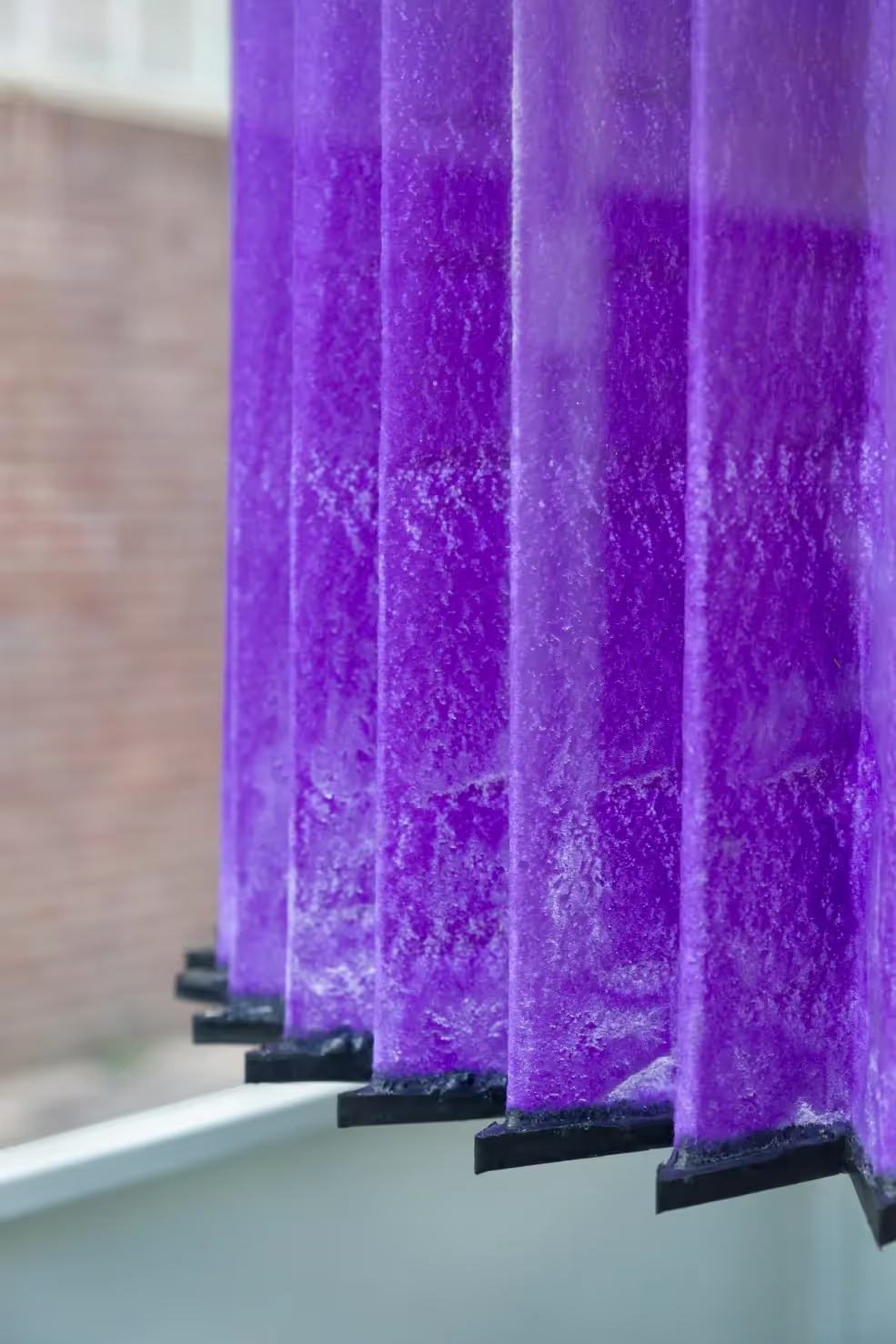
Public Air Filters was one of the two winning entries for the 2021 NDSM Open Call. For this work, artist proposed Anne-Jan Reijn the question is what actually happened in the outside air that we breathe. By filtering air in public spaces, a dichotomy automatically arose: filtered air and unfiltered air. This immediately raised a question: maybe the unfiltered air could not be trusted? The series of sculptures by Anne-Jan was on display between July and October and was changeable during this period. This slow process was, in fact, the essence of the work.
In theory, every cubic meter of filtered air left a residue on the outside of the filters. The artist wanted to play with this residue, creating an archaeology of air filter pollution, where a form of manipulation was allowed. What if that residue on the filters formed the most amazing colored crystals? Did that have a direct psychological effect, making the air we breathed, for example, undesirable or unpleasant? Reijn played with the idea of danger that we couldn't see. Invisible risks that were in the air, such as asbestos or a virus, were scary but could also evoke a form of awe. With this work, the artist offered a different perspective on this issue by materializing the invisible. “We were constantly connected to invisible matter — and therefore the risks — and we systematically tried to eliminate it. At the time, the relationship of trust we had with science and politics was under great pressure,” says Anne-Jan Reijn.
Under no circumstances did the artist claim that filtered air was safer than unfiltered air: “This was really a work of art that played with the idea of distinction.”
Also read the interview with Anne-Jan Reijn in the Digital Depot - Online Magazine.
Credits and references
Visuals: Robin van Dijk, Benjamin Kotek, Gert Jan van Rooij
In the spring of 2021, it was quieter than usual at the NDSM shipyard. This had everything to do with the Corona pandemic that gripped the entire country, and the whole world. Due to social safety restrictions, programming at the outdoor area of the NDSM shipyard was a challenge. Nevertheless, at the NDSM-werf Foundation, we looked for ways to make NDSM's public space as beautiful and accessible as possible, even though it was quieter than previous years during this period.
From this idea, the NDSM Yard Gardens came into being: 30 to 50 garden boxes where NDSM residents could use as a small piece of urban garden. All at least half a meter apart, so that users could garden while respecting social distancing”. It turned out to be a great success: all gardens were immediately used by residents, visitors, artists, neighbours, and some entrepreneurs at and around the NDSM shipyard. From early spring to autumn, flowers, vegetables and other plants were grown in the square between the Y slope and the Noorderlicht. Workshops were also given to small groups of gardeners and at the end of the season, a real NDSM garden community was created.
In 2021, the first expressions in the (Un)monumenting program series were published on NDSM, including on the NDSM Billboards
What should or could a monument be today, for whom, and who decides this? For their programme series (Un) Monumenting, Stichting NDSM-werf invited makers and artists to reflect on these questions by creating a (temporary) work at the shipyard. For (Un) Monumenting #1, the collective Frerara — Frederick Calmes, Raquel van Haver and Raul Balai — invited to make the Drawing Assignment 2020, which they realized for the Amsterdam City Archives, visible at the NDSM shipyard. (Un) monumenting #1 presented Frerara with images from “Breathing of the City”, which focused on understudied Amsterdammers and their stories.
From April 9, 2021, three construction boards at the shipyard showed drawings by Frerara, which they made as part of “Breathing of the City”. The collective saw the city as a “living organ that wakes up every morning and never sleeps in its entirety.” Especially at that precarious time, it became clear who had the luxury of being able to work from home, and who didn't. Cleaners, sex workers, bus drivers; diverse characters starred in the drawings that portrayed, fascinated or embodied the three artists separately. At the building signs, visitors were able to listen to audio clips about the images and/or the people portrayed with their smartphones. The three artists brought together themes such as the archive, transition, art and culture and the city's signature in their work. To do this, they investigated the residents of the city of Amsterdam and specifically into continuing the tradition of keeping the city alive as a ritual. For example, with the drawings, they showed a different face of Amsterdam and created a temporary 'monument' for a number of understudied townspeople. On April 9, not only did the presentation start at the NDSM shipyard, but Frederick, Raul and Raquel also physically handed over the drawings to the City Archives for inclusion. The collection of drawings was published by the City Archives in three separate zines, which could be viewed and purchased, and they worked towards a fine publication that year. What was special was that the topic “Breathing of the City” was submitted by Frerara to the City Archives even before the coronavirus pandemic, and it had only gained in urgency since then.
Continuation of (Un)monumenting
The global conversation about monuments meant that the Foundation used this moment to bring the shipyard's history more to the surface. What could a memorial be, mean, and who had a say in it? And asking who deserved to be present in public spaces and who felt represented (and who didn't)? Based on the wish of the NDSM-werf Foundation for a polyphonic public space, the foundation commissioned several artists to give their views on this on the shipyard. The (Un)monumenting project consisted of several episodes: for each chapter, the foundation invited one or more artists to reflect on the theme of 'monuments' of the future. At that time, work was underway on (Un)monumenting #2, a video work by Turkish-Dutch artist Belit Sağ, in which she highlighted the invisible history of the NDSM shipyard. In the video, a collaboration with the Institute for Sound and Vision, Belit Sağ investigated the role of female Turkish migrant workers at the shipyard using archival material.
An exhibition with an audiowalk that took place in the future
Plastic Hypersea is was an interactive, site-specific work by an artist Sissel Marie Tonn commissioned by Sonic Acts and was experienced at the NDSM shipyard in Amsterdam.
Set in 2099, Plastic Hypersea was a guided, spatial and interactive experience that speculated on a possible future in immunology, merged with the topic of environmental health. As listeners explored the terrain, they were invited to imagine the environment as an extension of their immune system and to consider the many ways their bodies intertwined with microplastics in the sediments of Amsterdam's waterways. Ultimately, Plastic Hypersea asked listeners to leave behind the war metaphors that haunted immunology and to think about a more expansive sense of self.
Produced in collaboration with musician Vincenzo Acquaria Castellana and sound and recording artist BJ Nilsen, the localized sound experience was complemented by custom boat sails and ceramic sculptures created by Sissel that acted as “membranes” encoded with material and immaterial data about the hydrophobic, industrial waste that flowed through the waters of the Netherlands.
About the artist
Sissel Marie Tonn was a Danish artist based in The Hague. Her practice focused on the shifts in perception that occurred when people became entangled in their surroundings, blurring the boundaries between body and environment. Her artistic research often resulted in interactive, sensory installations.
Plastic Hypersea was built on Echoes, an interactive GPS-enabled mobile app for audio walks. To access the work, you had to download the app from the App Store or Google Play. They then put on headphones and wandered around the area of the NDSM shipyard while following the sails and ceramic sculptures. The gradual unfolding of the work was activated while walking and exploring the environment.
SEXYLAND was an art project in the form of a temporary society. For 365 days, the club had a new owner every day. He was able to implement the program as he wished, ranging from art expressions to sporting events, from gangster rap to stroboscopic light dinners. SEXYLAND was a tabula rasa that could be described in any way. SEXYLAND strived to mark every unknown corner of Amsterdam and show the enormous diversity the city had to offer.
In 2021, Sexyland moved from the NDSM shipyard to the other side of Amsterdam-Noord under the name: Sexyland World. As part of Sexyland's departure, we spoke with stakeholders Aukje Dekker and Samira Ben Messaoud in a podcast episode of NDSM X. Listen to it below.
On the way to school or work, kissing behind a corner of a building, sprinting to the ferry, giggling from a car, chewing gum on the ground, fishing in the dock: daily activities at the NDSM shipyard. In NDSM Nursery Square, a project by Studio Makkink & Bey they looked at daily activities at the NDSM shipyard asking how they could reprogram them through cultural activities.
From October 2019, there was a temporary square to visit where there was space to intervene with a flexible infrastructure and influence the behavior in the shipyard's public space. The square therefore never looked the same, moved with its visitors and was sometimes coloured by artists in residence. For example, park furniture could be borrowed and there were singers and artists who sang to the sailors during rush hour in September.
Artist Antoine Guay built a bread oven in a container, after which the bread baked therein was distributed to visitors on a number of Saturdays in exchange for a nice gesture or action. City poet Gershwin Bonevacia spent a while at Nursery Square as a “poet-in-residence”. A documentary was also shown in the Nursery Square of Nina Swaeny Cherry. And because this was also a public square, by and for Amsterdammers, designer Jurgen Bey and curator Jules van den Langenberg also invited local residents and parties at the shipyard to make their own programming proposals.
In this film, the viewer sees how large cargo ships, when depreciated, are sailed to the beach from Gadani in Balochistan, Pakistan, to be disassembled by workers under appalling conditions. The materials extracted in this process are resold or recycled. What does this work say about the consumer society we live in? What happens to “things” when we throw them away? Listen to this special episode of NDSM X now!
As part of the exhibition (Un)monumenting: The Future Should Always Be Better, we will talk to artist Krijn de Koning. His work 'In here, Up There', two works for (Un) monumenting will be shown in the NDSM Loods during the exhibition.
Krijn de Koning (Amsterdam 1963) studied art at the Rietveld Academy (NL), De Ateliers (NL) and the 'Institut Des Hautes Etudes En Art Plastique' (FR). Since the 1990s, he has been creating site-specific sculptures and installations for exhibitions, museums, galleries and public places.
In your work, you discuss the experience of spaces and how, by making various interventions, you can change them for the visitor. How did you work for (Un) Monumenting? What (new) experience of the North Strip in the NDSM Loods did you have in mind?
It's not so much my goal to change a space and make it experience differently for others, it's more of a means and an attempt to 'really' look at a space again, or if you like. Sometimes you have to ruin or even ridicule something for that. For me, art is largely about “watching”. A priori, this is not directly a mental or formal thing. That is why aspects such as' feeling ', intuition and a certain directness are important to me. Rational thinking is certainly interesting, but in my opinion, that comes after it.
For the exhibition (Un) Monumenting, I initially mainly looked at space. It is already monumental in itself and that is mainly due to its enormous volume. But what you actually see is the limit of the volume, which is enormously unsettling, a total cacophony of current and historical details with all kinds of different meanings.
The 'Un-Monumenting' consists in the fact that I attack the objects.
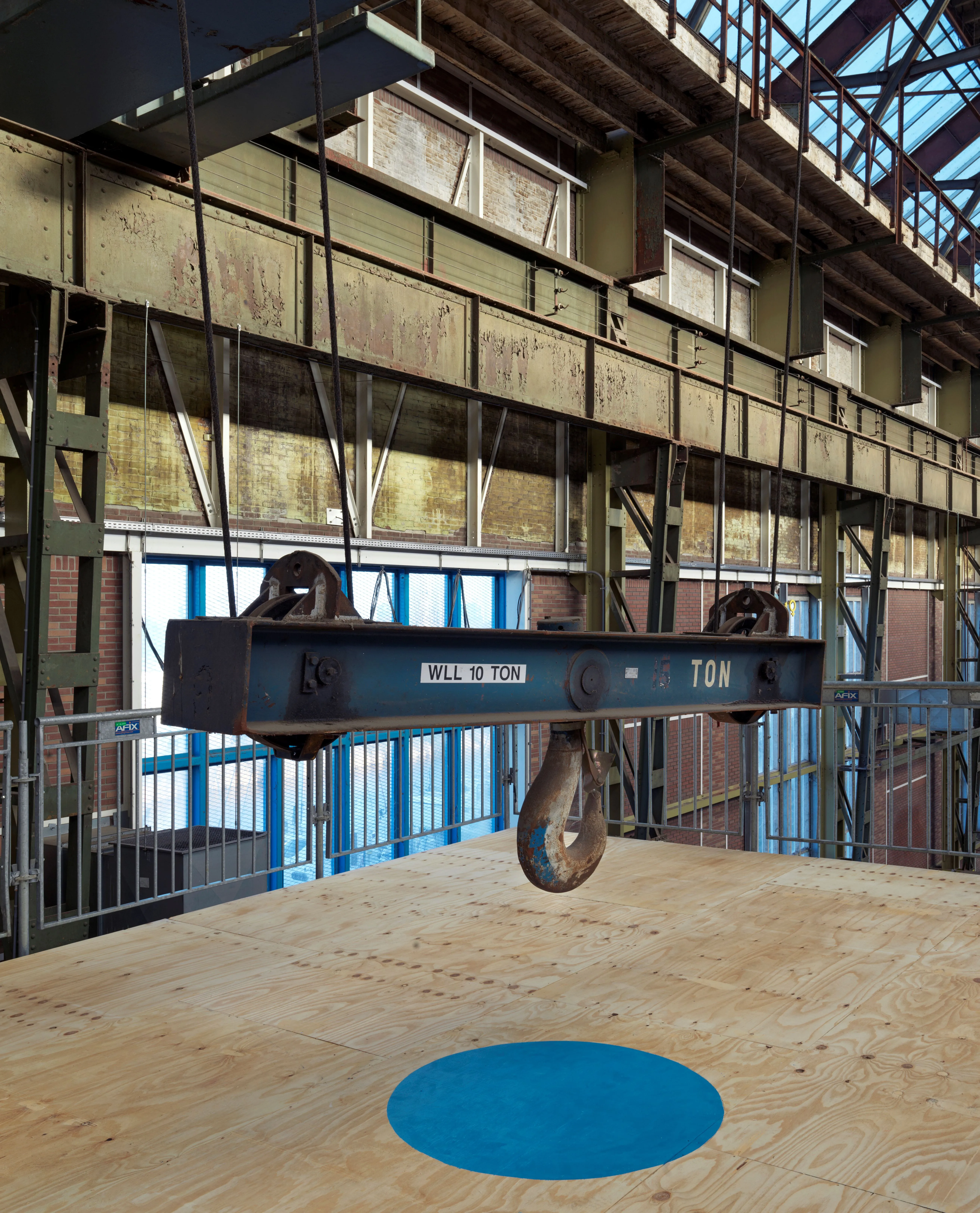
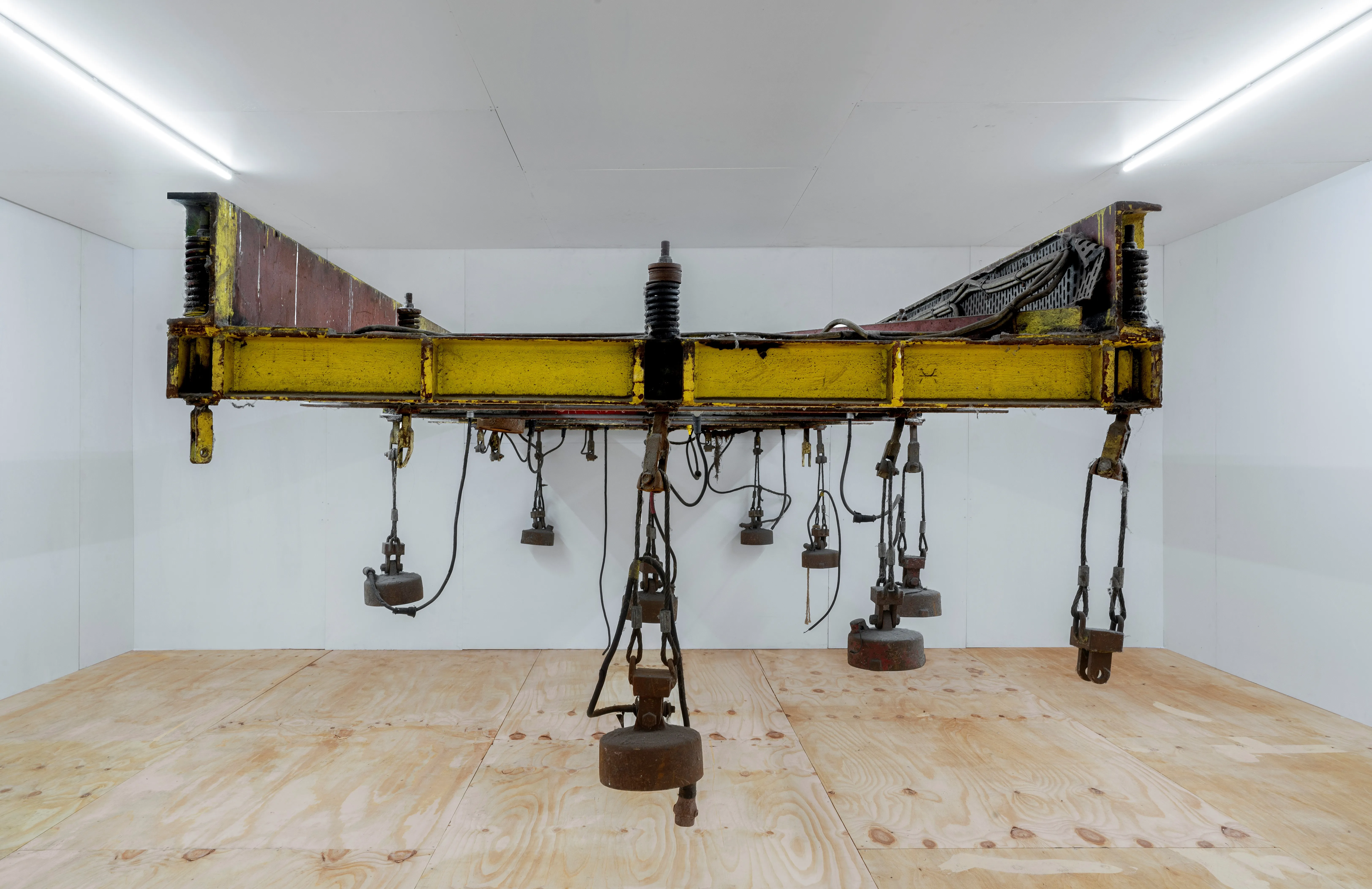
The sparse details and objects that are still part of the original space are somewhat dwarfed in the current situation. My idea and feeling was that it would be interesting to highlight some of the warehouse's original objects. This ultimately happens in two works, one for a large lifting beam that hangs high in the ridge, and one for an old magnetic crane, which also hangs in the air. Both objects are 'framed' by me in a temporary architectural setting.
How do you think the work In Here/up there, two works for (Un) Monumenting relates to the subject of “monuments”?
You can say that the NDSM warehouse is an (architectural) monument and that the few sparse original objects that are now functionless are a kind of reminder of that warehouse's' grand 'past and are therefore also a kind of monuments to it. You increase the attention for a monument by placing a large pedestal underneath it. On the one hand, that's what's in my two works happens, and what you might associate with the idea of 'Monumenting'. The objects and what they stood for are “lifted”. The 'Un-Monumenting' consists in the fact that I attack the objects. For me, this is mainly about trying to rid them of their conditioning and meaning again.
Do you think monuments are still relevant in contemporary society? And if so, what should monuments look like, and who should they be for?
One of the classic ideas for a monument is to link a person to a major historical act and then create an image of it, but monuments are also created as a result of grand, impressive events. Logically, such an image is always exaggerated, serves a social, political or other interest and rigidly appeals to an often not entirely realistic reality.
What you actually and especially see in the NDSM Loods is precisely the limitation of the volume
It's hard to get away from that in more modern versions. Regardless of whether you agree with the reason for a monument or not, I usually find it quite grotesque and kitch, and not immediately very pleasant and human. When it comes to very serious matters, I'm more in favour of very dry and modest monuments, but that conflicts a bit with his own idea.
(Un) monumenting: The Future Should Always Be Better can be seen on the outside of the NDSM shipyard and inside the NDSM Loods until February 18. For more information, click the button below.
Listen now to the NDSM X (Un)monumenting special with Koos Buster.
If you fake something exactly, I don't find it interesting anymore
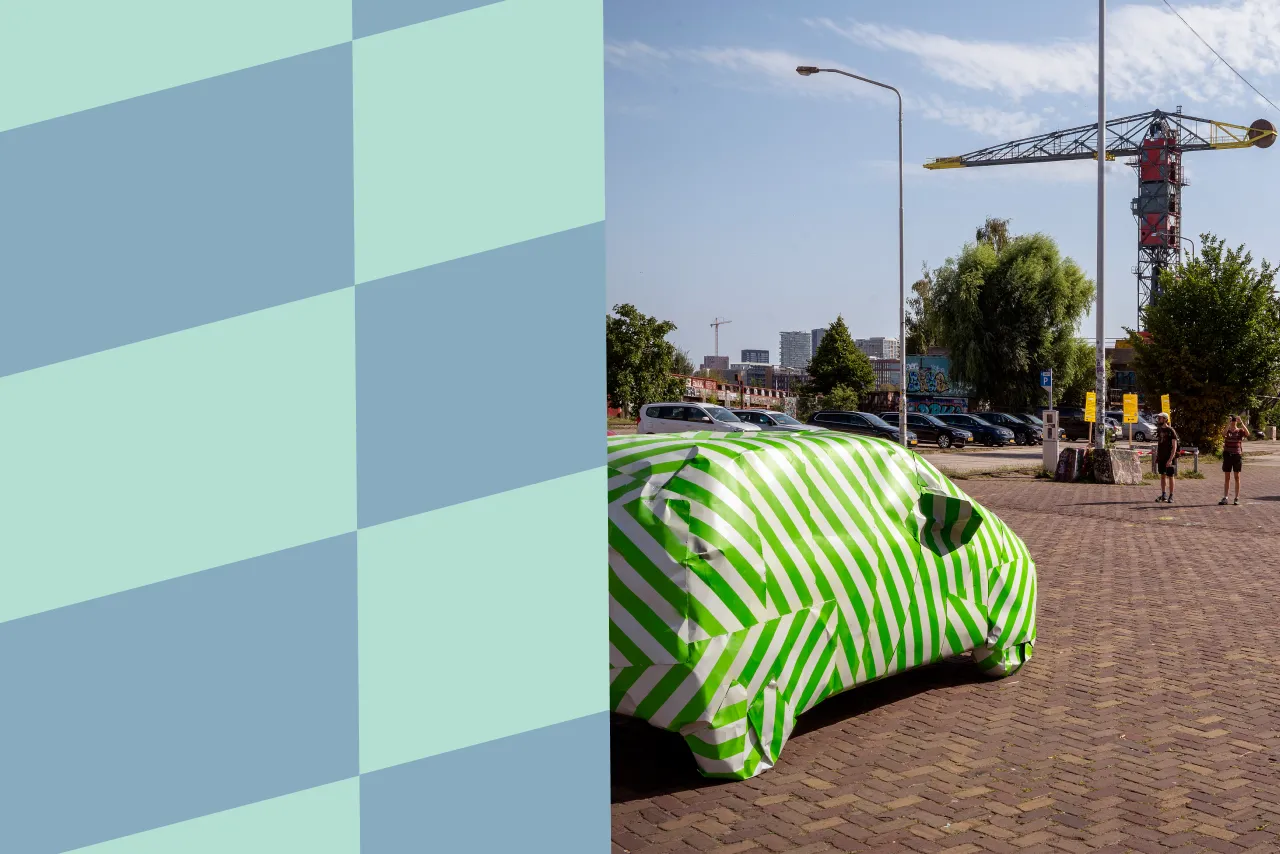
Minister of Ceramic Affairs himself Koos Buster tells us more about his work in clay and the inspirations that come with it. 'Monument to the departing Amsterdammer' is now on display in the exhibition (Un) monumenting at NDSM. This is the typical red Canta car from the streets of Amsterdam-Noord, but made entirely of ceramic including “I <3 my canta” sticker, beer crate in the front passenger seat, and Ajax symbols. And there's much more on Buster's clay list, hear all about it in this episode of NDSM X!
This is the last episode of season 4 of NDSM X. We're taking a winter break to reflect and get new inspirations. See you in the spring!
As part of the exhibition (Un) monumenting: The Future Should Always Be Better, we will talk to artist Elsemarijn Bruys. Her work Volume 2.0 will be on display at the NDSM Loods during the exhibition.
Elsemarijn Bruys (1989, NL) is a visual artist with a strong curiosity about sensory perception. In her hybrid practice, she alternates between sculptures and architectural interventions, but the spatial experience is always her starting point. She works primarily with inflatables and kinetic mirrors.
My background in fashion has influenced my material and sculptural work to a great extent.
Elsemarijn, how would you describe yourself as an artist? What does your practice look like?
Messy 🙂
Haha check. For the exhibition (Un) monumenting, you are creating a new work, called Volume 20.0. How do you see this work in the context of the (Un) monumenting theme?
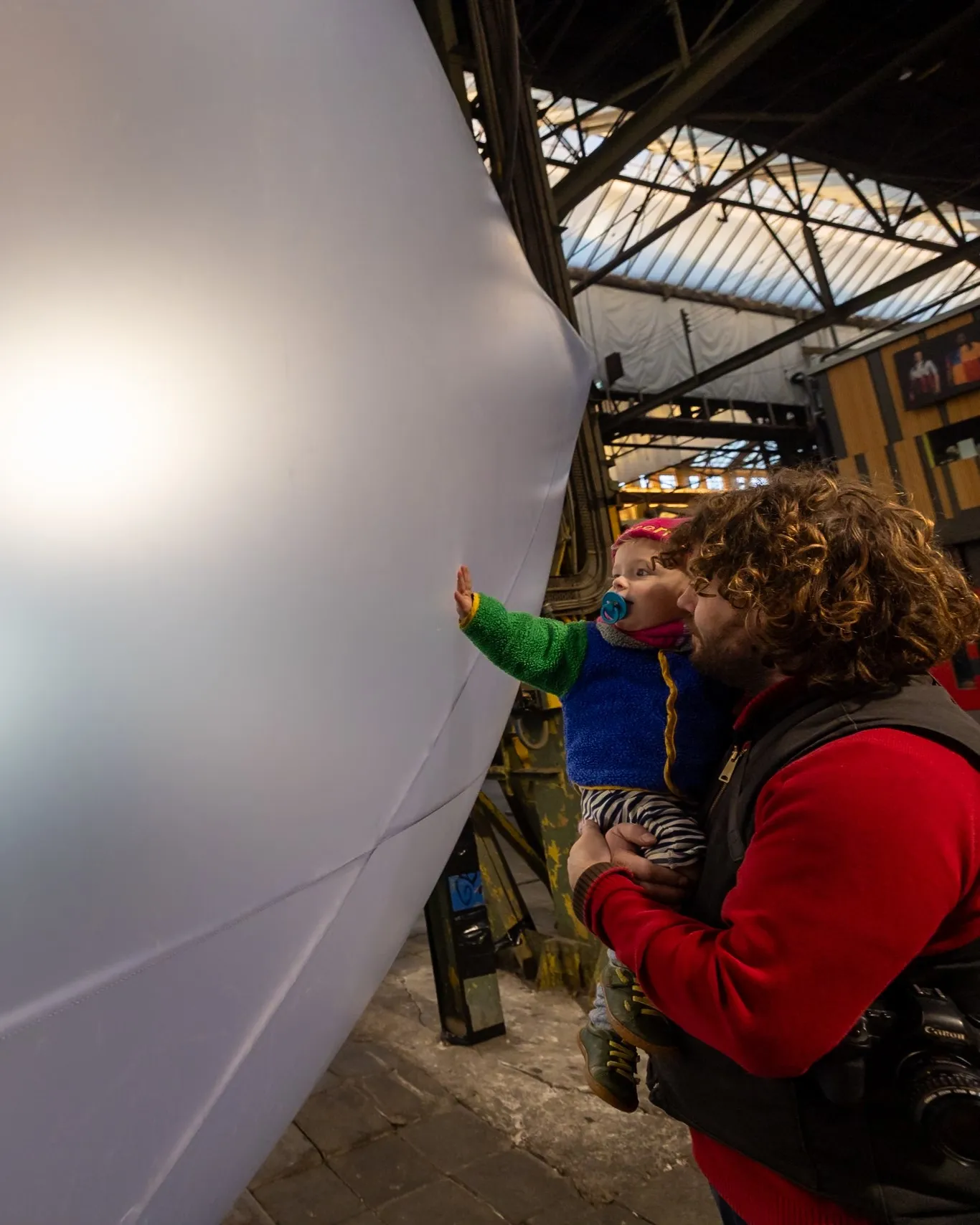
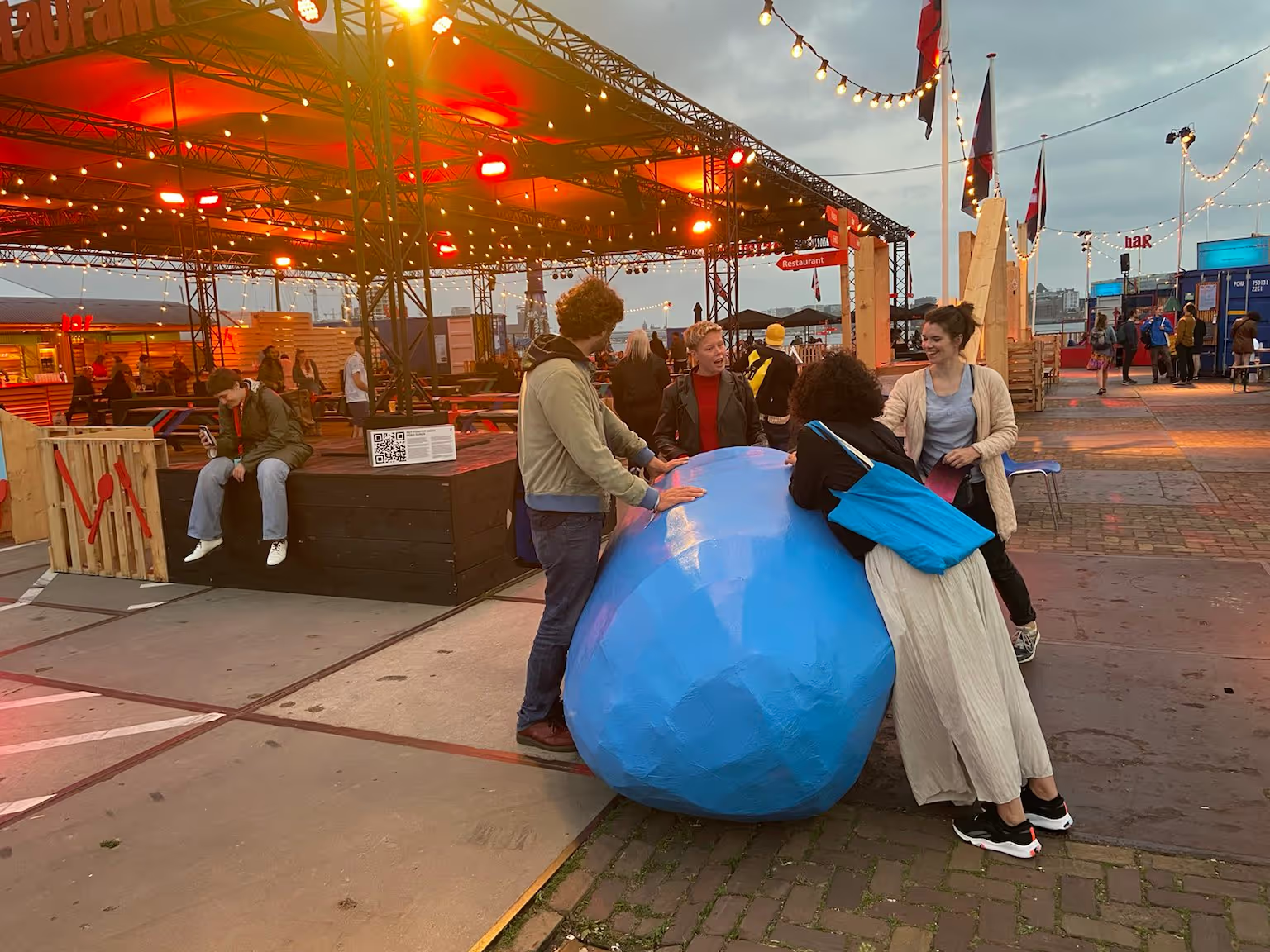
I am interested in how space and material influence each other and the effect this has on the existing architecture. With Volume 2.0 I'm creating a cube of air that seems to be bursting at the seams and fighting for space. Trapped between the pillars and the ceiling of the industrial warehouse, the semi-transparent inflatable simultaneously seems to let the environment through while blocking the view. The work is part of my research into how space can be deformed by a temporary intervention that affects human movement. In addition, refers Volume 2.0 about who and what can take up space when there is only limited space and themes such as changeability and temporality, which often form the basis of my practice. This is in line with the theme of (Un) monumenting: who can take up space in public space? Who should feel represented?
To continue “fighting for space”, the architecture and the material you choose work together. Volume 2.0 can be seen in the NDSM Loods, how does it relate to this location specifically?
The work is firmly embedded in the structure of the NDSM Loods. As a result, there is an emphasis on the gigantic scale in which you are when you enter the NDSM Loods. At the same time, the object is also of a large scale, and clasped into the pillars of the Underscate, the space takes on a different character. When you come Volume 2.0 when you walk around, you see the edges of the pillow pressing against the pillars of the NDSM Loods, almost as if it were about to splash. It gives an ominous, but also a soft feeling. The semi-transparent material also contributes to this.
I ask a lot of questions when it comes to “taking up” public space.
You just said that temporality and changeability are recurring themes in your work. Words that also apply to NDSM; a place full of projects that exist in temporality, a place of movement. Can you explain what interests you about these themes?
The inflatables that I make only exist by virtue of the given air: a “material” that always surrounds us without us seeing it. By filling a bag with that material, the object suddenly takes up space. In that sense, my work is temporary; it exists by the grace of air.
With the exhibition (Un) monumenting, we also want to open up the conversation about monuments in general. What are your own ideas about what monuments should be and for whom, or if they should be there at all?
I ask a lot of questions when it comes to “taking up” public space. I like to go to places where supposedly everyone goes, such as a station. What everyone uses for a purpose without interfering too much with differences in cult and culture. They are, as it were, anonymous spaces. I hope those places are not about claiming space, because I think that's a complicated topic. Whose street is it and which monument can rightfully stand there? Who does it stand for? I myself see many sculptures in public spaces as images of time and I am very happy that there are more and more different monuments for many more different people/groups/cultures.
Check out the work Volume 2.0 by Elsemarijn Bruys during the exhibition (Un) monumenting: The Future Should Always Be Better, on view until February 18, Tue to Sun from 11:00 — 18:00 at the outdoor area of the NDSM shipyard and in the NDSM Loods.
By clicking “Accept all cookies”, you agree to the storage of cookies on your device to improve site navigation, analyze site usage, and assist with our marketing efforts. Check out our Privacy Policy for more information.




.avif)
.avif)
.avif)


.avif)