Podcast NDSM X deze aflevering met Mike Rijnierse en Ludmila Rodrigues van Sunset in Amsterdam
Tune in voor de nieuwe aflevering van NDSM X, de eerste van 2025! In deze editie schuiven Mike en Ludmila aan in de studio om te praten over hun werk op NDSM: Sunset in Amsterdam. Dit werk heeft de vorm van een permanente ondergaande zon op het IJ. vanuit een 360-perspectief is het iconische beeld te zien van een zon die zakt in he twater aan de horizon. Maar niet voor slechts één ogenblik, maar bevroren voor langere tijd.
Mike en Ludmila vertellen ons hun werkwijze en inspiratie voor dit kunstwerk. Waarom bevroren zij de zon? En wat betekent het dar dit werk nu in Amsterdam op NDSM te zien is? Luister nu, in NDSM X met hosts Petra Heck en Ewa Scheifes.
Interview met kunstenaars Mike Rijnierse en Ludmila Rodrigues over hun werk Sunset in Amsterdam op NDSM
In January, a glowing red sunset will appear over the IJ. Sunset in Amsterdam, an installation by Mike Rijnierse and Ludmila Rodrigues, plays with the idea of the sun slowly disappearing over the horizon, reminiscent of a day at the beach. However, in this case, the sun remains stationary and is visible 360 degrees. This striking light installation has previously been displayed in cities such as Paris, The Hague, and Delft, and will now come to the NDSM wharf for one month. We asked the duo about their motivations and inspiration for the installation.
What inspired you to create the first version of Sunset, and how do you approach something so universal and timeless?
We were literally at the beach, observing how many people reached out for their devices to photograph the sunset. We questioned how many people are taking these pictures every single day. Right now there are thousands of photos being taken of the same scene. Moreover, the photographed image can never do justice to the actual phenomenon, which is spatial, it’s deep, really glorious. So it's a bit pathetic that we try to capture it and even share it with the world. Then we joked, what if we would make an inflatable sunset that could simply stay there and people wouldn't have to rush to capture it? After all, by waiting for this sublime moment, we miss the whole spectacle because we replace our biological, stereoscopic apparatus (our eyes) with the technological apparatus of the camera, or in other words, we turn into cyclops. Then we started researching the psychological effects of the sunset and its colors; how it appears in art and in films.
Sunset was first exhibited in Delft in 2021 and has since traveled to other cities. How do you think the environment where the work is displayed influences the audience’s experience?
The installation always establishes a strong relation with the location where it is shown. There are always different elements in each city that make the work unique. Every time it’s a new work, so to speak. It’s fascinating to discover it from different angles, like from another street, under the bridge, from a window view. Friends and even strangers started sending us photos they took from the most incredible points of views. This was a pleasant surprise. So, after the whole challenge of installing it (it’s always a saga to finance it, to get all the permits and to actually put it on the water) we also learned a lot more about the work. As you walk through the city, you slow down, you talk to people, it becomes an invitation to wander and explore it as if it was the first time. [By the way, if the listeners / readers of this interview want to contribute, we would be delighted to receive their photos by email. We’ll share the pictures with due credits. Check our site for more info.
The NDSM Wharf is a place with a rich history and significant transformations. How does Sunset fit into this specific context?
The work always creates a context, where different perspectives and stories arise. These can be interpreted differently by each person. We heard incredible stories from the first visitors in Delft. We believe the Sunset will connect NDSM with the IJ, which is not always the case, as we tend to see them as separate entities. Because the work invites you to be in the present, it makes you look at your surroundings differently. It’s like a reset of your relationship with the city.
You seem fascinated by the relationship between people and natural phenomena, such as a sunset, in an urban environment. What draws you to this contrast?
We are both intrigued by the various ways we sense the world. Our senses are culturally conditioned, some are more heighted than others, but they all can be trained, or re-trained, tuned and truly educated. So, our works explore the different ways we see, hear, touch, smell, move and make sense of our natural and built environments. If we are aware of this interface that is built in our body, then we may as well play with it, tweak it, and in doing so we are expanding our skills, perhaps our knowledge too.
I read that you are intrigued by how we often replace our personal gaze with the technological perspective of our cameras when looking at something as beautiful as a sunset. How does this affect how we experience our surroundings?
By rushing to register the moment we don’t fully experience it. It’s becoming harder and harder to really be there and open up to things, as we get distracted by all the means of communication available. By shifting from a stereoscopic view to a cyclopic view, our horizon becomes flat, a two-dimensional screen, like our devices.
an you give us some insight into the technical aspects of Sunset? How do you manage to recreate a sunset so authentically?
Well, we don’t know if it’s that realistic (how dare we recreate the sun!) but it is as close as we could get from the “iconic image” of it. It’s an 8-meter diameter half-sphere inflatable with a lot of light inside, as much lumen as we can get. The lights are controlled by a microprocessor to transition slowly through the warm hues of red, magenta, orange. At this speed that is undetectable for the eyes, many people don’t notice these changes, like the hands in a clock. You only notice the changes when you turn your eyes away for a bit. Further there’s a ventilator inside the inflatable, always on, keeping the shape of a dome.
Finally, sunsets differ all over the world yet are universally recognizable. What do you hope visitors will take away from their experience with Sunset?
We believe that once you’ve seen it, you won’t forget the experience, you’ll always look at the place and remember how the artwork brought a new perspective. The colours also provide a sense of warmth during these winter days. But above all it reminds us of our place in the planet, as well as in the universe, in relation to our Sun. This relationship is unique and fragile. We cannot live closer or further from it. Life as we know it, is only possible right here.
Sunset in Amsterdam is presented as part of the program line (Un)monumenting, where artists explore and question the monumental character of NDSM as a site. At NDSM, monumental heritage, creativity, events, and makers come together. In response, artists continuously examine what the unique character of the wharf signifies and how it can shape the future of a city and its inhabitants.
Mike Rijnierse and Ludmila Rodrigues have been collaborating since 2011. They share a fascination with the ways human perception is formed. Their works encourage the audience to navigate with all their senses and to rediscover how to see, hear, and feel.
Credits
Beelden: Connie van Driel, Fred Leeflang, Zeno van den Broek
Terugblik: Pavlopteri, hoe klinkt een onder-water-Amsterdam?
by
Redactie
April 23, 2025
In the spring of 2024, the Pavlopetri installation was on display at the NDSM shipyard: a work of art that refers to aworld under water.
The forecast is that the sea level will rise sharply in the coming centuries. With their work Pavlopetri on NDSM, the makers referred to the Greek underwater city of the same name, which rests on the seabed at a depth of four meters. Sahabi and Zuydervelt In doing so, they investigated how it feels when Amsterdam — which is an average of two meters below sea level — becomes the new Pavlopetri in the long run.
The installation had different visual and acoustic properties of water coming back. Sahabi's spatial design was inspired by typical monumental columns in Greek architecture and referred to this history. Inside the pavilion, Zyudervelt's soundscape was heard: an underwater world that interacts with the natural sounds of the shipyard.
With the work, the creators wanted to make the (future) consequences of the climate crisis tangible to the public. Specifically, at a location whose (ship) history is characterized by the presence of water and where elements such as wind and water are always explicitly present. The installation is no longer visible at NDSM, but you can now listen to the soundscape! So close your eyes, press “play”, and imagine yourself in an underwater Amsterdam.
NDSM Lusthof is an architectural garden designed by Studio Ossidiana and has been on display at the NDSM shipyard since July 2024. But which plants exactly can you find in there?
With the installation, Studio Ossidiana questions about private and public, and who has the right and access to green and exclusive nature in today's city. NDSM Lusthof, like the former Lusthoven, which were intended for the richer people of Amsterdam, is surrounded. Now not through hedges, but through a playfully designed and colored fence with peepholes that make you curious. The fences have a rounded shape that looks like an observatory, a place where the world is seen from the inside out.
In addition to the design of the fence and infrastructure, the plants that grow in NDSM Lusthof also have a link with the subject of lustthoven. In the Lusthoven of yesteryear, all kinds of botanical finds were collected. The plants at NDSM Lusthof are inspired by the Turkish Ottoman gardens where medicinal herbs as well as trees or flowers flourish. It is an agricultural garden in the broadest sense of the word where plants have a 'function', from pollinators for bees and butterflies to tea herbs. A true “Living Library”, in the words of Studio Ossidiana.
Planting NDSM Lusthof
Landscape Architect Arja Helmig of Yes studio brought this theme to life in her design for the plants at NDSM Lusthof. The richness of gardens such as “Living Library” on the one hand, and the tension between accessibility to green in an urban environment on the other. This accessibility is important because plants and green areas have proven to have a positive effect on human physical and mental health. For some populations around the world, plants are still the only available and reliable medicine for certain conditions or types of pain. That is why, when designing the green, urban oasis NDSM Lusthof, Arja chose plants that have medicinal properties: a pharmacy garden. Just like a physical pharmacy, the garden is not always open and you need to provide the necessary information before you can pick from it.
The functionality of the plants in NDSM Lusthof is not limited to those for humans. The design is specifically tailored to a balance between people, plants and animals. Plants are absolutely essential for birds, bees and butterflies. That is why, in NDSM Lusthof, Arja chose a combination of native trees, shrubs and herbs, species that are best for our native small animals.
The design
The final design of the growing parts of NDSM Lusthof makes it a green urban oasis. Following Studio Ossidiana's design inspired by the shape of an observatory, the plants in NDSM Lusthof are also planned in circular shapes. The garden is a place for recovery, which implies change, improvement, care and maintenance. The changing nature of the garden over the seasons and the growth over the years reflect this, but the changing perspective on the accessibility of green spaces for people also contributes to this.
NDSM Lusthof is also a community place. This means a personal space, with tea ceremonies led by gardener Maryam Kalami, guided tours and a dedicated volunteer team maintaining the garden. It is a place where people are not just allowed to enter all the time and nature can take its course undisturbed.
The garden is about care and warmth, both between people and between people and nature. This is emphasized by the choices of the mainly native plants in the garden, with their functions for humans, animals and nature. The selections are warm plant colors (different shades of blue and pink) and with plants from sunnier climates (greyish leaves).
For plants, animals and humans, example: the White Willow
If you look through the peepholes of the NDSM Lusthof fence, you will see the White Willow (Salix Alba) The bark of the Salix Alba has been used by various cultures for thousands of years as a remedy for colds, fevers and joint pain. The active substance, salicylic acid, was first isolated and then produced in a synthetic form as a medicine called acetylsalicylic acid (aspirin). In the past, people simply chewed on a willow twig for gout and pain. Also a handy tip if you're walking in the polder and your ankle sprains!
In addition to its medicinal functions, we can scale white willow trees among the absolute best in terms of biodiversity. Countless plants, birds and insects live on and in the crown and trunk. Research shows that more than 450 different species of insects can occur on a willow tree. This is important, because insect life is not doing well.
The Schietwilg in NDSM Lusthof also contributes to helping to restore the contaminated soil at the shipyard as a result of the intensive shipbuilding industry of the last century. This is because white willows can absorb high levels of lead and cadmium from the soil and store them in various parts of plants. This knowledge comes from the second half of the 20th century when several researchers came up with the idea of using plants in remediation (phytoremediation) to extract heavy metals to purify soil and water. Fortunately, an investigation by the municipality showed that this piece of land is not contaminated and can be picked out.
We liked the idea that it would require some effort to enter. The effort not being that it is physically difficult to go through the door, but that it requires a bit of work in terms of contribution in a social way.
In this episode of our podcast NDSM X season 4, we talk to Giovanni Bellotti and Alessandra Covini. Together, they form Studio Ossidiana: a studio that works on the boundaries between architecture, design, and landscape. Their practice explores innovative approaches through buildings, materials, objects, and installations. Their recent architectural garden at NDSM, called NDSM Lusthof, investigates what a garden at NDSM can mean. This is because this garden can always be viewed, but only entered at specific times.
Listen to the last episode of NDSM X now! After this episode, we go into hibernation for a while to come up with new ideas. But don't worry! Next season, we'll be back with more stories about art in public outdoor spaces and events at the NDSM industrial site.
Credits
Presentatie: Petra Heck en Ewa Scheifes, productie: Erik's House op NDSM.
In het kader van de 3Package Deal hebben Stichting NDSM-werf, Over Het IJ en Das Theatre de coalitie Urban Realm gevormd. Deze coalitie ondersteunt recent afgestudeerde Das Theatre-kunstenaars binnen de context van de Urban Realm van NDSM. Deze editie is de 3Package Deal-kunstenaar de freelance performance maker, schrijver en performer Fariborz Karimi.
Kun je jezelf eerst even voorstellen en iets vertellen over je artistieke praktijk in het algemeen?
Mijn naam is Fariborz Karimi. Ik ben theatermaker en heb mijn master afgerond aan DAS Theatre in Amsterdam (AHK) in 2023. Daarvoor woonde ik in Teheran, Iran, waar ik mijn bachelor in theaterregie en acteren behaalde (2012). Mijn praktijk draait om de concepten samenwerking met vrienden, intimiteit en zelfcensuur. Ik onderzoek hoe vriendschappen en zelfcensuur verweven zijn met de systemen van de omgevingen waarin we leven. Daarnaast onderzoek ik hoe verschillende realiteiten aan elkaar gekoppeld kunnen worden of hoe ze overlappen rond deze concepten. Dit leidde in mijn laatste werk tot een vorm van samenwerking op afstand.
Je bent afgestudeerd met een theaterstuk bij DAS dat het publiek in september kan zien bij Fringe. Kun je dit stuk kort introduceren?
Het stuk dat ik ontwikkelde tijdens mijn master aan DAS Theatre heet “Oh, Wild Gazelle, Where Are You?”. Het is een collectieve droom die vriendschap en nabijheid biedt, zelfs wanneer we, als samenwerkers en vrienden, fysiek ver van elkaar verwijderd zijn. Het stuk is gemaakt in samenwerking met een choreograaf in Iran, die het stuk op afstand en live uitvoert en leidt. Samen als groep van makers onderzoeken we hoe censuur evolueert in verschillende contexten en hoe het ons als kunstenaars beïnvloedt. Dit stuk werd voor het eerst gepresenteerd op het Cement Festival in Den Bosch in maart 2024 en we zullen het opnieuw presenteren tijdens het Fringe Festival in Amsterdam in september.
Zou je iets willen zeggen over de rol van de publieke ruimte binnen je praktijk?
Mijn onderzoek naar zelfcensuur en vriendschap gaat dieper in op vragen over solidariteit binnen bepaalde groepen, gemeenschappelijk denken, collectieve creatie, overleven en bescherming, culturele normen, geïnternaliseerde censuur en de invloed daarvan op identiteit in onze publieke ruimte.
Wat betekent het voor jou om nu te werken en wonen in Nederland?
Leven en werken in een land met een aanzienlijke kloof tussen de culturele en politieke landschappen van mijn thuisland is zeker een uitdaging. Het navigeren door de privileges van de Europese context en het vinden van manieren om mijn werk te de-exotiseren, kan ook lastig zijn. Echter, als kunstenaar word ik geïnspireerd door deze uitdagingen en vind ik het interessant om te onderzoeken hoe ze mijn praktijk en creatieve proces beïnvloeden.
Aan welk nieuw project werk je op dit moment (bij Productiehuis TR in Rotterdam in het najaar) als onderdeel van de 3Package Deal?
“Whispered Dreams” is het nieuwe project dat ik ontwikkel in 2024-2025, wat ook deel uitmaakt van mijn 3Package Deal-traject. Het zet mijn verkenning van vriendschap en zelfcensuur voort, waarbij ik dieper inga op hoe vriendschap een politieke rol kan spelen, zelfs in deze donkere tijden. Samenwerking staat centraal in dit werk, waarbij alle medewerkers mijn vrienden zijn. De co-schrijver en performer werkt op afstand samen vanuit Teheran. Deze verbinding op afstand, samen met de deelname van het publiek via tekst en dromen, vormt de basis van de opzet. Ik ontwikkel dit werk door middel van verschillende residenties zoals BUDA (Kortrijk), Hellerau (Dresden), Productiehuis Theater Rotterdam en WpZimmer (Antwerpen).
We willen de lezers uitnodigen om je stuk te zien bij Fringe in september. Kun je de details van waar en wanneer met ons delen?
“Oh, Wild Gazelle, Where Are You?” wordt gepresenteerd op 12, 13, 14 en 15 september als onderdeel van het Fringe Festival Amsterdam. De locatie is LikeMinds in Amsterdam Noord en tickets zijn verkrijgbaar via de website van het Fringe Festival. https://amsterdamfringefestival.nl/oh-wild-gazelle-where-are-you/
Over de 3Package Deal
Bemiddeling voor een woon- en werkruimte en een individueel ontwikkelingsbudget (€25.000) voor talenten, en begeleiding van een interessant en nuttig netwerk - dat is de 3Package Deal. Dit succesvolle programma van het AFK (Amsterdams Fonds voor de Kunst) en Bureau Broedplaatsen van de Gemeente Amsterdam in samenwerking met 45 gerenommeerde Amsterdamse organisaties, die hun netwerk, kennis en locaties voor hen openstellen, wordt nu beschouwd als een best practice op het gebied van talentontwikkeling.
Under the name 'NDSM Young Curator', the NDSM-werf Foundation annually invites a novice curator to intervene in NDSM's public space. Since this year, we've been collaborating on this with QISSA, the talent platform that scouts tomorrow's storytellers, literary innovators, screenwriters, rioters and stage animals. This year, Charmaine de Heij, one of the alumni of the QISSA process for Visual Storytellers, was asked to curate an intervention at NDSM as NDSM Young Curator.
Charmaine, you graduated from the Master Photography and Society at the KABK. Where does your love for photography and images come from?
When I was a kid, I got an analog toy camera. I remember the discussions about how many photos I took and the costs of developing them. I loved capturing moments. I also used to browse through the magazines my mom read and was intrigued by a photo of Inez van Lamsweerde and Vinoodh Matadin. In that photo, two women are standing on racing bikes wearing shorts; one holding a raketje (ice cream), while a rocket takes off in the background. That image has always stayed with me; it had something absurd, but everything was right. It may not seem so special with the digital tools anymore, but this was back in the 90s. I was blown away by this photo as a little girl.
Years later, I visited an exhibition of Gregory Crewdson and I fell in love with images. In a video, he showed how he set it all up, and the idea that a concept could be captured forever fascinated me, and then I realized that you could create anything you wanted with photography. I now use my visual work to confront people with the colonial past and its influence on contemporary society. Sometimes I can also be provocative about this. I also see images as a tool for education and dialogue, and to highlight topics that don't get enough attention.
How would you describe your own practice, what is currently keeping you busy in your work?
As a person of color, I find it crucial to visually depict our experiences. My work often focuses on my Surinamese and Dutch cultural background, with a specific focus on colonialism. I mainly use photography and work a lot with archival material. I see working with these archives as a method to decolonize them and bring out new perspectives.
Recently, I completed the start of my project “Een geketende Reis” (A Chained Trip), a project with video, photography and an experiential performance. The central question here is: what does it feel like to have been enslaved in the past? During the performance, the audience was taken into the terrible journey of the enslaved and became an active part of the experience. This project was part of the anniversary year of slavery in Alphen aan den Rijn. Currently, I am working on further developing this project.
You can't change the whole world with art, but art can change someone's thoughts and perspectives.
In addition, I am currently working on other projects that highlight the colonial past in different ways and each have a different focus. There are countless stories about the colonial past that need to be told, and I always select another specific topic to highlight. Hopefully, this will encourage people to become aware of the deep-seated impact of colonialism on our current society and history.
You are one of the alumni of the QISSA development process for visual image-makers. What did this process bring you?
I still often think back to my participation; it was a special experience that brought me a lot. It was the best exhibition opening I've ever experienced: very diverse, and the sense of inclusion was strong. I met a lot of new, fun people. The masterclasses were both educational and fun! My participation has given me skills that I can use for the rest of my artistic life.
As a project, I created a book, “The Netherlands is the Best”, that explores and reveals the absurd remains of colonialism that are still entrenched in Dutch society. It started with finding an ad on Marktplaats about necklaces that were once used on enslaved people, and led to much more research. We were given the artistic freedom to develop our vision. Without this freedom, the book would never have become what it is today. We were appointed a coach; mine was Ashley Röttjers, and we had conversations with the exhibition curator, Guinevere Ras. Their guidance and support really made me grow within the project.
What role do you think art and storytelling can play in social change, including looking at your own projects?
You can't change the whole world with art, but art can change someone's thoughts and perspectives. And that person, in turn, can influence others, causing a chain reaction of change, no matter how small or large. Maybe that person changes the minds of two people, but maybe six people. An example of this is a message I once received from someone who told me about my book “The Netherlands is the Best” at school. For me, this illustrates the ripple effect: someone sees my work and then shares it with others. This is how the message spreads.
My experience as a maker has given me a great deal of insight into the themes of the colonial past and its influence on the present.
I think art makes difficult themes accessible, it stimulates reflection and awareness, and art projects can promote social change through education and storytelling.
Together with QISSA, we invited you to work as an NDSM Young Curator in NDSM's public space. What made you respond to this call?
I worked as a co-curator several times, and the idea of organizing my own project about the colonial past has been in my head for a while now. In order to do this properly, I want to learn more from professionals about organizing projects/programs and being a curator. The Young Curator project offers the opportunity to learn and do this! I hope to learn how to bring a complex topic to the public in a good way. It is a valuable opportunity to develop new skills and apply them later in future projects.
How do you look at this place? How familiar are you with the terrain?
I think the NDSM-wharf is a special and unique place in Amsterdam. The site is accessible to various target groups, which for me contributes to inclusiveness. I have been to NDSM several times; I watched street art there and, of course, also visited the museum. I also think street art plays an important role at the NDSM-wharf. I used to hunt for treasures at the IJ-Hallen and went there for parties. As a result, I am aware of the versatility of the terrain and the ways in which it is used, which I want to include in the development of the intervention.
What challenges and opportunities do you see within the project?
I see it as an interesting challenge to address a diverse target group. I also see the weather as a challenge, I hope it stays dry during the program! I find young makers fascinating, both recent graduates and self-taught artists, and I prefer lesser-known artists who haven't had much exposure yet. So I hope to make new connections with that during the project.
You work as an artist and maker, and as an NDSM Young Curator, you will work more in the role of curator or program maker. How do you look at that?
For me, these roles are interrelated. My experience as a maker has given me a great deal of insight into the themes of the colonial past and its influence on the present. Research is an important part of my artistic practice, and I include this knowledge in my role as Young Curator. I think my background as a maker also allows me to empathize well with the artists. I understand the challenges they face. Both roles complement each other and have the same goal for me regarding the theme of the colonial past and the impact on contemporary society.
Credits
portret Charmaine de Heij, foto boek Charmaine de Heij, Inez van Lamsweerde en Vinoodh Matadin
Listen now to this special episode of NDSM X with British artist Morag Myerscough. You know Morag from her work at NDSM called (Leave) Space for Space, which she created at NDSM in May 2024: a colorful installation that you can see from the ferry.
In my approach I learned to listen to people, understanding where they are coming from, and then try to find a way of adapting to each situation. The outcomes are never set.
In this episode of NDSM X, British artist Morag Myerscough tells us more about her way of working as a creator. In March 2024, she organized workshops with neighbors and acquaintances of NDSM, with the theme: “sense of belonging”. The results of these workshops inspired her work (Leave) Space for Space at the wharf. This way of working, and involving local communities, is not unknown to her. But what does this process entail exactly? Find out in this episode (including a bonus chat with Erik from Erik's house).
After this episode, NDSM X will take a summer break for a while. But don't worry! After the summer, we will be back with brand-new discussions with the artists, makers and many more at NDSM.
Credits
Productie door Erik's House, gepresenteerd door Ewa Scheifes.
(Leave) Space for Space by Morag Myerscough and spoken word by Mahat Arab
An art installation about “sense of belonging”: what makes you feel at home somewhere? Inspired by stories from residents, acquaintances, and interested parties in Amsterdam-Noord. Word artist Mahat Arab made a poem to accompany this work called: “Sommigen waren al zo lang hier”.
On display at the NDSM shipyard until September 31, 2024.
Since 2018, Stichting NDSM-werf and Stichting Kinetisch Noord support projects that arise from the creativity of the NDSM community with the NDSM Open Call. Indeed, the NDSM shipyard has a community of around 400 artists who have their studios in the NDSM Loods, under one of the slopes, near Treehouse NDSM or elsewhere on the shipyard. We have delved into the archives and have listed all the winning entries from the past years for you.
The NDSM Open Call was born in 2018 from a mutual wish between Stichting NDSM-werf and Stichting Kinetisch Noord (NDSM Loods) to highlight artistic initiatives specifically from the so-called “breeding ground” of the NDSM shipyard. The NDSM shipyard is a place for art, culture and creative ingenuity, and the resulting ideas are often inspired by this ever-changing area and are of great value to its identity.
For this reason, the NDSM Open Call was created; the assignment has remained essentially the same in those years: submit an idea for a cultural intervention at NDSM. No distinction is made between art form, medium, subject, specialty, area of interest or material. In principle, the type of projects is also completely open: from performance, to art installation, to festival, everything goes and everything is possible. The projects must be realized at NDSM (in the outdoor area or inside the warehouse) and can be seen and visited by the public.
With this information under our belt, we've received nearly 100 submissions from creators and creatives at the site over the past few years. An ever-changing program council decides which entry (s) can be realized that year.
2018
In the first year of the NDSM Open Call, no less than three entries won: The Birds - Hélène Min (2018), The Dutch Nightingale - Eibert Draisma (2018), The Street Theater Festival - Pieter Post (2018) (support).
An animated film inspired by the Greek comedy of the same name that commented on the cramped city and meddling residents. From her studio under the X slope, Hélène makes birds from fish skins that become completely transparent when they dry. The light in the old slipway brings the birds to life.
In the animated film, two Athenians leave the city and call on the birds to build an ideal city in the sky. The subjects of Ancient Greece translate into the present in De Vogels.
De Hollandse Nachtegaal| Eibert Draisma (2018)
The inventor and designer Eibert Draisma is exceptionally inventive and inventive. His work is driven by an unceasing fascination with how things work and the why behind them. As part of the NDSM Open Call, Draisma created a proposal for an interactive songbird machine: via Bluetooth or Spotify, visitors can decide for themselves which song the Dutch Nightingale sings to them.
2019
In the second year of the NDSM Open Call, several winners also emerged: Henk Schut — Right Of Way (2019), Babok, Guido Bevers and Carina de Wit — PolderCoaster (2019), Marc Faasse — Document NDSM Street Art photography (2019), Marc Faasse — Document NDSM Street Art photography (2019), Balthasar Prinsen — Ascending (2019).
Document NDSM Street Art photography | Marc Faasse (2019)
Based on the constantly changing street art at the NDSM shipyard, Marc Faasse with NDSM Street Art Document would like to photographically document the transition that the NDSM is currently undergoing.
Right of Way was a sound installation at the former skate park in the NDSM Loods (now NDSM Fuse). On this “attic”, visitors were able to take a break from the speed of daily life and urban developments in Amsterdam. Using a self-designed computer algorithm, a spatial game with 64 speakers was created with simple sounds. In the almost empty space, visitors noticed how they rocked the hall into a sounding board.
PolderCoaster | Babok, Guido Bevers and Carina de Wit (2019)
Babok was founded in 2005 to make visual theatre for public spaces. Polder Coaster is in the words of Babok the “absurd, theatrical version of a roller coaster in the form of an energetic, hilarious and highly interactive street show.” The NDSM Open Call further supported this project in 2019.
Ascending | Balthasar Princes (2019)
Ascending was an idea of Princes where he turned the North Strip of the NDSM Loods into the roof of a cathedral with arches. The North Strip has been called (an industrial) cathedral many times and Prinsen wanted to create a new place for silence, encounter and gathering where metal used to be melted and forged with lots of sounds. This project was finally realized in 2021.
2020
In 2020, the NDSM Open Call must be adapted to a drastically changing world, due to the consequences of the corona crisis. The new assignment: “Visualize what the future use of public space might look like in whatever form”. It still needed to be publicly accessible, so this year the initiative had to be on the shipyard's outdoor site. The famous winner: The Museum of Unintentional Art (MOK)).
The Museum of Unintentional Art (MOK) does not put the artist on a pedestal, but the visitor and his imagination. They do this by placing everyday objects or compositions in a museum context. This often results in hilarious interventions in the public space.
2021
The 2021 NDSM Open Call still had limited options due to the consequences of the corona pandemic. Nevertheless, there were two winners this year: Animal Factory by Luca Boscaridn (2021), and Public Air Filters by Anne Jan Reijn (2021).
Animal Factory | Luca Boscardin (2021)
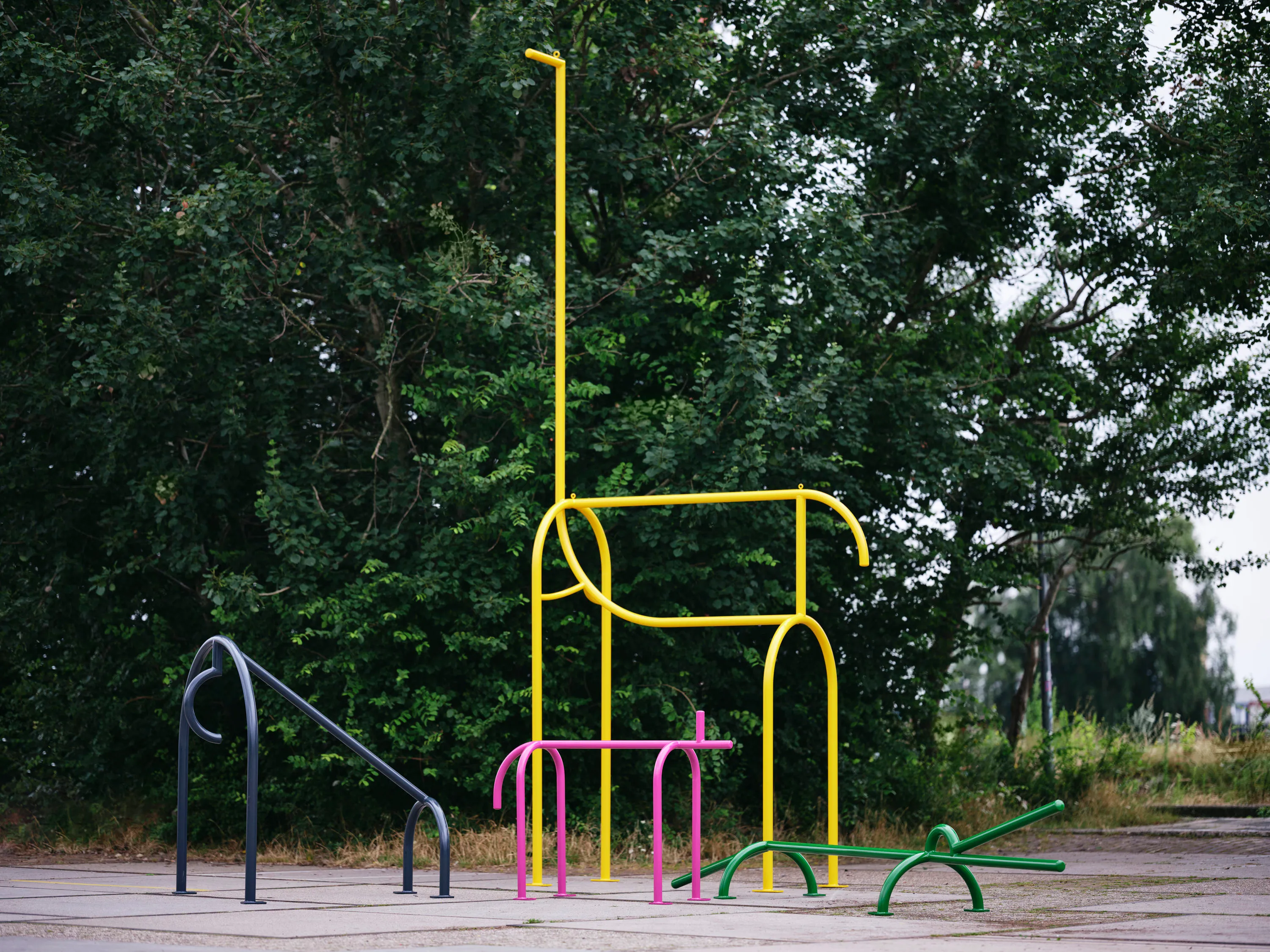
With 'Animal Factory', toy designer made from the NDSM warehouse Luca Boscardin playful elements for the urban jungle of the NDSM shipyard by creating minimalistic animals. A positive picture at a difficult time when animals are taking over more and more cities, because people had to stay inside. The multifunctionality of his animal kingdom fits the use of the site; for example, they served as a play object, alternative sports equipment or meeting place.
Public Air Filters | Anne Jan Reijn (2021)
In cooperation with New Dakota, Anne Jan Reijn three large air filters in NDSM's public space. As a result, Reijn made the visitor think about invisible dangers in the air that we surround ourselves with and that we breathe. How healthy is this air really? By filtering a little bit of air into the public space, a question was immediately raised: is the rest of the air, which is unfiltered, perhaps not to be trusted?
2022 and 2023
Unfortunately, there were no winners of the NDSM Open Call in 2022. The last edition of the NDSM Open Call in 2023 had a longer production period, allowing the winners to realize their work in 2024. Creators Catarina Garcia and Jim Du Pan realized this year Under Pressure with half the crane as a base on the NDSM wharf. With this work, the artists highlight the cycles of transformation of the NDSM shipyard, an area that has moments of crisis and destruction but also stages of revival and redevelopment. All information about this work can be found at the culture page.
Registrations for the NDSM Open Call 2024 are now open. Do you have a studio or workshop at NDSM and do you have a good idea? Let us know! Click here for more information about this year's NDSM Open Call.
NDSM X Open Call winners Catarina Garcia and Jim Du Pan
by
Editors
April 23, 2025
Luister naar de eerste aflevering van de Podcast NDSM X seizoen 5
"We are going to have to let go and let the plants decide how this work will grow"
In this first episode of the new season, we talk to NDSM artists Catarina Garcia Rabanada and Jim Du Pan: winners of the NDSM Open Call 2023, who are realising their work 'Under Pressure' at the shipyard with the famous half crane as a base. A work of art about the cycles of transformation of the NDSM shipyard, an area that has moments of crisis and destruction but also stages of revival and redevelopment. With the title, the creators refer to the growing housing and area development in expanding areas such as NDSM, which puts valuable places like this under pressure. Listen and learn everything about this work and its creators.
This week is National Spring Jitters Week (yes, really!). Maybe you've already felt it in yourself: the urge to go outside, sit in the sun, or roll up your sleeves in a new project. As the sun starts to shine longer and stronger over the NDSM shipyard, the gloves for the summer pants are being changed and the winter jacket for the spring jacket. You probably haven't noticed that the shipyard's icon, the container arch, has also recently been given a new look.
In the course of 2021, designers Sue Doeksen, who has had a studio in the NDSM Loods since 2012, and graphic designer Jord Noorbeek, commissioned by the NDSM-werf Foundation, set to work to renew the shipyard's hostess. The reason to change from being a shipyard icon right now is to show that the shipyard is far from standing still and to pay tribute to all future eyes who will see the arch for the first time.
The container arch welcomes every visitor to the NDSM shipyard; from festival-goer to visitor to walker. Unfortunately, the usually so bustling and lively area remained a lot quieter than other years last year. Nevertheless, we are looking forward to the future as bright as the container bow, and we thought it would be a good time to look back at all the different appearances the bow has taken so far.
2018
The bow was born in 2018, when the festival DGTL wanted to add something new to the festival site for that year's edition. In collaboration with artists from the shipyard, the arch was initially created with a black appearance with white lettering on the head that spelled DGTL. Anyone who has had the pleasure of ever visiting DGTL knows that this event is about discovery, inspiration and surprises. The festival is characterized by its industrial atmosphere and free-spirited character. A stage for both established artist and beginning DJ. It is precisely for these reasons that the bow was and is a special part of the festival.
Surely it means something that he is still there and that a different picture is given to it every time.
After this successful year of the festival, the bow was left behind at the shipyard as a relic for practical reasons: a reminder of yet another successful edition of DGTL. But instead of falling into ruin, the arch turned out to be a key figure in the shipyard and began her own life.
After DGTL 2018, almost every festival or event at the shipyard has adopted the bow as part of the site and added its own flavor. Sometimes an entrance for visitors, sometimes a detour in the walking route on the site or a triumphal arch that offered some shade at the shipyard on the hot days. But above all, a place where many dances have been daring over the years. Legend has it, that if you put your ear close enough to the bow, you can hear the people partying! Partly because of this, but also because of the changeable weather in North Amsterdam, the bow was often the result of a restoration round where the current colors were slightly enhanced again. This is also the case in 2019 when the Drumcode festival organized their event at the Docklands (the square between the two warehouses) and provided a great opportunity to refresh the paint layer again.
The licks of paint that the bow has now received can no longer be counted on one hand. In addition to the fact that the container arch has often been repainted, she has also often had temporary faces. By means of canvases, light projections or other innovative ideas, event organizers at the NDSM shipyard gave the container arch their own twist.
“It certainly means something that he is still there and that a different picture is given to it every time,” says Petra Heck, curator at the NDSM-werf Foundation. “It's such a remarkable sight on the shipyard, it's pretty special that he keeps changing with the times”. A great example of the icon in full glory was, among many others, the Elrow festival. With the theme “Together we make magic happen”, Elrow is a festival of color, creativity and, above all, a lot of craziness. In 2018, the festival took place at the NDSM shipyard and used the container arch as an eye-catcher on the site. By using emoji-like icons, another layer of paint and huge inflatable animals, the organization gave its own interpretation to the arc.
2021
Now the bow is black, blue and white. Inspired by Eberhard van der Laan's last words to the people of Amsterdam — who enjoys their own portrait at the Docklands right behind the arch — the words “Be kind” originate in geometric shapes on the arch. The text is disguised in both form and color and is part of a larger graphic work, so the message is not easy to decipher at first glance. The back looks like an abstract halo. The sides show the versatility of the NDSM shipyard: an owl that represents wisdom and magic and a court jester that symbolises fun and fun. This new identity of the arch gives a somewhat quieter impression compared to the fierce, screaming graffiti artworks on the rest of the Docklands. But maybe this is exactly what makes the design so appropriate. The shipyard is a home for experimentation and contrast that the iconic container arch does not escape either.
“It's also about the recurring question: when does something belong to the public space?” says Petra Heck. “The underlying idea of this new design was also to add to the bow's familiar role. So far, it has been a festival beacon for many people; with this new jacket, he might become a bit more part of the public space. He welcomes everyone who visits the shipyard, not just those who come with a ticket to an event.”
Where the NDSM shipyard would normally buzz around this time with the cautious first musical sounds of the festival season or the first outdoor stalls of the IJ-Hallen, it still remains to be seen when and what will be possible on a large scale at the shipyard. With a bit of luck, the shipyard icon can welcome the required number of people again this year. For example, DGTL 2021 has been moved from Easter weekend to September in the hope of organizing a full batch again after the summer. Until then, the container arch is still the shipyard's steadfast icon, welcoming everyone who comes to take a look and reminds us to be kind to each other, especially at this time.
Curious about another glimpse into the process of editing the bow? During the podcast NDSM X, Ewa Scheifes (programmer of the NDSM-werf Foundation) and Petra Heck spoke to creators Sue and Jord about how to redesign such a familiar object on the shipyard. You can find the link to this episode here:
Oops! Something went wrong while submitting the form.
This website uses cookies
By clicking “Accept all cookies”, you agree to the storage of cookies on your device to improve site navigation, analyze site usage, and assist with our marketing efforts. Check out our Privacy Policy for more information.


.svg)

.avif)


.avif)


.avif)
.avif)


.avif)


.avif)

.webp)




.avif)